
Saloon Car Brawl
The early days of the British Saloon Car Championship inspired some delightfully spicy road-going versions
Race on Sunday, sell on Monday. It’s a simple marketing concept but it has served a multitude of manufacturers well over the years. And for the real car enthusiast, the closer your Monday purchase is to the Sunday winner, the better. In the Sixties, racing saloons were rather closer to their roadgoing starting-points than racing saloons are now.
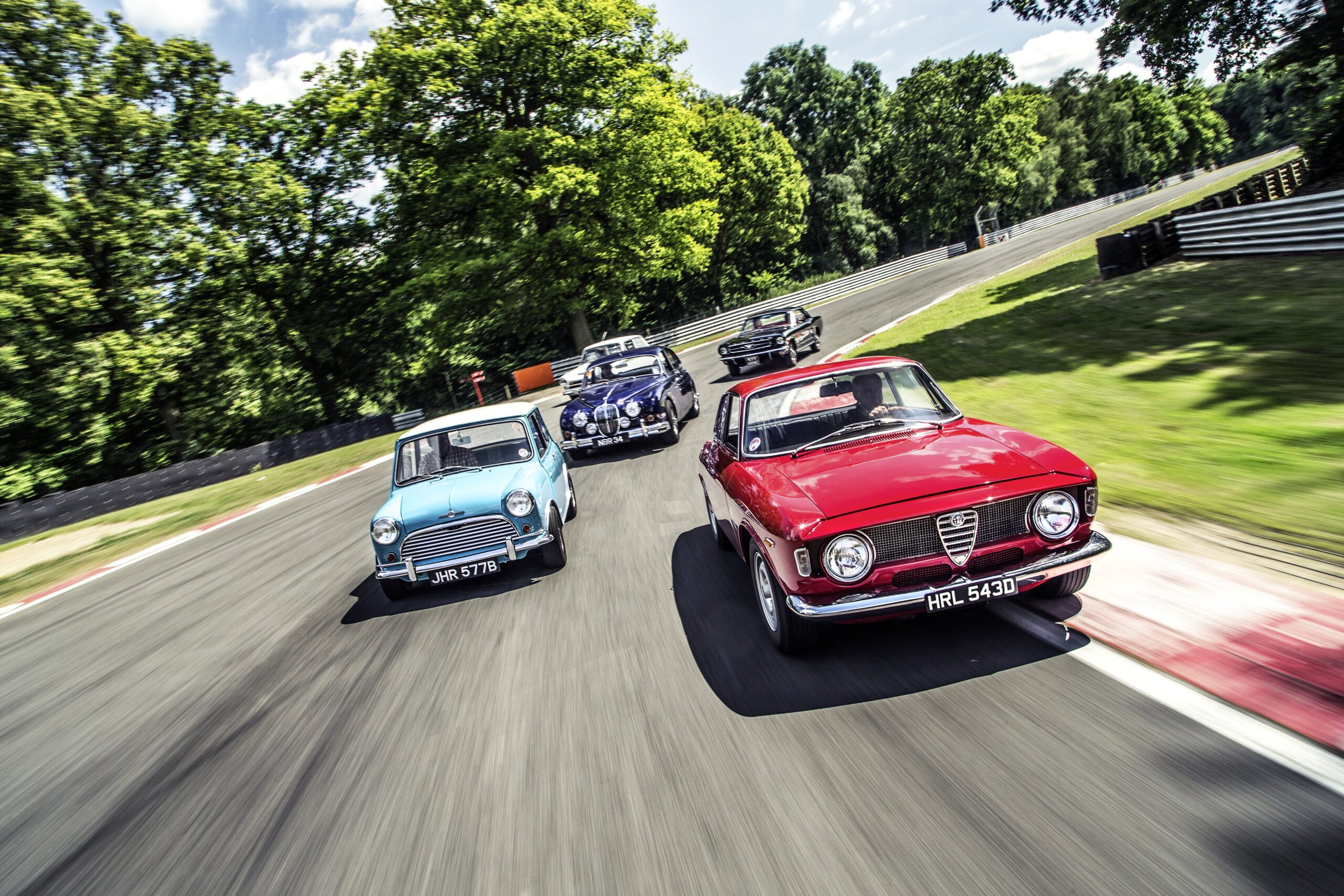
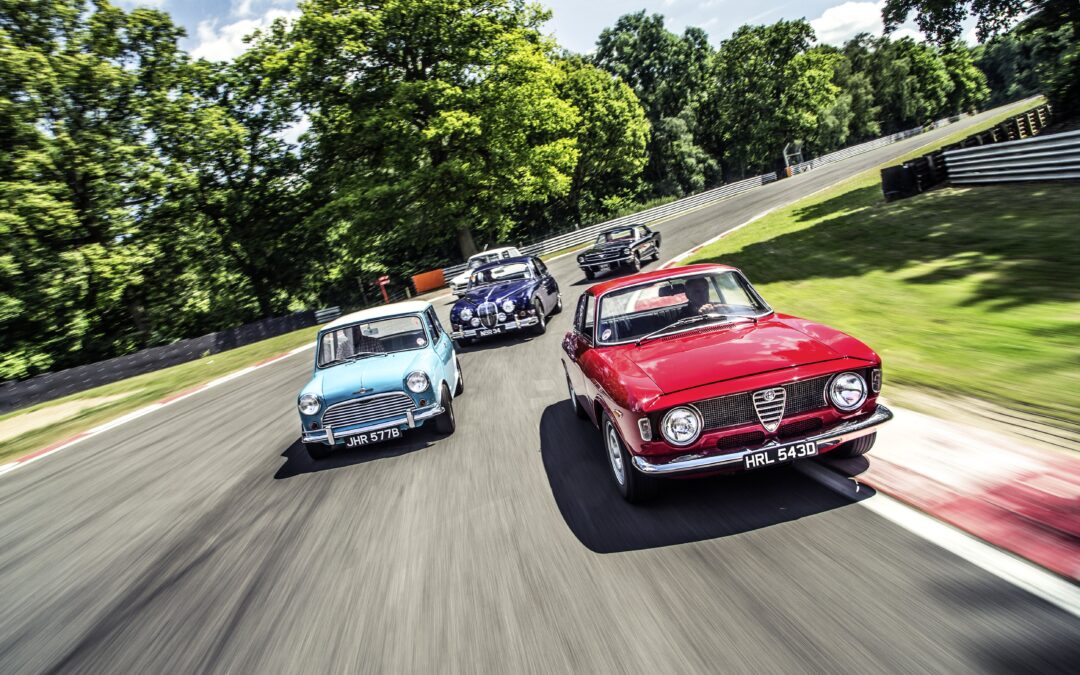
Compared with today’s hot road cars, all taut sinews, clamped-to-the-road grip and power-steered virtual reality, these Sixties machines are an exercise in flow, mid-bend mobility, vast variations in steering weight and total driver immersion in that broad, sepia-tinted zone between grip and no grip. But different cars did very different things in that zone, illustrated by the five examples here.
All are road cars that wear their racing credentials with varying degrees of seriousness. Softest and most showroom-similar is the Ford Mustang, represented here in the correct notchback shape but with a mild version of the 4.7-litre V8 that powered the racing versions, and mere drum brakes behind those fierce imitation spinners. Most track-honed is the Alfa Romeo Giulia Sprint GTA Stradale, the road version of the aluminium-panelled hot rod that tore European Championship honours away from the Lotus Cortina. We have one of those, too, in early pre-Aeroflow guise with aluminium panels and A-bracket rear suspension.
‘The nose darts into a corner as though following grooves in the track.’
And at our size extremes we have a Jaguar Mk2 3.8, the oldest car here (1959) and featuring a light dusting of Coombs-style modifications to reflect one of the greatest entrants of the race versions. Its dimensional opposite is a Morris Mini Cooper S, here in ultra-rare, homologation-special 970cc guise and sporting some period sporting enhancements: check out those ‘rose-petal’ wheels, the Microcell bucket seat and more.
Let battle-fantasy commence…
ALFA ROMEO GIULIA SPRINT GTA
A lot of we car-enthusiast types like 105-series Alfa Giulias, be they GTs, GTVs or whatever. A GTA, however, is outside the experience of most of us. Replicas or tributes, to varying degrees of accuracy, are more common, while genuine GTA race cars are merely rare. But a proper Stradale road version is a precious find indeed – the more so given the past tendency for original Stradali to have become racers themselves over time.
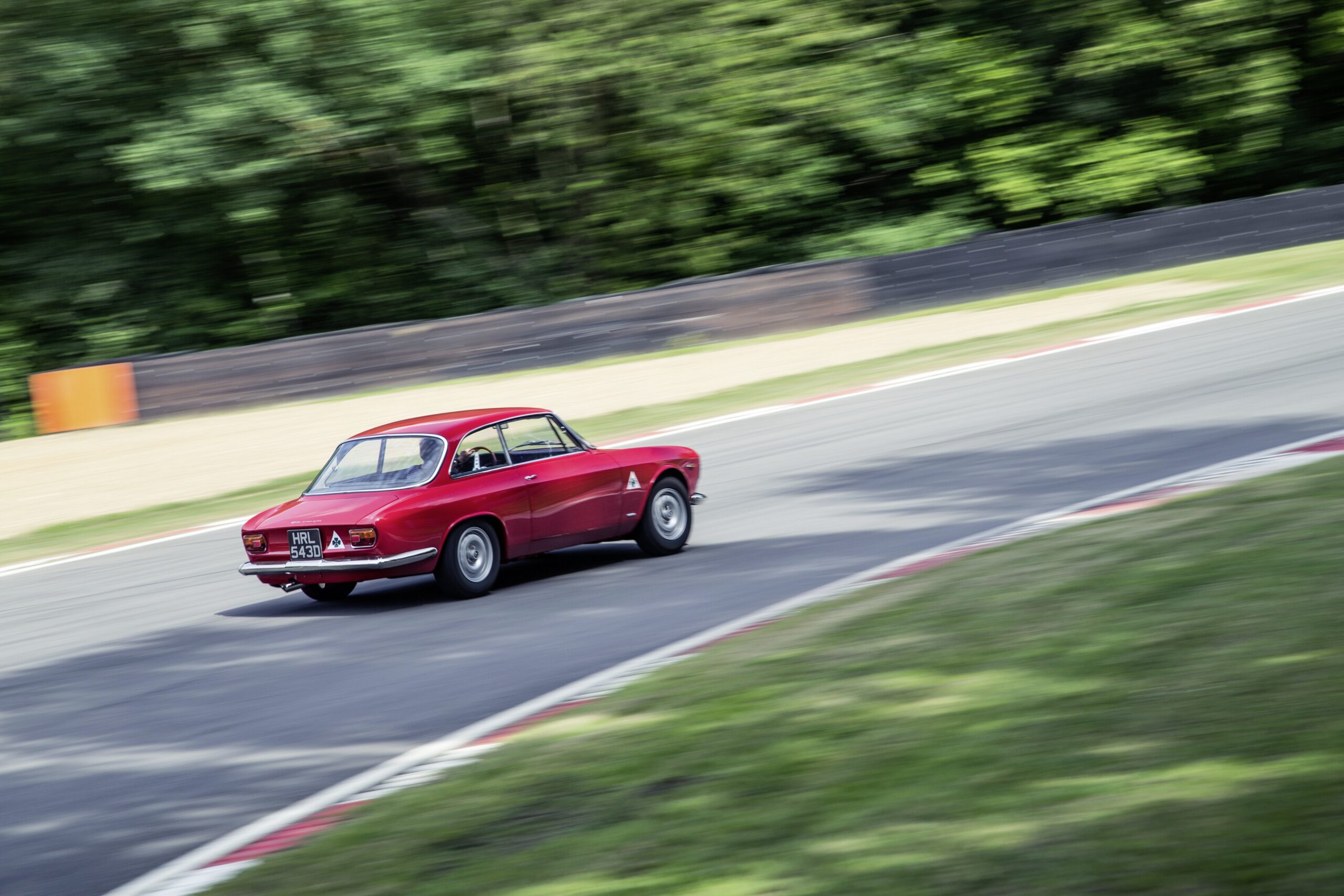
That could have been the plan for this one, given that it had been lightly modified for a Tour Auto entry in the past. But it was structurally unmolested and came with its vital original, GTA-unique trim parts that are too often lost. ‘So many original GTAs have been bastardised,’ says Max Banks of Alfaholics, which has restored this example beautifully, ‘so the decision was made to put it back to factory specification.’ From which the only departures are a pair of more adventurous camshafts, helping towards an output of around 150bhp rather than the factory’s claim of 115bhp, and Alfaholics’ own limited-slip differential – which is a copy of the Autodelta racing original.
Ah yes, Autodelta. This was Alfa’s competition arm, run by Carlo Chiti, which developed the GTA to attack the European Touring Car Championship. The ‘A’ part stood for Alleggerita (‘lighter’), achieved to the tune of more than 200kg thanks mainly to simplified and lightened trim, no soundproofing, Perspex door and rear-side windows, magnesium wheels and, most importantly, Peralumen 25 aluminium skin panels, mainly riveted to steel inner panels of thinner-than-standard gauge. The driveshafts and even some of the bolts are rifle-drilled, trim strips are thinner, the upper rear suspension arm is aluminium; the list is huge, to the extent that few components are shared with the regular Sprint.
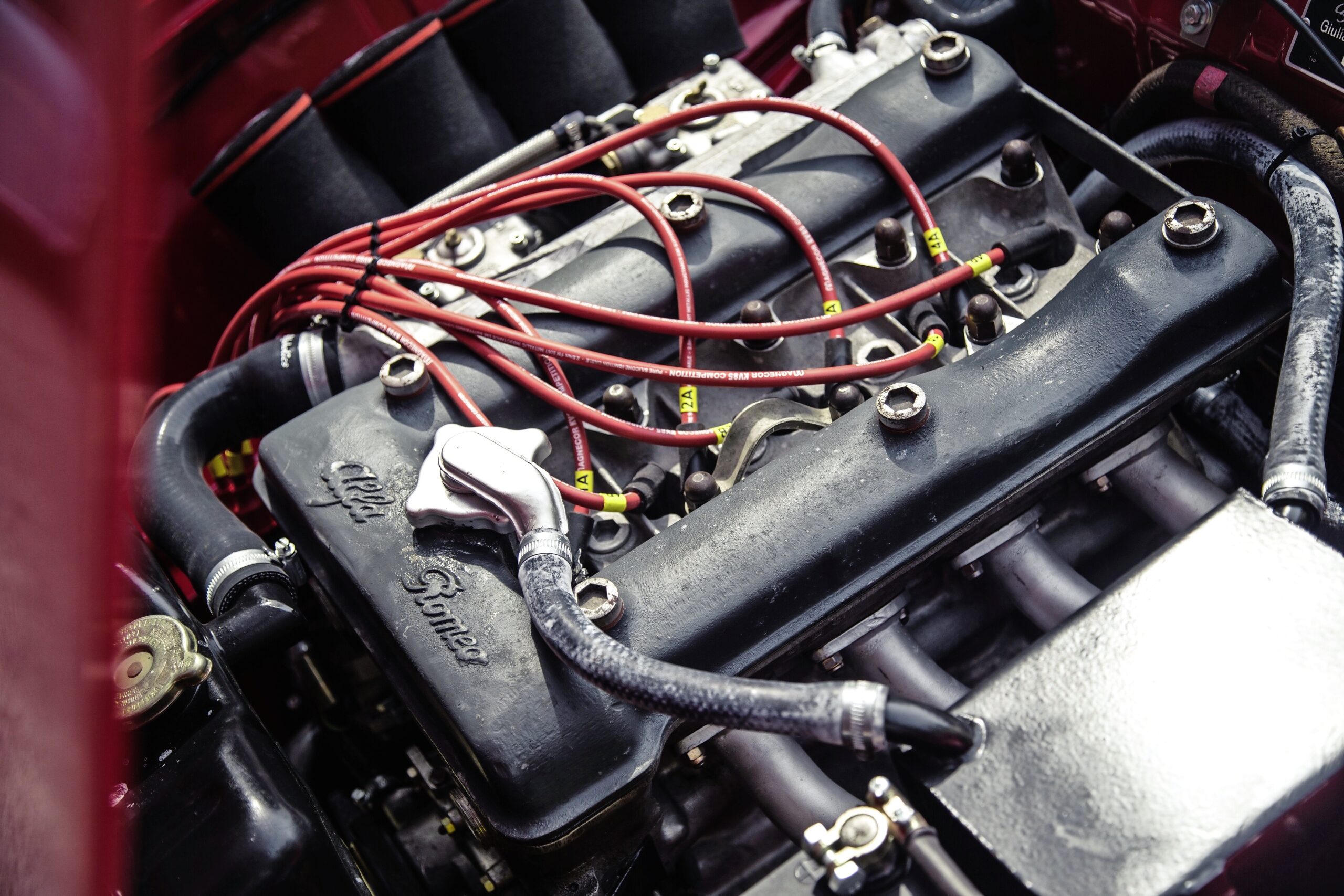
1570cc engine delivers 115bhp in road trim – racers had 150bhp
The engine gained larger Weber carburettors with 45mm instead of 40mm throttle butterflies, plus a new cylinder head with significantly bigger valves and two spark plugs set between each pair of them. That factory 115bhp sounds modest given that it took little to raise this to 150bhp for racing – as mirrored in the example we’re playing with today, which is owned by Adam Burstow.
The GTA proved quick in its launch year, 1965, but the Cortinas prevailed. For 1966, Autodelta prepared an onslaught, and in the opening race at Monza, GTAs took the first seven places. Andrea de Adamich took the title at the season’s end, and the Alfa GTA’s place in motorsport history was assured.
Driving Adam’s car is quite unlike driving any other Giulia Sprint derivative. You enter by pulling on a tiny aluminium door handle, then pull the door shut with a lightweight door-pull as you snuggle down into the prominently bolstered seat. The engine fires with the blattering snort typical of open-mouthed Weber DCOEs, hard-edged and overlaid with the clatter of tappets whacked by cam-lobes with a steep-ramped acceleration curve. It sounds rough but feels smooth, and the throttle response is electrifying.
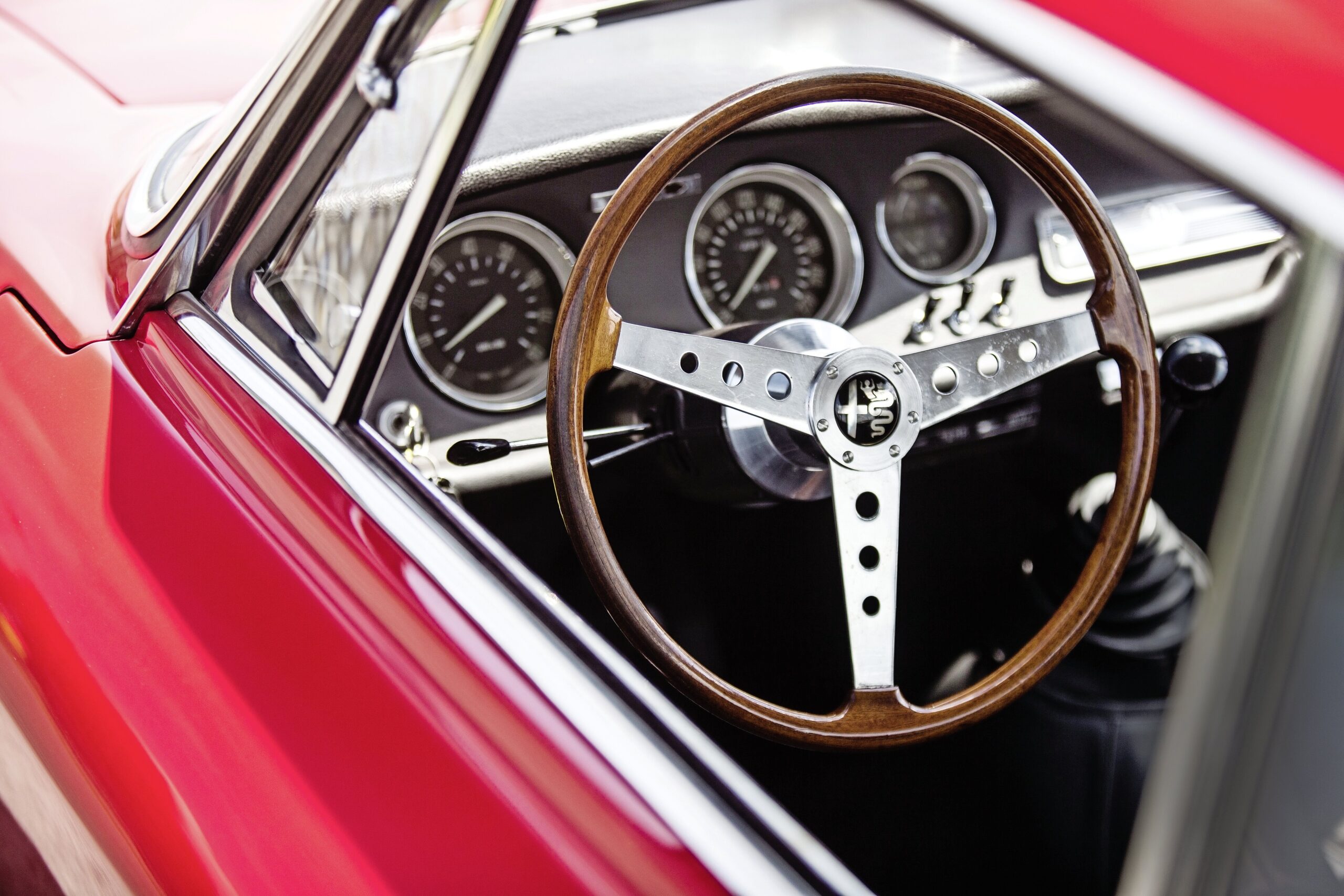
A most direct interface between you and the road
Driving Adam’s car is quite unlike driving any other Giulia Sprint derivative. You enter by pulling on a tiny aluminium door handle, then pull the door shut with a lightweight door-pull as you snuggle down into the prominently bolstered seat. The engine fires with the blattering snort typical of open-mouthed Weber DCOEs, hard-edged and overlaid with the clatter of tappets whacked by cam-lobes with a steep-ramped acceleration curve. It sounds rough but feels smooth, and the throttle response is electrifying.
Off I chunter to the Brands pitlane, low-mass gears chattering, suspension wriggling. As soon as I’m out on the track it’s clear that this is a short-geared, revvy machine but its minimal mass ensures it feels torquey too. But that low mass and the resulting lower centre of gravity aren’t the only reasons why this feels unlike any other Sprint GT derivative. The steering’s response is instant, the nose darting into a corner as though following grooves in the track, seemingly encountering no resistance from masses that I’d expect to favour continued travel in a straight line.
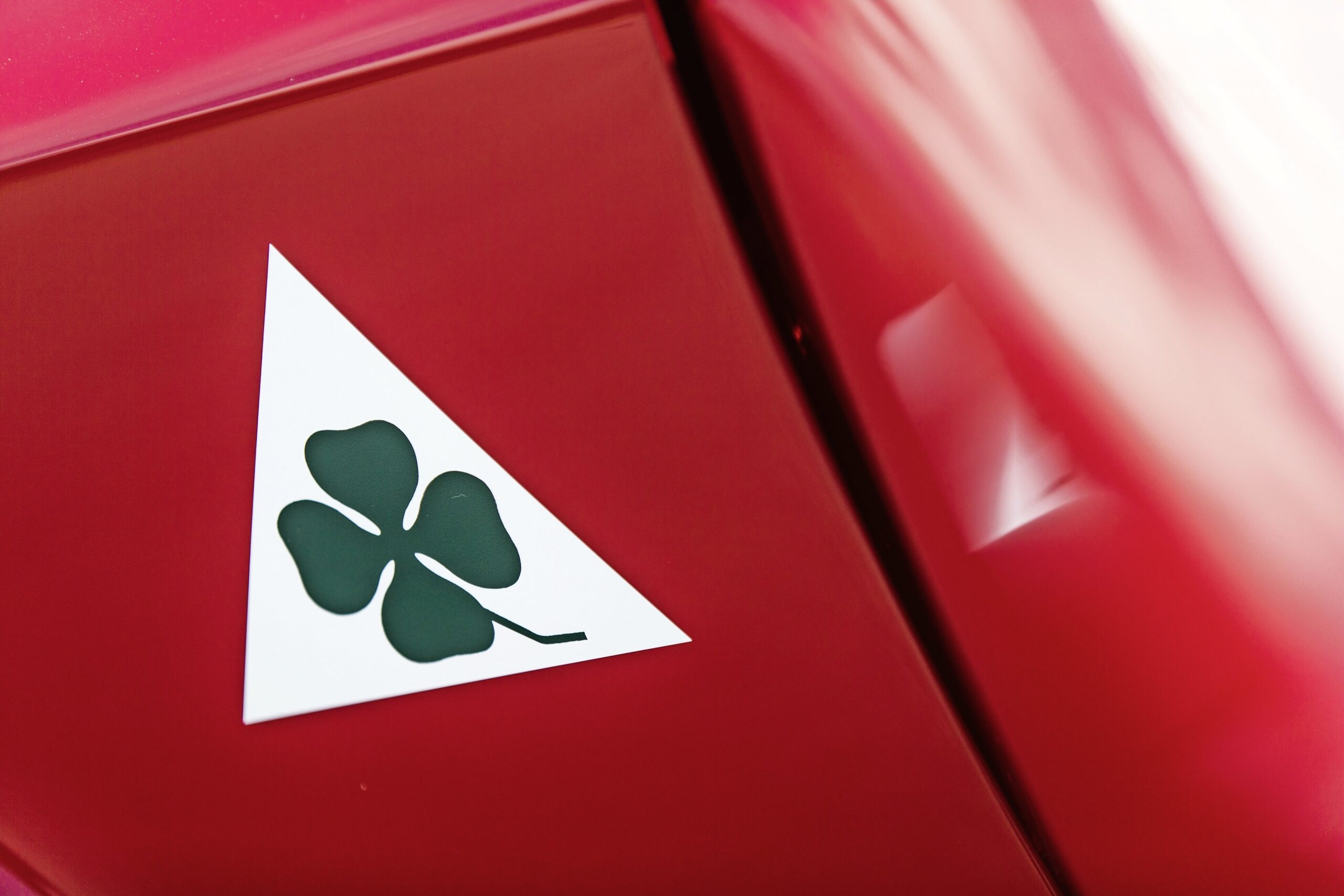
Quadrifoglio Verde: since Ugo Sivocci affixed a four-leaf clover to his Alfa Romeo RL prior to winning the 1923 Targa Florio, this logo’s been synonymous with Alfa’s competition cars, from touring cars to F1
Then I apply the power, feeling the soft tail squat a little as it helps point the nose to the bend’s exit, and wonder how it is that the minimal weight can be marshalled so effectively to fling this Alfa Romeo through the corners. Subtle changes in suspension geometry are why, bespoke front hubs the key to the fantastic steering feel and remarkable bite. This feels like a racing car for the road, which is exactly what it is.
FORD MUSTANG V8
Roy Pierpoint won the 1965 British Saloon Car Championship in a Mustang, one of several taking part that year. Some had been run as rally cars the previous year by Alan Mann Racing, and one even won the Tour de France to score the Mustang’s first competition success anywhere in the world.
Alan Mann’s team prepared Pierpoint’s car for 1965, as well as cars for Mike Salmon and Sir Gawaine Baillie, while in 1966 Jackie Oliver scored well in his DR Racing example.
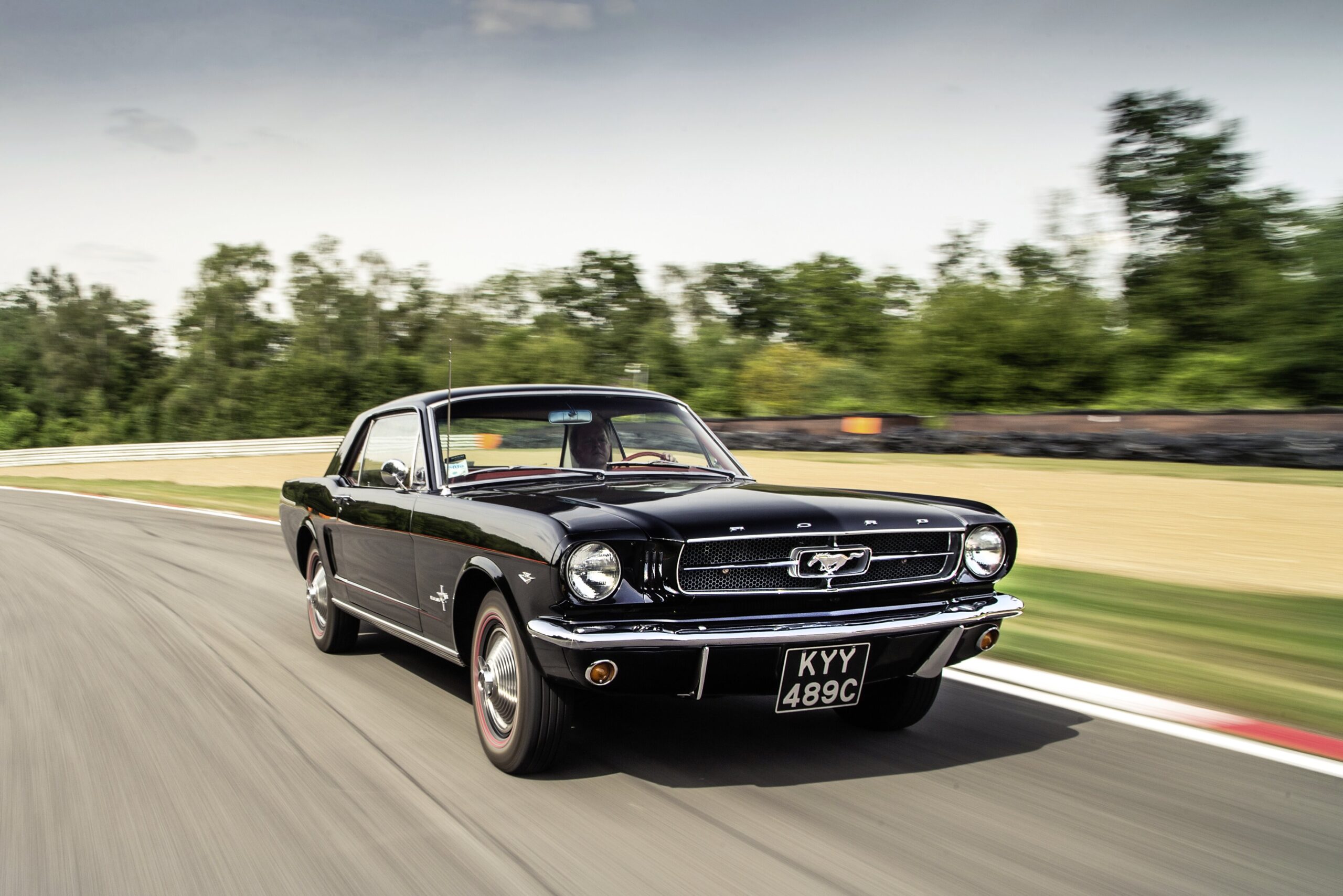
Ford’s Pony Car proved to be a remarkably able competitor in the UK in race trim
That championship win was a bit controversial. Jack Brabham in another Mustang won the series final at Oulton Park, but was disqualified after his engine (unbeknown to Jack) was found illegal. The series gave points for class placings rather than overall positions, and after this final race and Jack’s win it was Warwick Banks, in a Mini-Cooper 970S, who had scored the most points. But Banks’ crown was snatched away before it had even been presented, because Brabham’s disqualification gave class honours to Pierpoint and enough points to clinch the title.
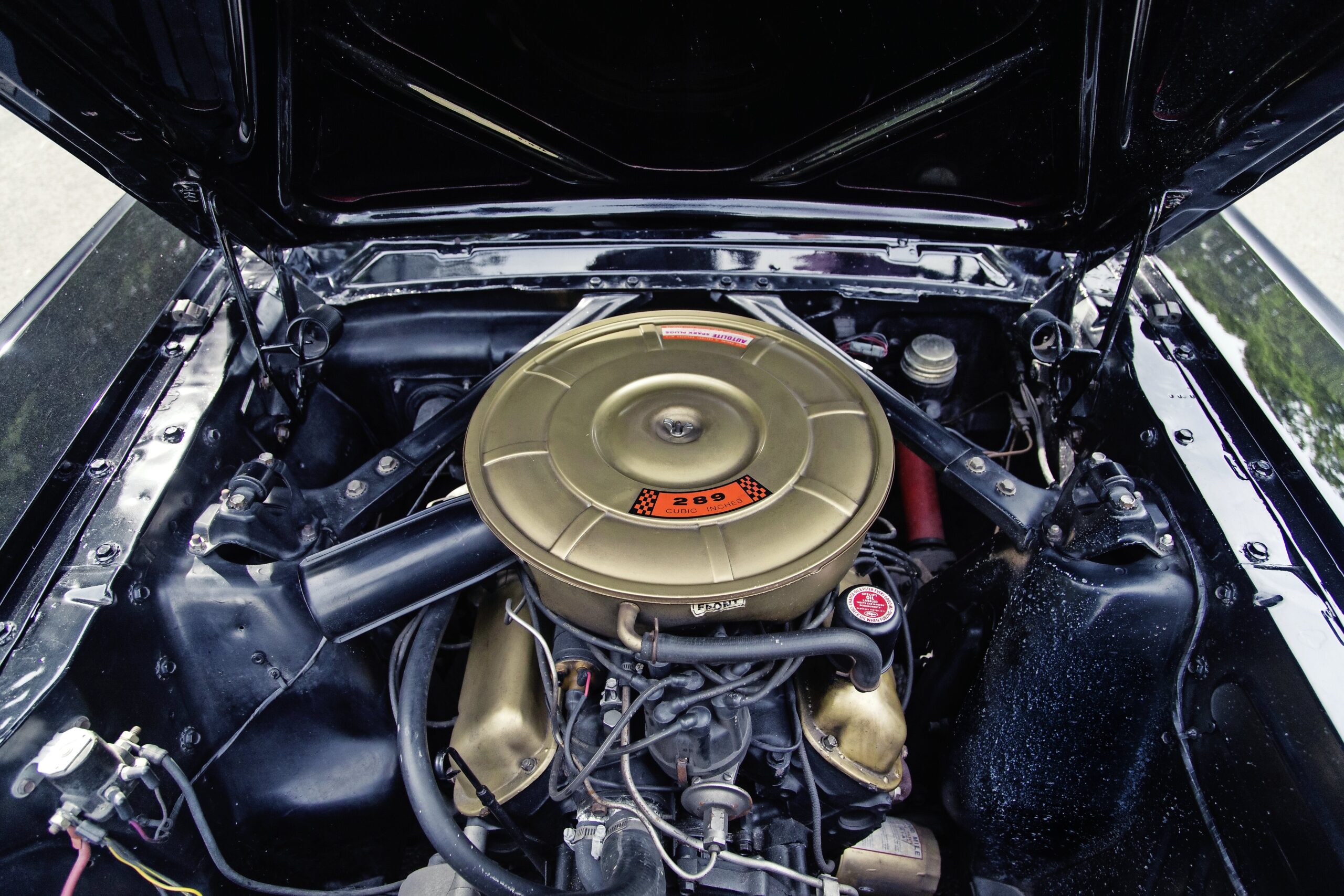
This Mustang’s 200bhp is enough for the road, and easily tuned for the track
So the American high-fashion coupé became the class of the British saloon-car field. Brawn had already proved a productive approach, as demonstrated by Jack Sears in his enormous racing Ford Galaxie, and the Mustang was a handier, wieldier version of a similar V8-powered idea. The fastest Mustang road cars of the time, before the Shelby-tuned Fastbacks arrived, were those with the 271bhp ‘Hi-Po’ version of the 4727cc small block – everything’s relative – V8, and of course these cars had a manual transmission and disc front brakes.
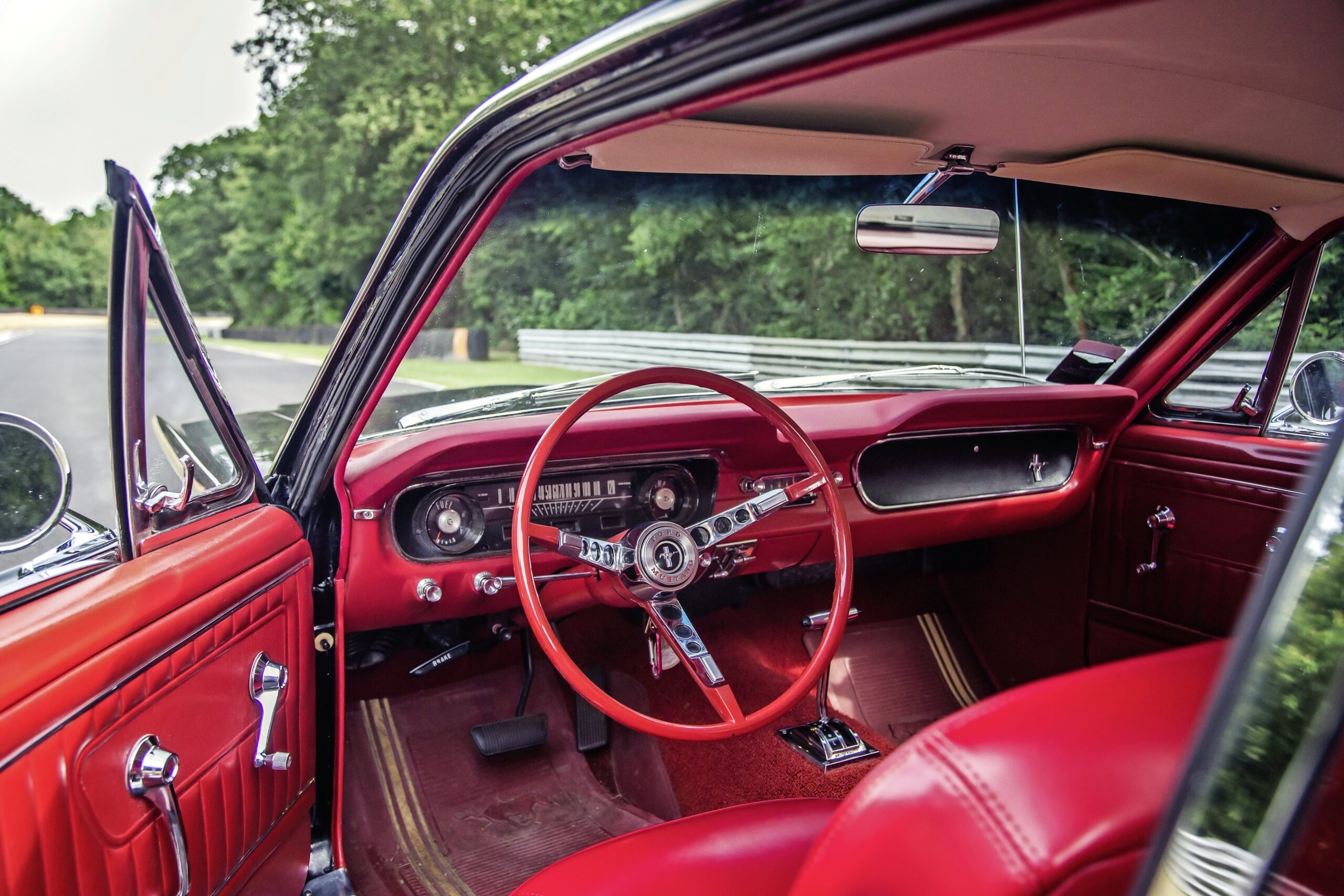
Not the sharpest tool for track work, but still a handy tiller on the road
Most Mustang buyers, however, bought their cars for style rather than sporting intent. But even the cooking version we have here, a 1965 three-speed auto with 200bhp and all-drum brakes, looks keen. Three-eared spinners sit on conical hubcaps formed of myriad concentric circles. The steering wheel, its rim the same red as the rest of the interior, has fake holes on the three-arm hornpush that covers the wheel’s spokes, suggesting the look of a Moto-Lita or a Momo. But instrumentation is sparse, an ornate horizontal-scale (but arc-needle) speedo flanked by two giant dials that prove to be no more than fuel and water-temperature gauges.
Owner Dougie Fuller loves it. ‘I love the interior, the chrome… and I’ve always loved old Fords. This is my first left-hand drive and American one, which I bought from California unseen on the internet, five years ago. When it turned up it was everything I expected, except it was too bright. Vermillion paint with a red interior was just too much.’
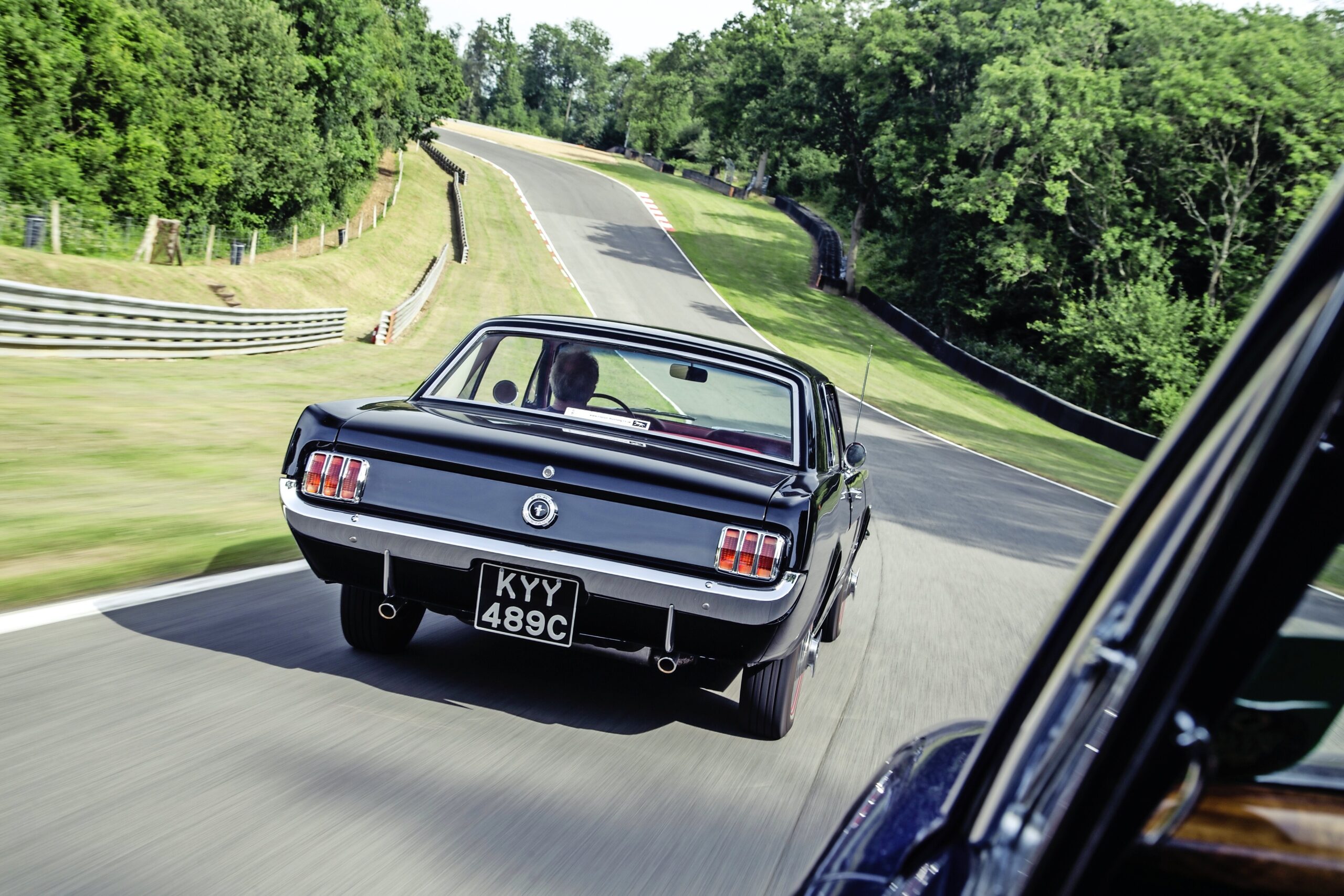
First-gen Mustangs were European-sized
On the road, the Mustang is pretty brisk when exploring the far reaches of a long accelerator travel, with an eager and quite violent kickdown. The engine never does much more than woofle – there’s no Bullitt emulation here – but the Mustang cruises happily, stops with more bite than expected provided I push the pedal hard, and handles with a pleasingly natural, fluent feel provided I don’t rush the retro-looking, but radial, tyres. The steering is soft and springy, so I let it find its own way, but there’s little slack in the system and before long the Mustang feels an entirely normal size. As it should; many modern European saloons are bigger.
‘The Mustang is pretty brisk when exploring the far reaches of a long accelerator travel.’
What this gentle-spec Mustang does not do, though, is racetracks. On the first approach to Paddock Hill Bend, downhill, tightening and off-camber, I’m fast running out of hard surface as the nose washes wide. I manage to coax it back online, tiptoe round the Druids hairpin and flop into Bottom Bend, all body-roll and directional indecision. It needs firmer springs, yet-firmer dampers and modern rubber if it’s to have a hope around here, but then it would have changed into a different sort of car: a car more like Roy Pierpoint’s BSCC winner, perhaps.
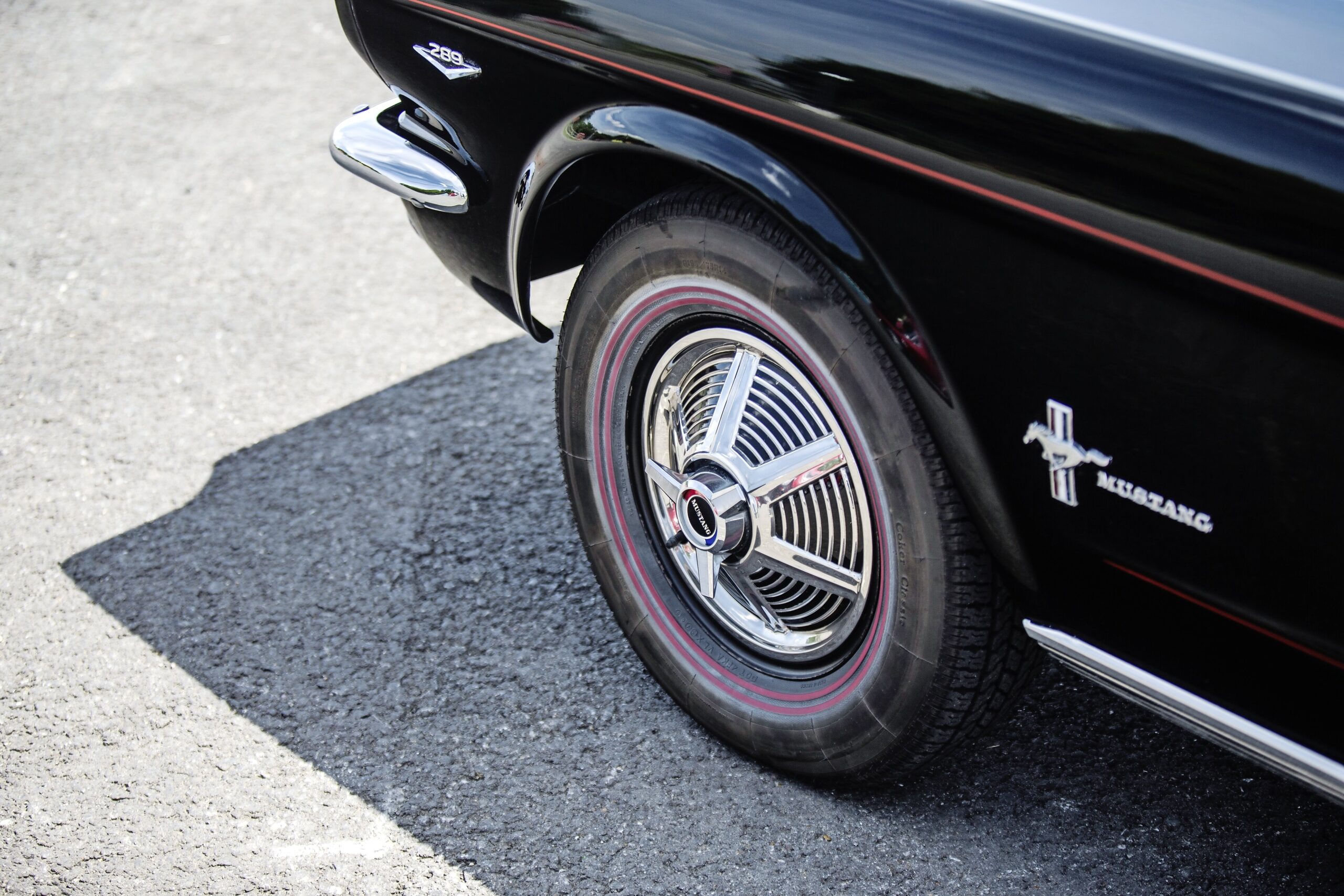
Behind fake spinners lie surprisingly effective drum brakes.
A Mustang is nothing if not versatile, and as a road machine Dougie’s black beauty is utterly charming. For fantasising about following in Roy Pierpoint’s wheeltracks, though, what you need is a Ford Mustang Hardtop Challenger High Performance V-8 four-speed, to give the full-fat version its full-fat name. Then you can really ride that pony properly…
JAGUAR Mk2 3.8
Think of early big-league saloon-car racing in Britain, with the British Saloon Car Championship starting in 1958, and you’ll probably think of Jaguars.
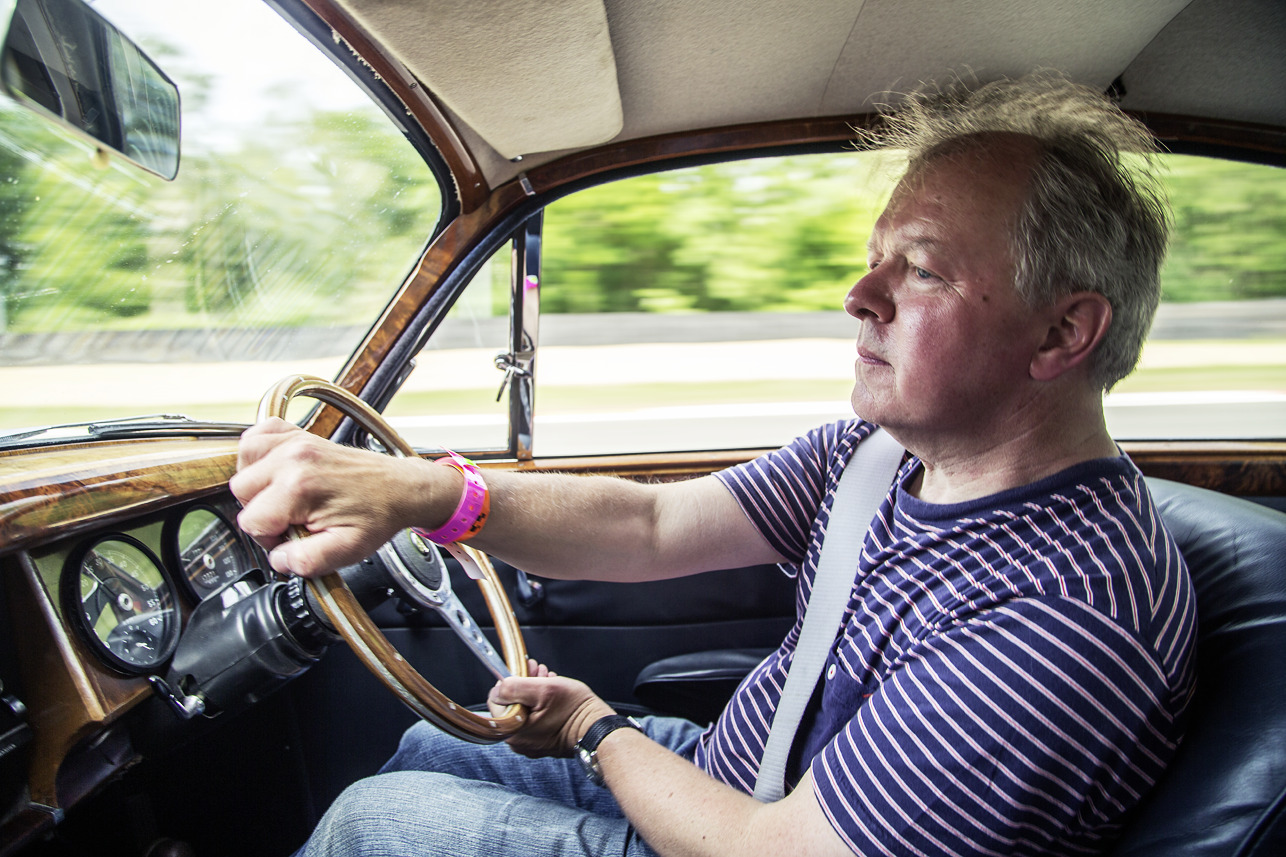
John gets rather warm emulating his touring car heroes
From 1960, the staple small Jaguar saloon (relative to the MkVII/VIII/IX) came in Mk2 form with a wider rear track and, crucially, a 3.8-litre version of the XK twin-cam straight-six instead of the 3.4 litres that was on offer before.
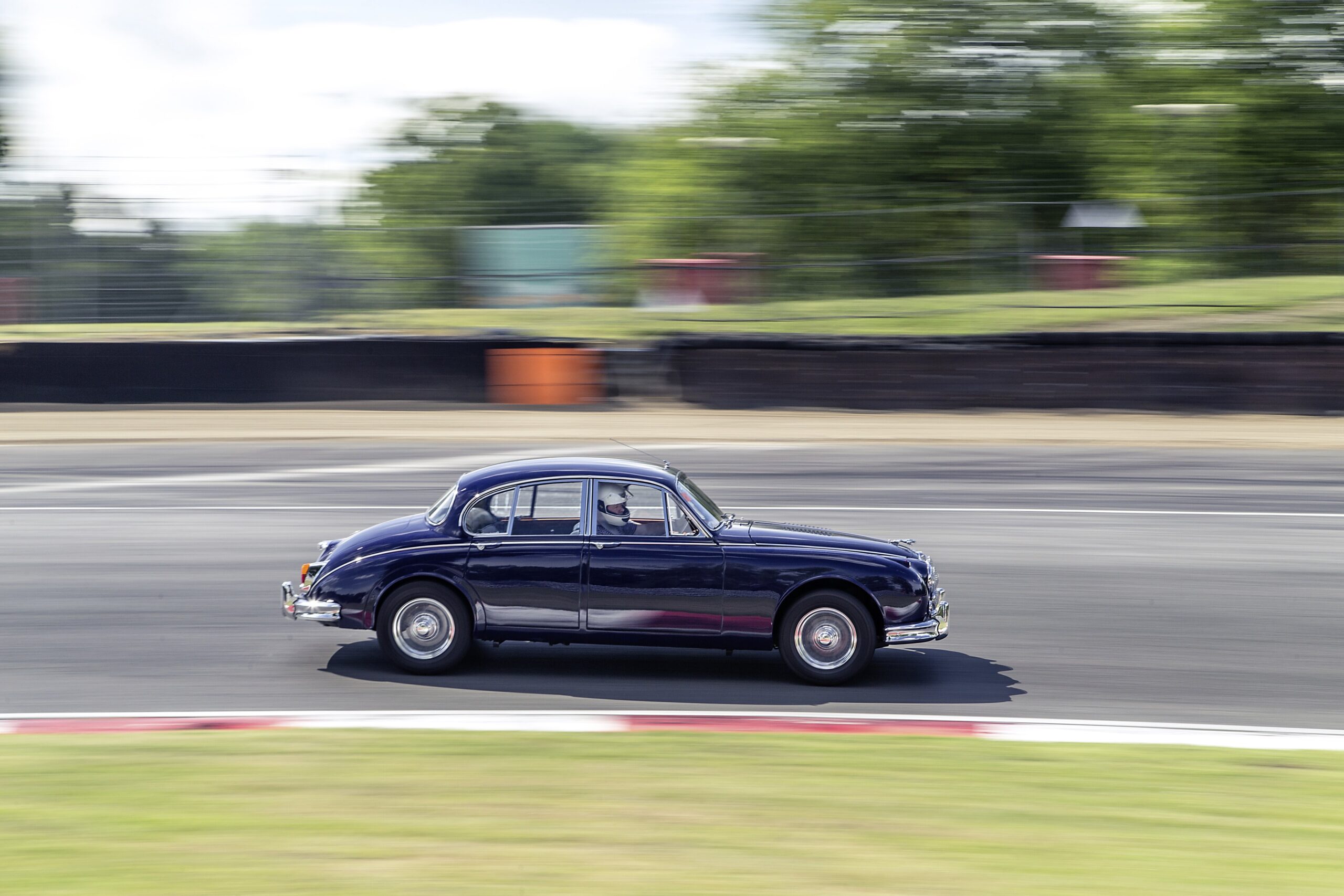
The oldest car here, this 1959 Mk2 has Coombs-style modifications
These were just two of the many differences between the Mk2 and its retrospectively tagged Mk1 predecessor, but between them they slashed lap times thanks to the extra pace and the vastly improved rear traction and grip.
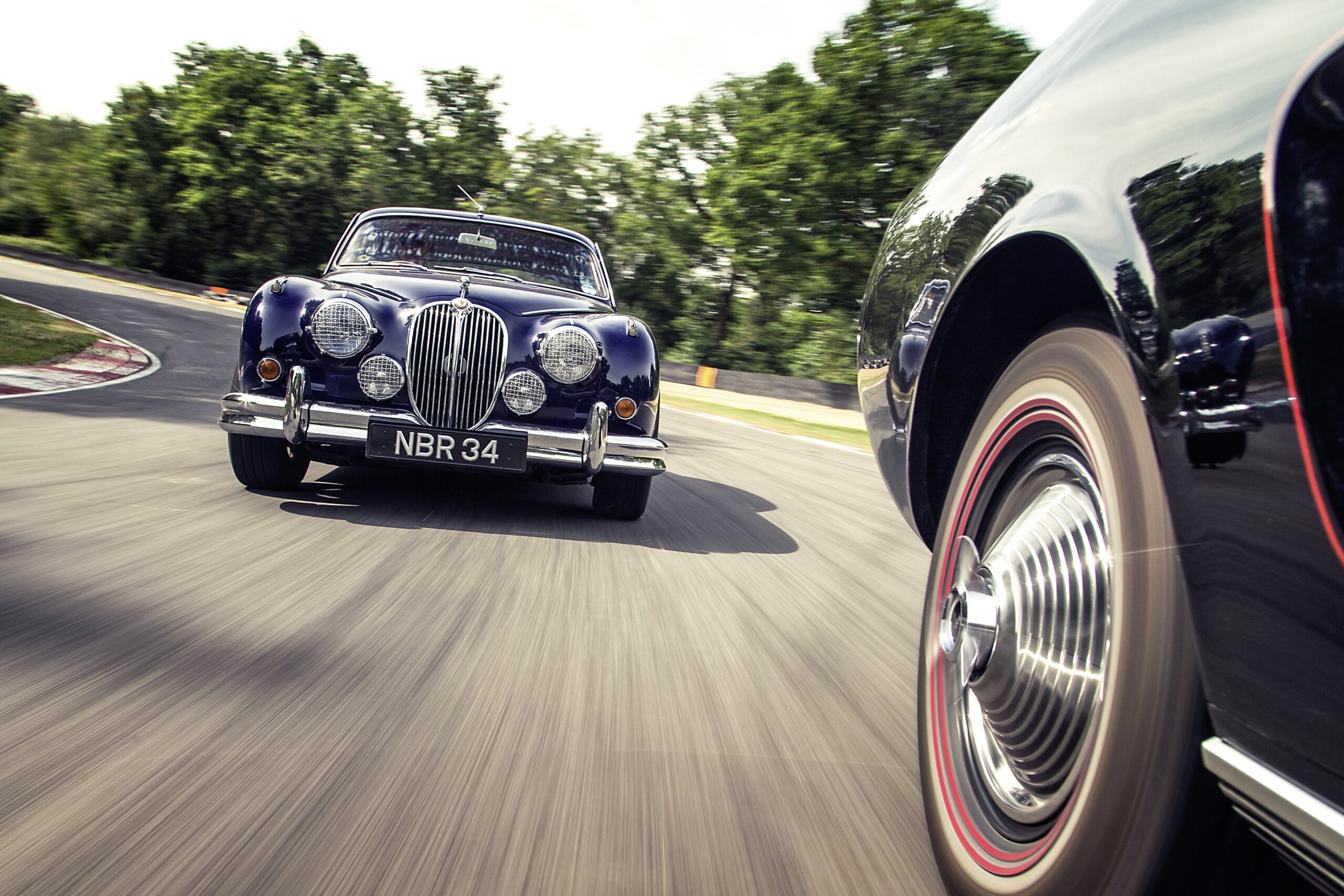
How many times have you wished to hurl a Mk2’s snout into such a corner?
Sears, with his spectacular drifts, was one of the most successful Mk2 exponents, continuing in this vein through 1961 and 1962 before switching to fast Fords for 1963. For 1961 and 1962, the BSCC contenders were lightly modified Group Two specification, and in the Jaguars’ final year of frontline competitiveness they came third, fourth, and fifth in the championship in the hands of Sears, Hill, and Parkes respectively.
John Coombs capitalised on his team’s successes by displaying the BUY 1 numberplate on a team car and offering the much-prized Coombs conversions for road cars. A genuine Coombs Jaguar was always rare, but it’s a good template for a bit of retrospective sporting enhancement on a Mk2 today.
This is what we have here, which has been brought to Brands by Chris Logue of Racing Green Cars, where this dark blue 1959 example, nicely restored a while ago and holding up well in the bodywork, is up for sale (yours for £39,995).
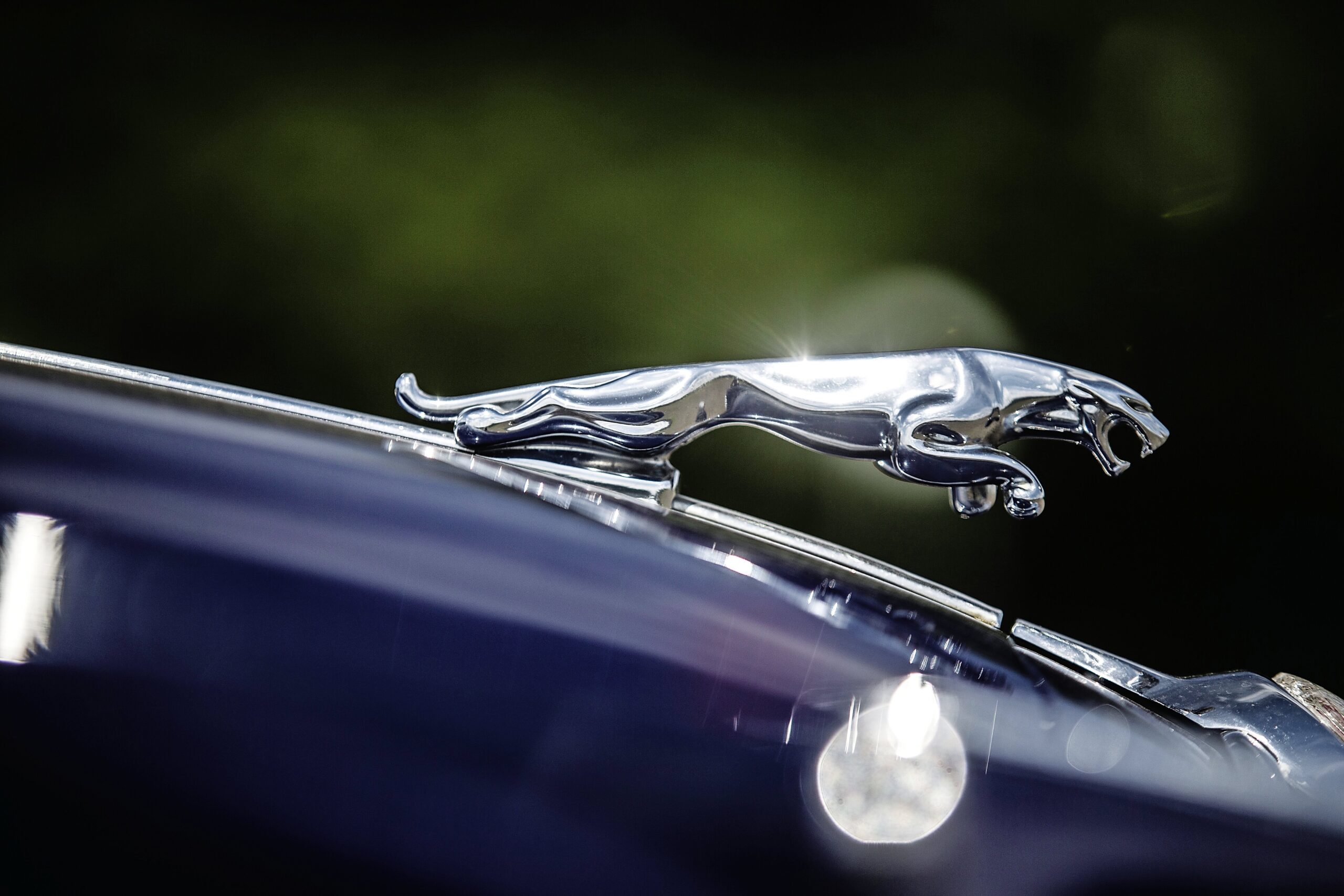
With Coombs-esque upgrades, this Jag moves like the proverbial scalded feline…
So it has a louvred bonnet, reduced-size rear wheel spats with lips to match the front arches, triple HD6 SUs fed through a bespoke aluminium-and-mesh air filter curved to fit the inner-wing contours, and a straight-through exhaust system. The result should be approximately E-type power, claimed at the time to be 265bhp, although this was as much a ‘gross’ – that is, uninstalled – figure as the standard twin-carb 3.8’s claimed 220bhp. Whatever this car’s true power, it’s fed to the road via a later all-synchromesh-and-overdrive gearbox and yet-later XJ6-size tyres on wide wire wheels.
The suspension, however, is standard, and its softness can’t cope with the sudden suspension compression at the bottom of Paddock Hill where the fat front tyres clout the arches. This car would be much more effective on standard-sized tyres, which would better allow those graceful Jaguar drifts as the body takes up its considerable roll angles. As it is, I can never load it up enough to discover what ultimately happens to the balance, because the bodywork gets in the way first.
‘It sounds fabulous, with the brass-band blare of a Jaguar six-pot’
But it does sound good. Fabulous, actually, with the brass-band blare typical of a free-breathing Jaguar six-pot ringing through my ears as the pace rapidly builds (along with the haze of exhaust smoke that goes with a truly loose, free-running and richly imbibing old engine). It’s possible to heel-and-toe in this car, something near-impossible in a standard Mk2 but vital for racing, and the all-synchro gearchange is sweet and easy.
No contemporary Jaguar BSCC racing driver had that nicety; it arrived after the Mk2’s racing sun had set. All-disc brakes rein in the Mk2’s considerable mass with confidence.
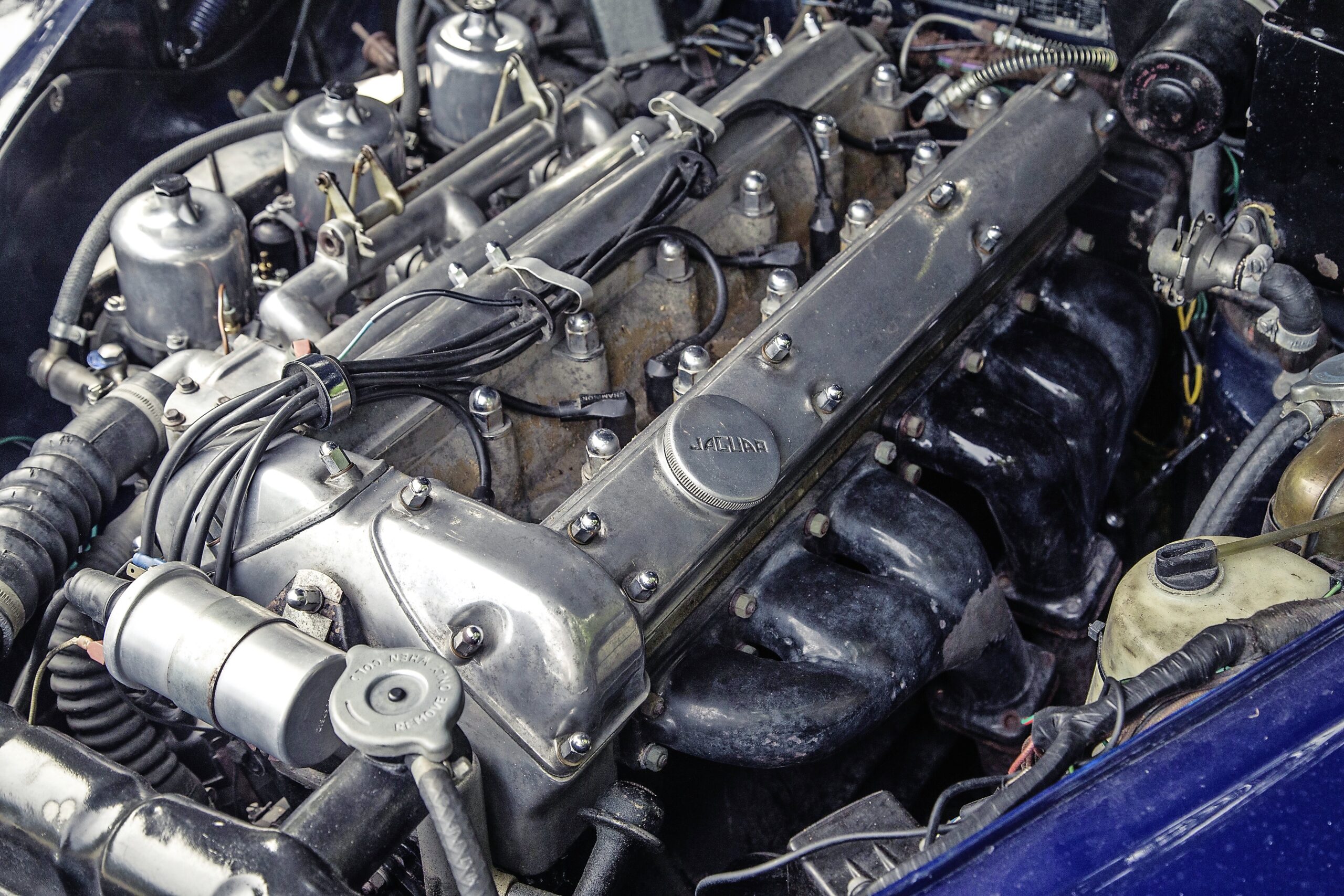
Six-cylinder Jaguar engine made gross 220bhp
Inside, the ambience is wood-and-leather Jaguar plushness seemingly unsuited to a racetrack environment, although the near-standard racers of the time had to retain most of their trim. The flat Moto-Lita steering wheel with its thin wooden rim feels good in the hands, though, helping me get the best from an original steering-box system that’s rather better than proponents of a rack conversion would have you believe. That said, the Jaguar is the grandaddy of the saloon racers here, and feels it.
Inside, the ambience is wood-and-leather Jaguar plushness seemingly unsuited to a racetrack environment, although the near-standard racers of the time had to retain most of their trim. The flat Moto-Lita steering wheel with its thin wooden rim feels good in the hands, though, helping me get the best from an original steering-box system that’s rather better than proponents of a rack conversion would have you believe. That said, the Jaguar is the grandaddy of the saloon racers here, and feels it.
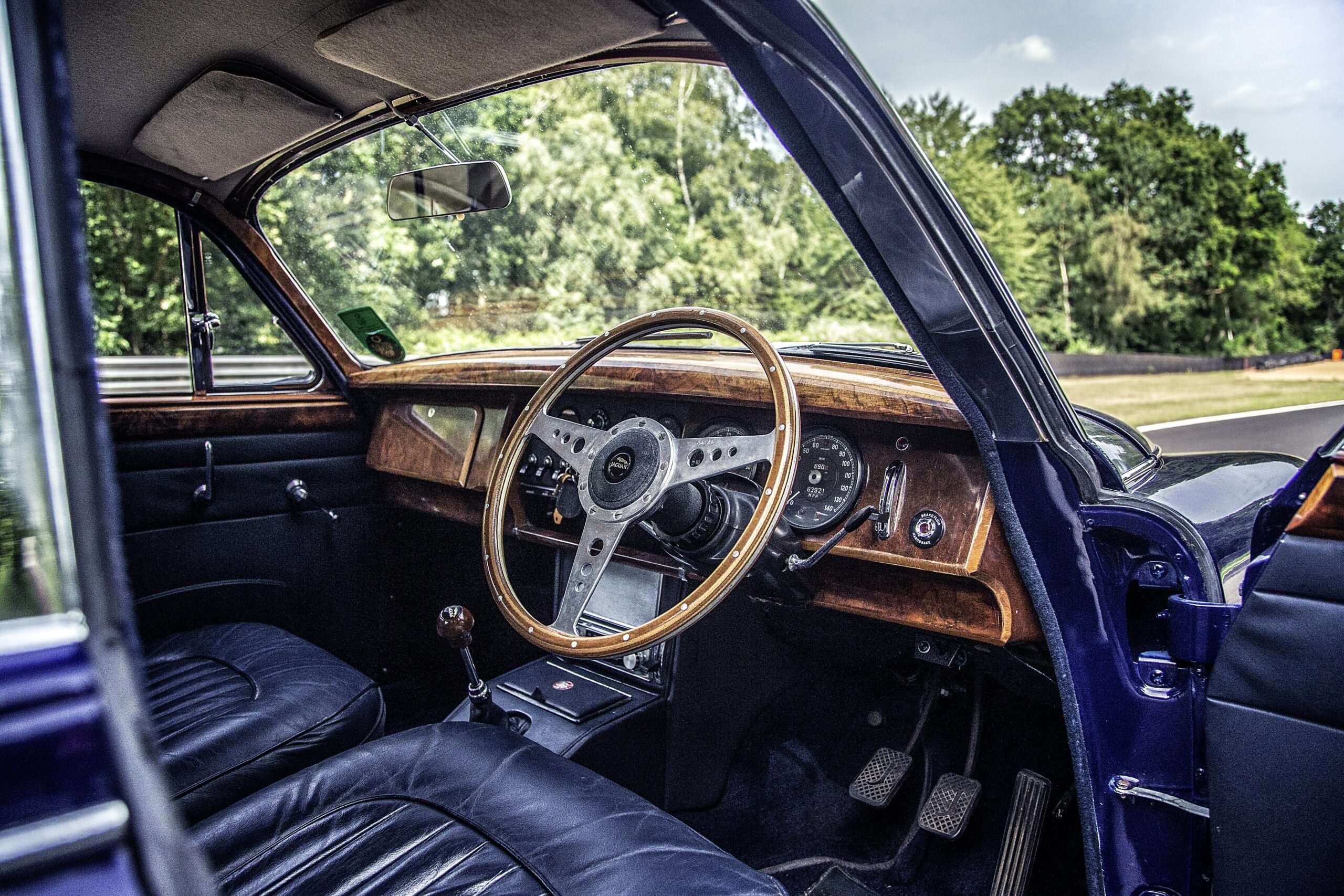
Luxurious trim had to be retained for the racetrack
Against that, it was also the car among our five that began its racing career in a form closest to standard specification. As probably the fastest European production saloon of its time, it couldn’t help but be a winner.
LOTUS CORTINA
Here was a great idea. Ford launches low-cost family car of conveniently low weight, while simultaneously seeking to raise its performance profile among buyers. Lotus launches new Ford-based twin-cam engine, seen first in the Lotus 23 sports racer and then put in the production for the Elan. Lotus wants to build more engines, Ford wants to win races. Thus was conceived the Ford Consul Cortina Developed By Lotus.
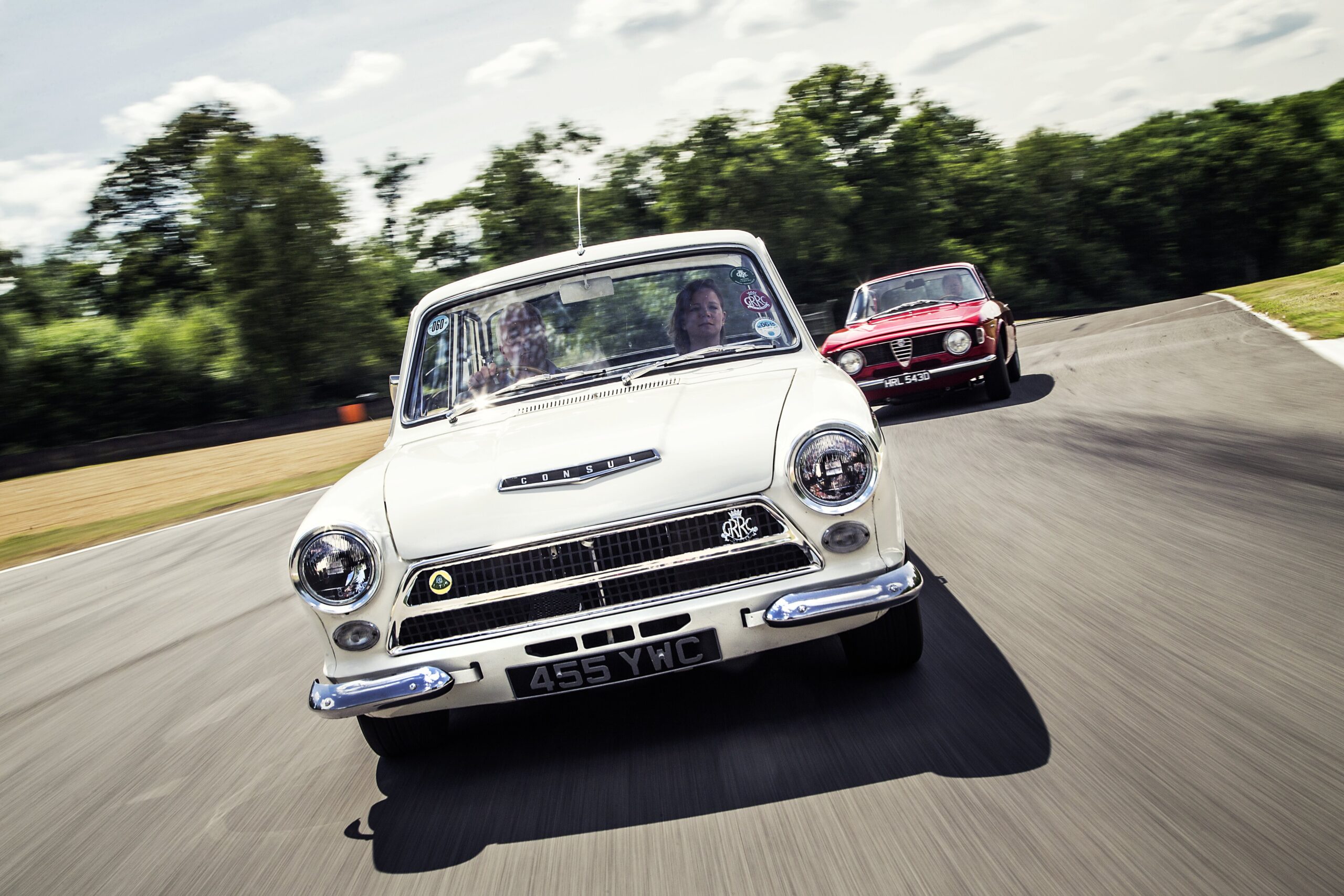
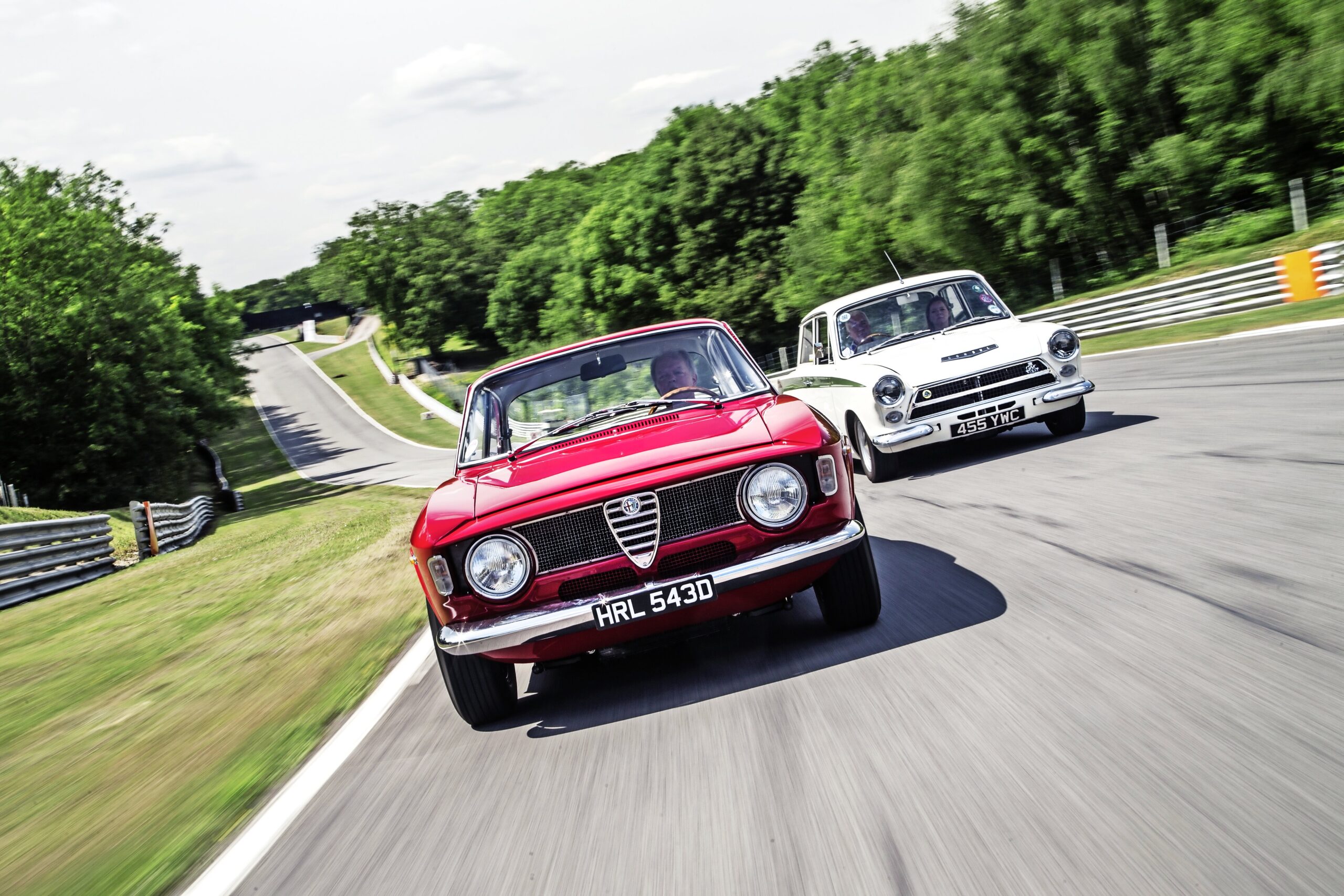
Lotus Cortina ahead of Alfa – it didn’t stay this way for long in the Sixties
And indeed part-built by Lotus, which received lowly Cortina 1200 two-door De Luxes at its Cheshunt factory and made them into the cars that changed the face of saloon-car racing. Into the Ermine White bodyshells went that 1558cc, 105bhp twin-cam, a close-ratio gearbox, a bespoke rear axle with an aluminium differential nose, coil springs and location by radius arms and an A-bracket, a sporting interior with huggy seats, a comprehensive set of round dials and a three-spoke Lotus steering wheel. On the bodyshells went doors and bonnet with an aluminium skin, an entirely aluminium bootlid covering a relocated battery, and a flash of olive-green paint. Under them went wide wheels attached to lowered suspension with racier geometry. Job done.
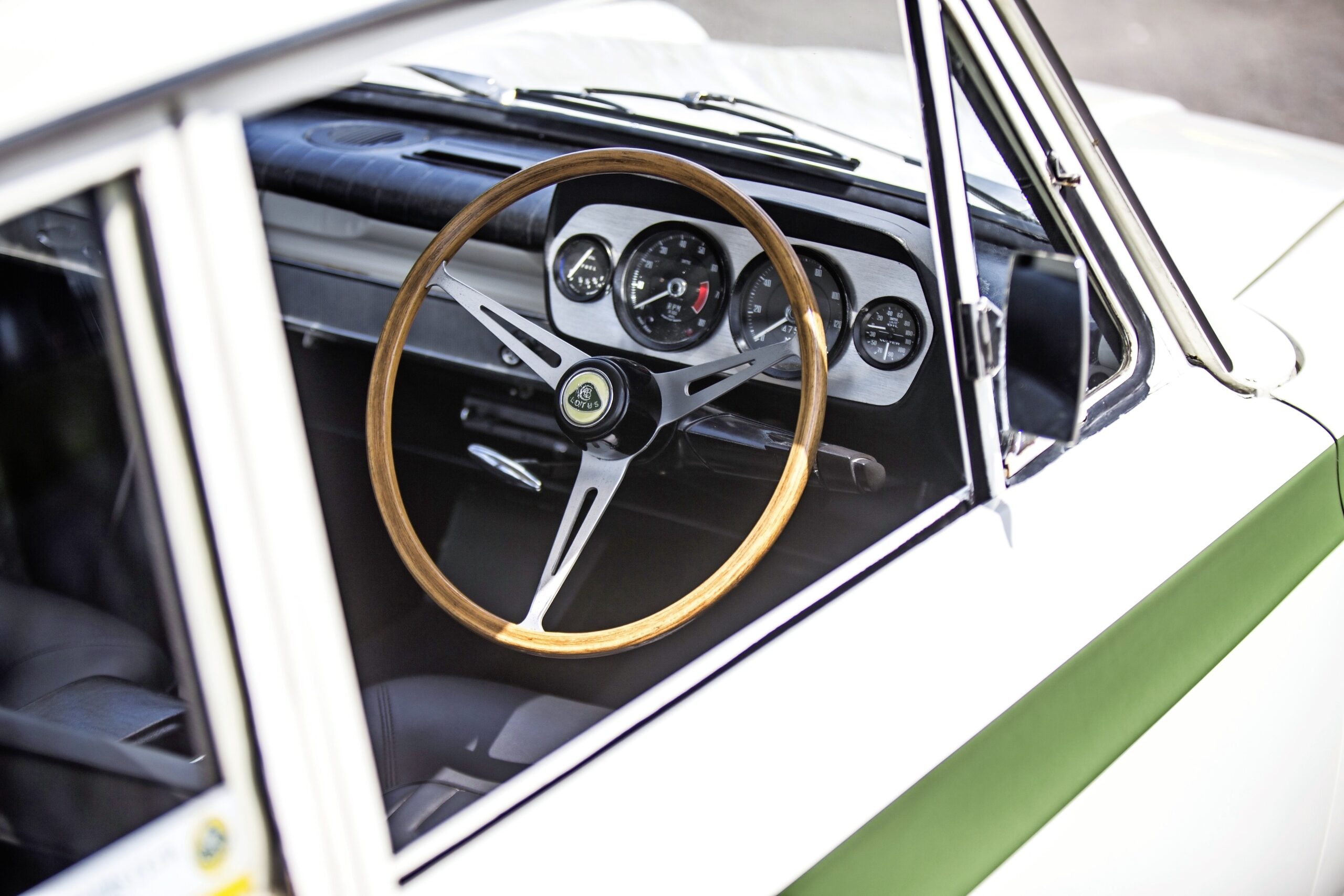
This A-bracket-equipped 1963 car has a more precise feel compared to leaf spring versions
You could buy a Lotus Cortina from your Ford dealer, and enjoy leaving much more exotic and expensive sports cars spluttering in your dust. If you did so, you would be especially interested in the fortunes of Team Lotus’s cars, competing mainly in the BSCC, and the red-and-gold examples of Ford-backed Alan Mann Racing, competing mainly in the European Touring Car Championship.
Jim Clark took the former championship in 1964; the following year Sir John Whitmore won the ETCC, sometimes winning not just his class but the entire race, just as had Clark sometimes done the previous year as he fended off giant Galaxies.
Driving Kate Horne’s ultra-original 1963 example reminds me how flexible fast saloons used to feel when worked hard on a track. Today’s historic racing saloons are set up far more stiffly, the better to make use of their tyres’ much greater grip, but period photographs of racing Cortinas show the usual impressive roll angles and, in the Team Lotus cars, inside front wheels dangling in the air. The Alan Mann cars didn’t do that, however.
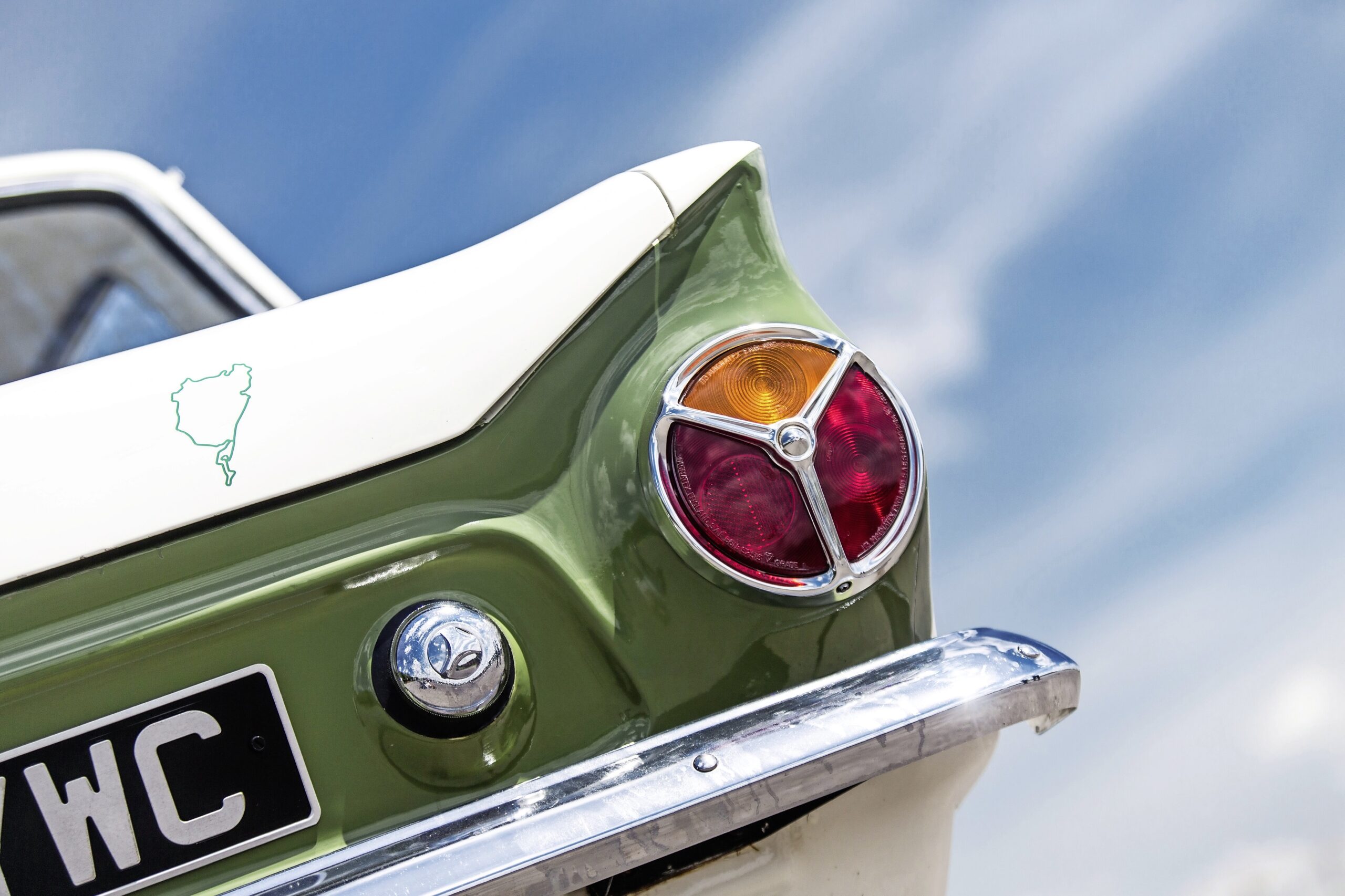
A view many ‘serious’ sports cars were left with back in the day…
Mann says in his book, A Life of Chance, that the Team Lotus cars were set up with a very stiff front anti-roll bar and a soft tail, better for tight British circuits where the inside front wheel could hover over the kerb and thus shorten the lap. His cars, by contrast, were set up to keep all their wheels on the ground for the longer, faster circuits prevalent in the ETCC, where stability in long bends was more important.
It’s also the case that, by 1965, Lotus Cortinas were using leaf springs and lower radius arms instead of the A-bracket, which had given better lateral location but caused problems with distorting differential cases and consequent oil loss. With a less positive rear end, it’s especially useful to have all four wheels on the ground, and it’s a fact that even roadgoing versions of the Lotus Cortina handle differently with the two rear suspension designs. With leaf springs, it’s gung-ho throttle-steerability; with the A-bracket, the Cortina feels relatively more precise and planted.
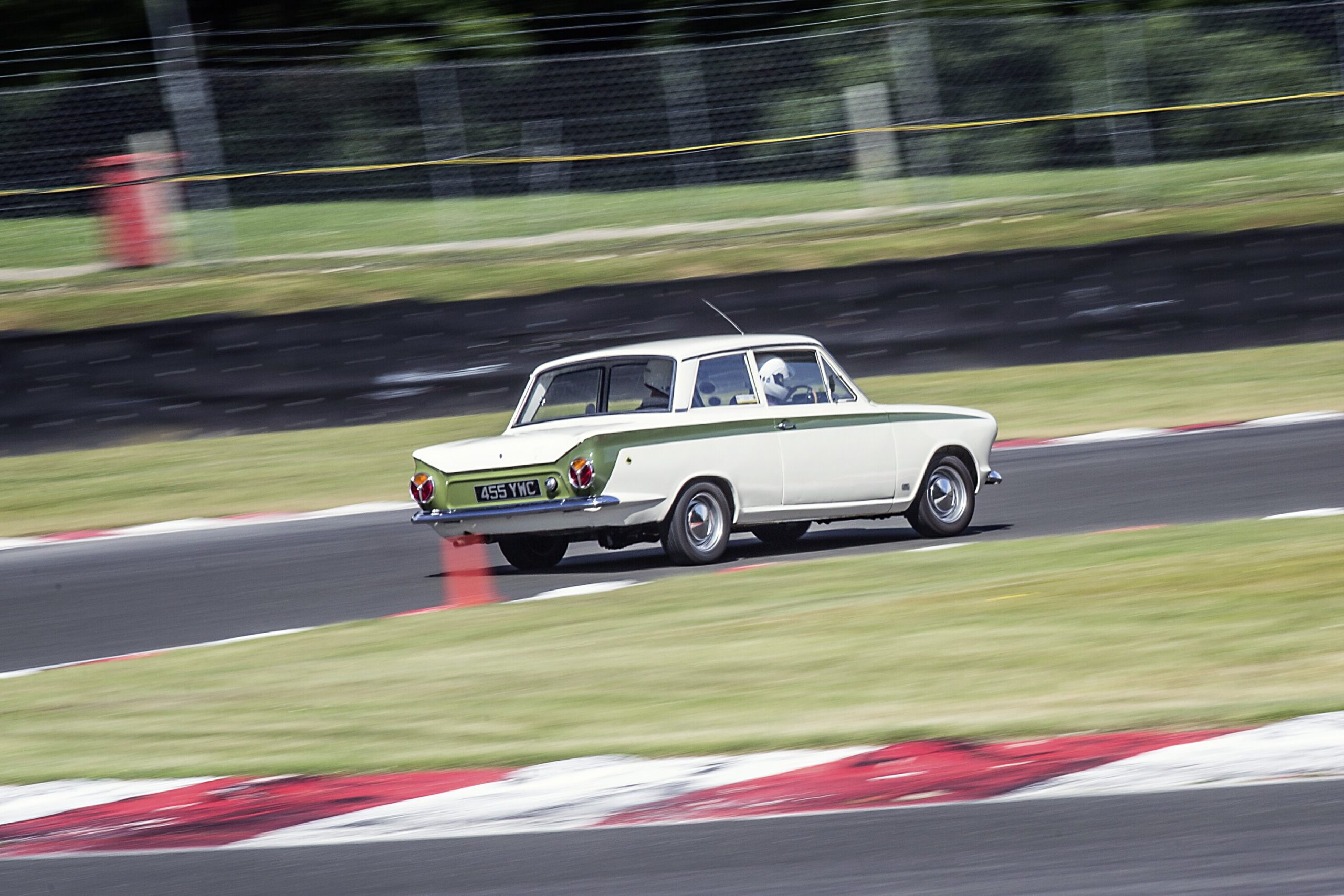
…it was much the same on track, with Jack Sears and Jim Clarkat the helm
But it’s still pretty soft and flexible once worked up towards track speeds, as I’m finding over a few Brands laps. Kate’s Cortina has the original ultra-close-ratio gearbox with a long-legged first gear, and it’s just what I need on a track to get the best from this revvy twin-cam. Then, as each bend approaches, you brake, turn a little – the steering is springy but accurate – and use the power to fine-aim the nose towards the apex and on to the exit. This car has a very mobile, power-influenced balance, which is why it’s great fun to drive and why the racers were brilliant to watch.
‘The ultra-close-ratio gearbox is just what I need on a track to get the best from this revvy twin-cam.’
Kate and her father David set off to the Le Mans Classic the day after our test, using the Lotus Cortina as it should be used. ‘We looked for three or four years before finding this one,’ Kate says. ‘The ones for sale tend to be race cars,’ adds David, ‘but we found this in Aberdeen and drove it back to Sussex. It had a repaint 25 years ago but as far as we know, it’s had no welding. That said, it’s bound to have had some at some point…’
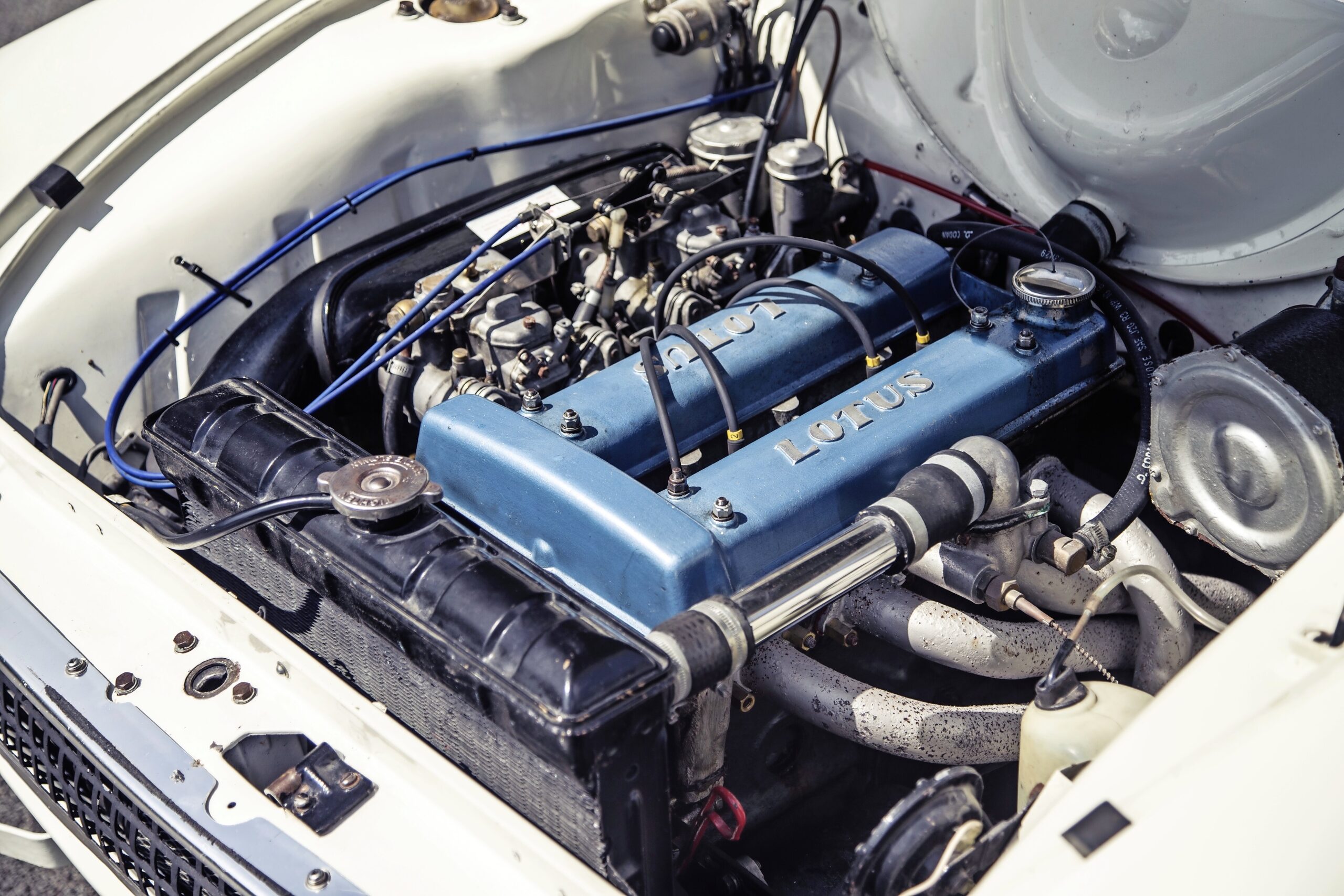
Lotus engine gives 105bhp
‘It’s in the same state as when we bought it,’ Kate continues, ‘and we’ve decided to maintain it rather than restore it.’ As for the mechanicals, it has Gaz rear dampers and Gaz-refurbished front struts, and will shortly get an engine rebuild as, even by Lotus twin-cam standards, it’s a bit smoky. It got to Le Mans, though.
MORRIS MINI-COOPER 970S
This is the Mini-Cooper combination that so nearly won the 1965 BSCC, but Roy Pierpoint’s unexpected promotion to victory in the big-bangers’ class at the final round left 1000cc-class winner Warwick Banks with fractionally too few points.
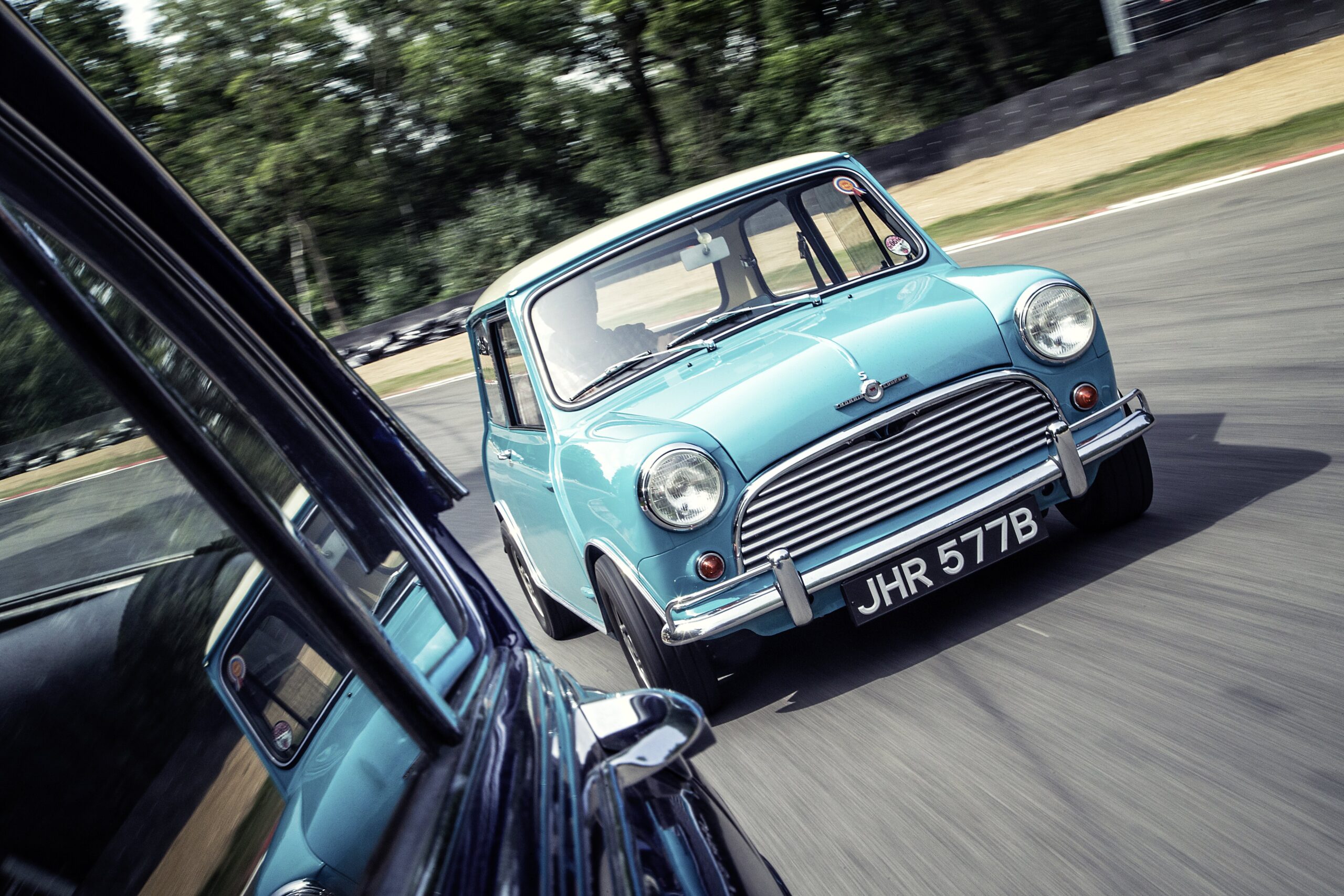
Despite the poor aerodynamics, the Mini was a successful racer
However, both Banks and team-mate John Rhodes were championship class winners in the dark green, Cooper Car Company-run Morris Minis, with their white roofs and white bonnet stripes, Rhodes taking 1300cc honours.
Intriguingly, the same cars, according to their numberplates at least, were raced by both drivers in their respective classes at various points in the season, as engines were swapped around. Banks’s final class win that year was in GPH 1C, still around today and currently in 1300cc form, but it’s as a 970 – enlarged to 999cc for racing – that the early Cooper S is the most intriguing.
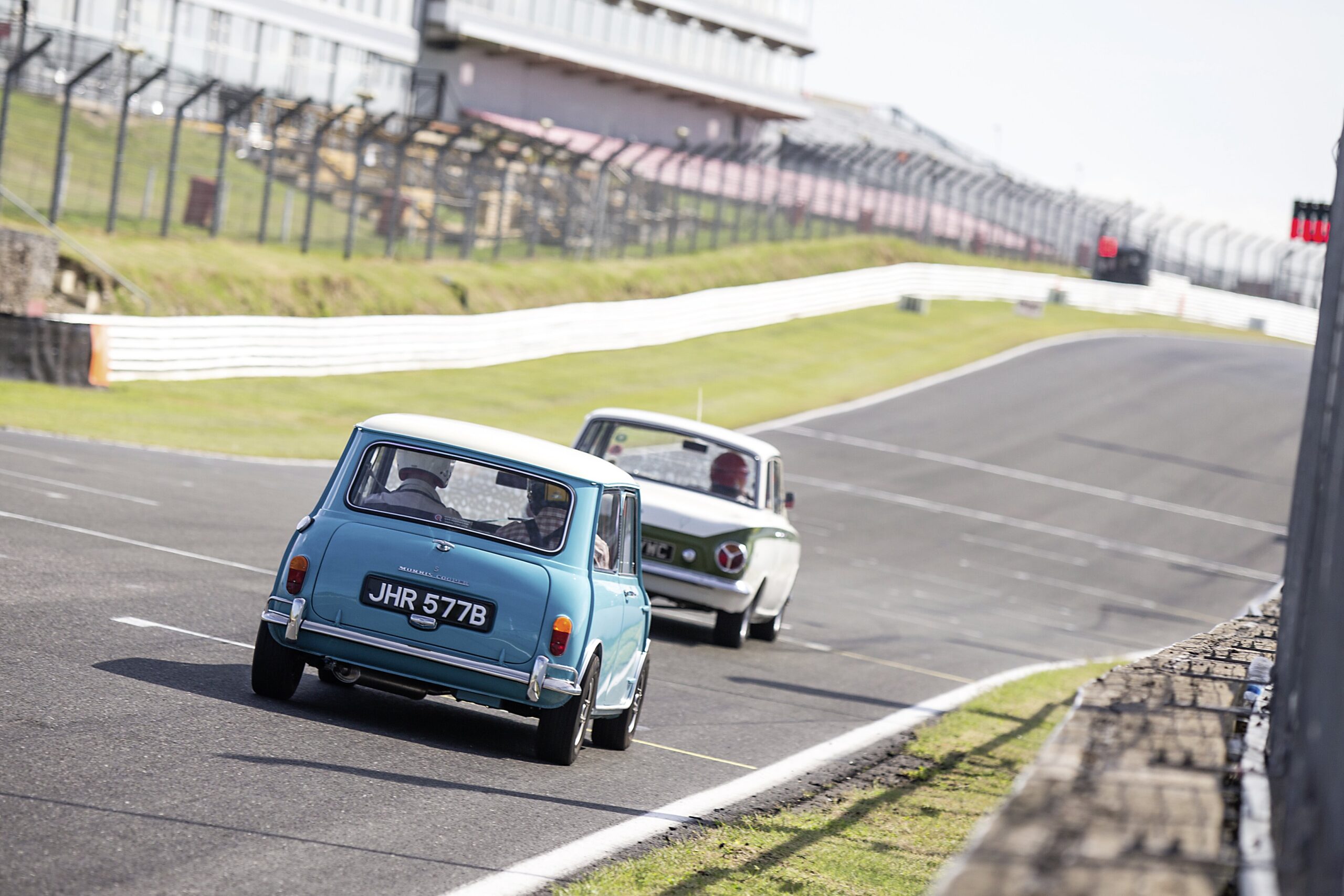
What Minis lacked in grunt, they made up for in cornering speed.
It’s also the rarest, with just 963 examples made from June 1964 even though the homologation (which technically required 1000 examples to be built) was certified in April. The engine used the biggest production A-series bore size, 70.6mm, with a short 61.9mm stroke, making it that rare thing, an oversquare A-series. The only other such engine was the earlier 1071S, with a 68.3mm stroke, which the 970S and 1275S together replaced.
The resultant space for big valves relative to cylinder capacity made the 970S potentially very powerful for its size as well as very revvy, but for road use with a mild camshaft it was pegged back to a still-useful 65bhp at 6500rpm. That the torque reaches its 55lb ft peak at just 3500rpm leads you to expect the roadgoing 970S to be less frantic than its reputation suggests, and so – short-legged gearing aside – it proves. As for ultimate pace, I can find no record of a 970S road test, nor any factory claims, so the figures in our table are informed estimates only.
Robert Lancaster-Gaye’s 1964 Morris in cheerful Surf Blue with an Old English White roof was restored by Fred and Tony Walters of Nippycars, shortly after the similar Almond Green 970S of Bryan Smart recently featured in these pages as an Epic Restoration (January 2014 issue). Again it required a full bare-shell rebuild, lots of new steel and a painstaking search for exactly the right parts.
In place of Bryan’s evangelical adherence to factory-correct specification, however, Robert wanted correctness of a slightly different sort to overlay the factory-authentic starting point. ‘Every car I ever owned in my youth was modified. And if I had owned a Cooper S back then, I would have done exactly what I have done to this.’ Which is: small steering wheel on a lowered column, Microcell bucket driver’s seat, open carburettor trumpets, lowered suspension, and Minilite-like ‘rose petal’ wheels shod with grippy, track-flavoured, 165/70 R10 tyres.
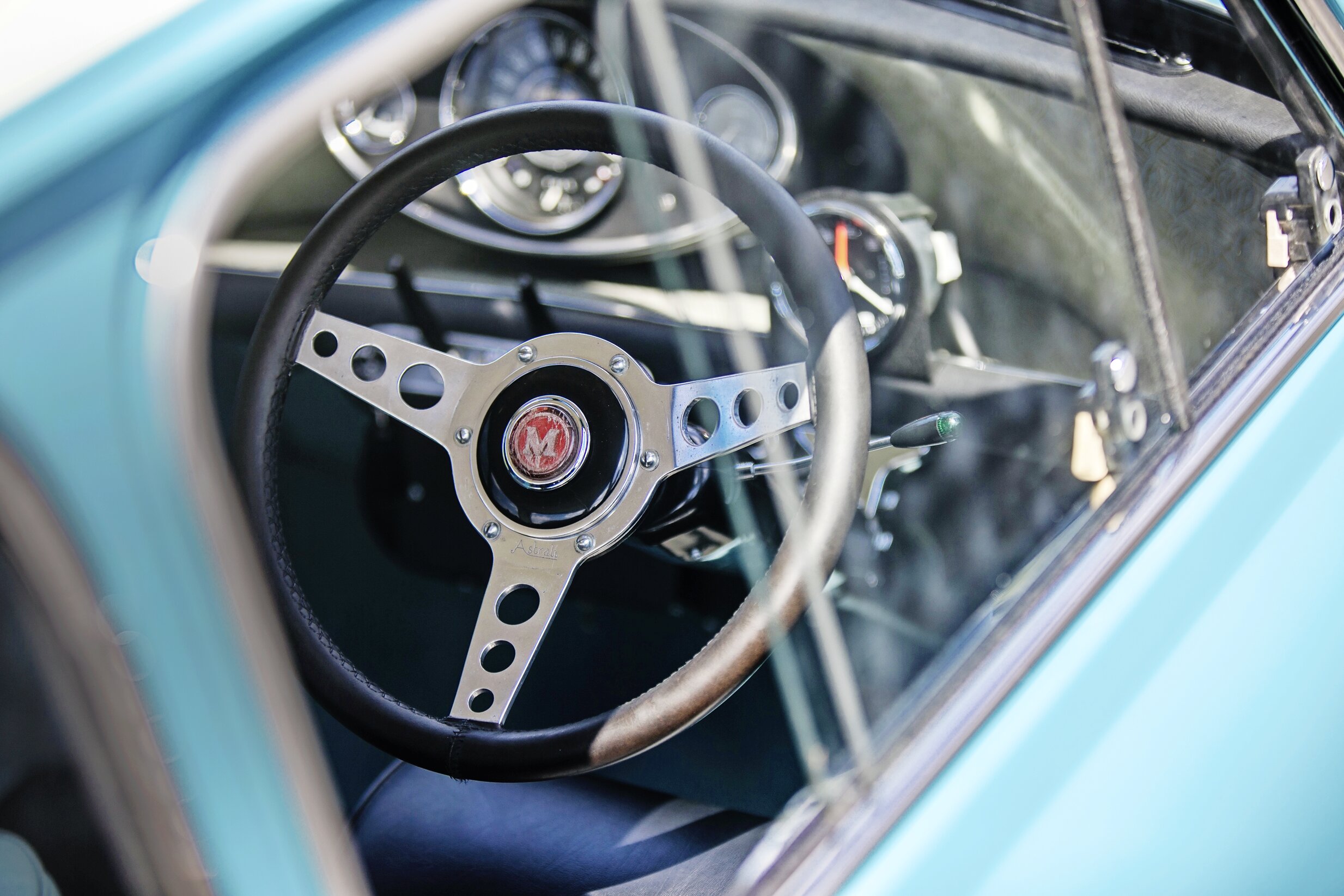
The Mini’s talkative steering makes every corner a hoot
‘I had heard about the 970S but had never appreciated what it was,’ Robert continues. ‘That homologation-special business, the way the racing versions revved to 10,000rpm… it’s a glorious piece of history, and when I saw Bryan’s, and the quality of work and detail that had gone into it, I simply had to have one.’
It’s a little jewel of a car, frisky and snorty and straining at the leash for a good time. Out on the track I won’t even attempt to emulate a John Rhodes smoking powerslide, but it’s instantly clear that the taut, grippy, micro-precise Mini feels a generation newer than any other car here. There’s no allowance needed for age (of design or actual car), no feeling of forces overwhelming a willing but old-school chassis, nor even any significant body roll.
The engine revs keenly, if not quite as sweetly as the short stroke suggests it should, and its small capacity is less of a handicap on the blast up towards Druids than I expected.
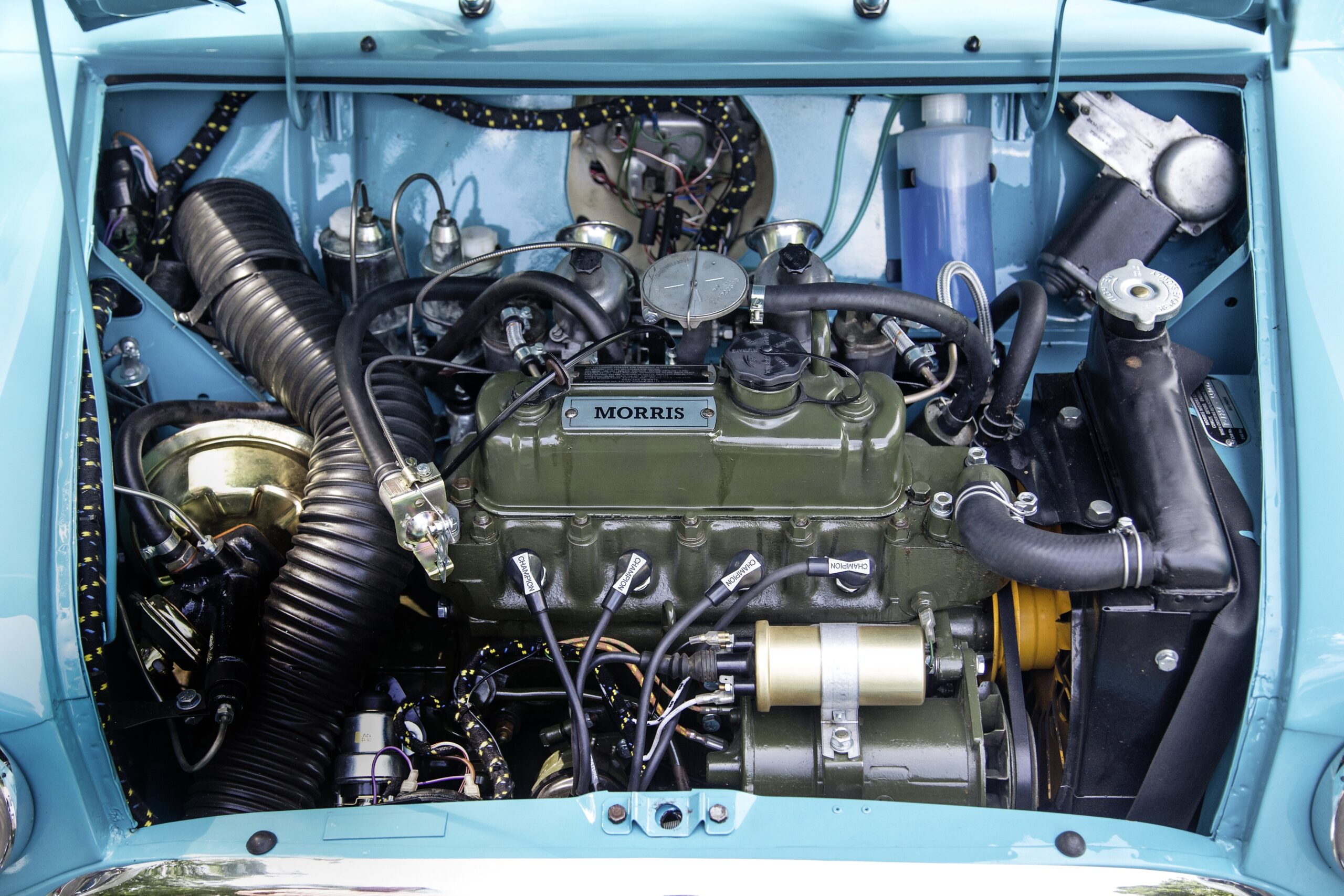
Racing versions revved to a screaming 10,000rpm
It’s a recently built engine and still a bit tight; once fully loosened it should be delightful. Despite a stiff action and a fuzzily defined gate, the gearlever finds its ratios exactly when you need them, while the stout brakes with amply sized front discs (unlike a regular Cooper’s) provide a firm, solid pedal.
Best of all, though, you simply arrive at a corner, brake, and then power through at full chat, inertia seemingly non-existent as you hang on to that little steering wheel, torque-steer similarly absent because there isn’t enough torque.
This Cooper S feels nailed to the track like… well, like a modern car. Except better, because it’s smaller and its controls talk to you more garrulously. What a complete hoot…
So, which road car makes the best fist of making you feel like a track star? Which makes the minimum compromises for that dual role, and gives you maximum fun? Not the Mustang, obviously, at least not in our test car’s form which, instead, makes it the best suited of all for a long cruise to, say, the Le Mans Classic (at which there were myriad Mustangs this year, marking the fast Ford’s 50th anniversary). Nor the Jaguar, which is too heavy and unwieldy as was the way in its era. It looks great, though. And sounds it.
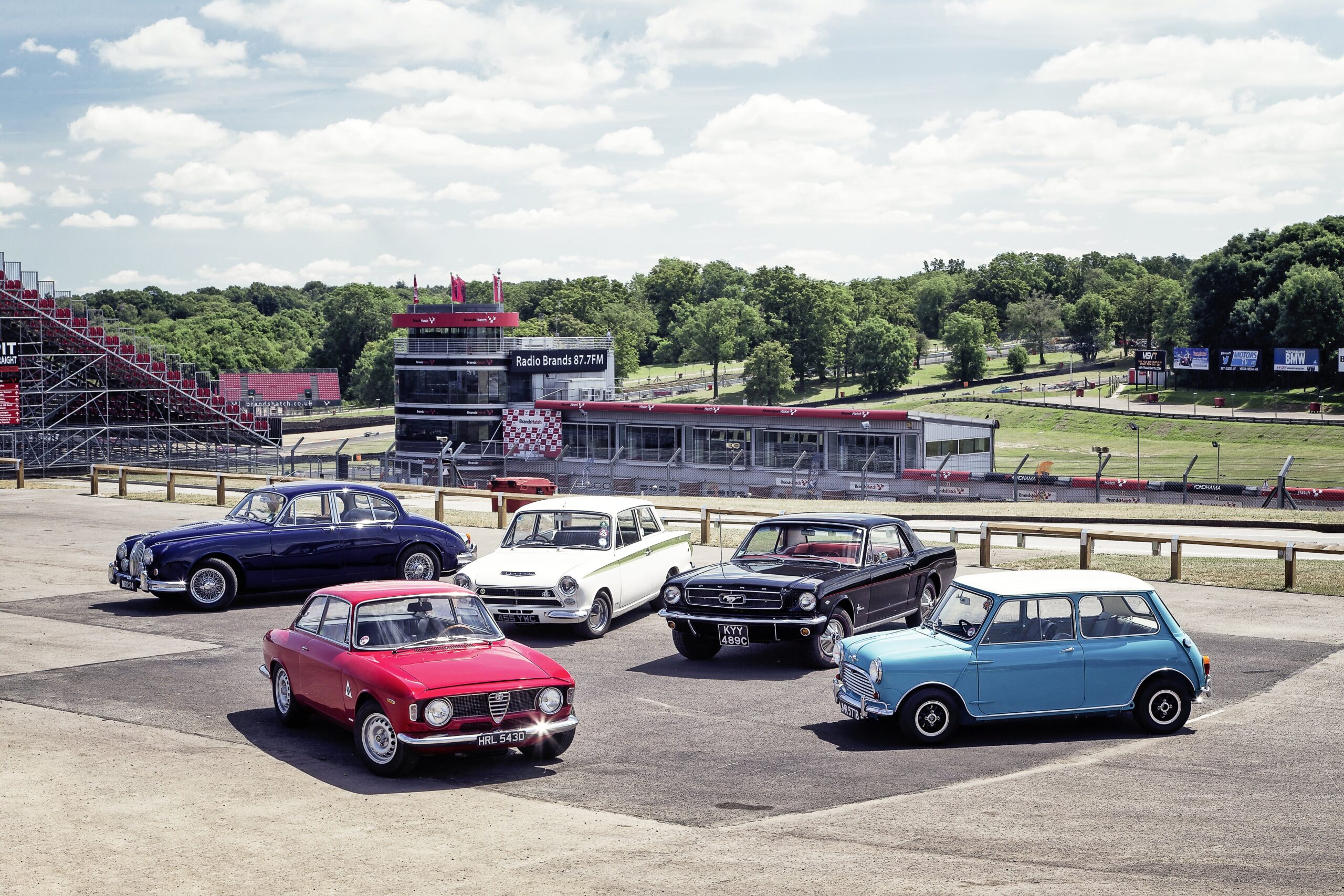
The Lotus Cortina? It and the Alfa GTA were deadly rivals on the track, but ultimately the Alfa Romeo got the upper hand – as well it should, given its rarefied state of development and the cost of getting it there. The same is true today; if you think Lotus Cortinas have become expensive, try pricing a GTA Stradale, the rarest and most valuable of all GTAs. The Cortina is great fun, but the GTA is a truly special thing with the snortiest of twin-cams and a dynamic eagerness to blow a regular 105-series GT driver right away.
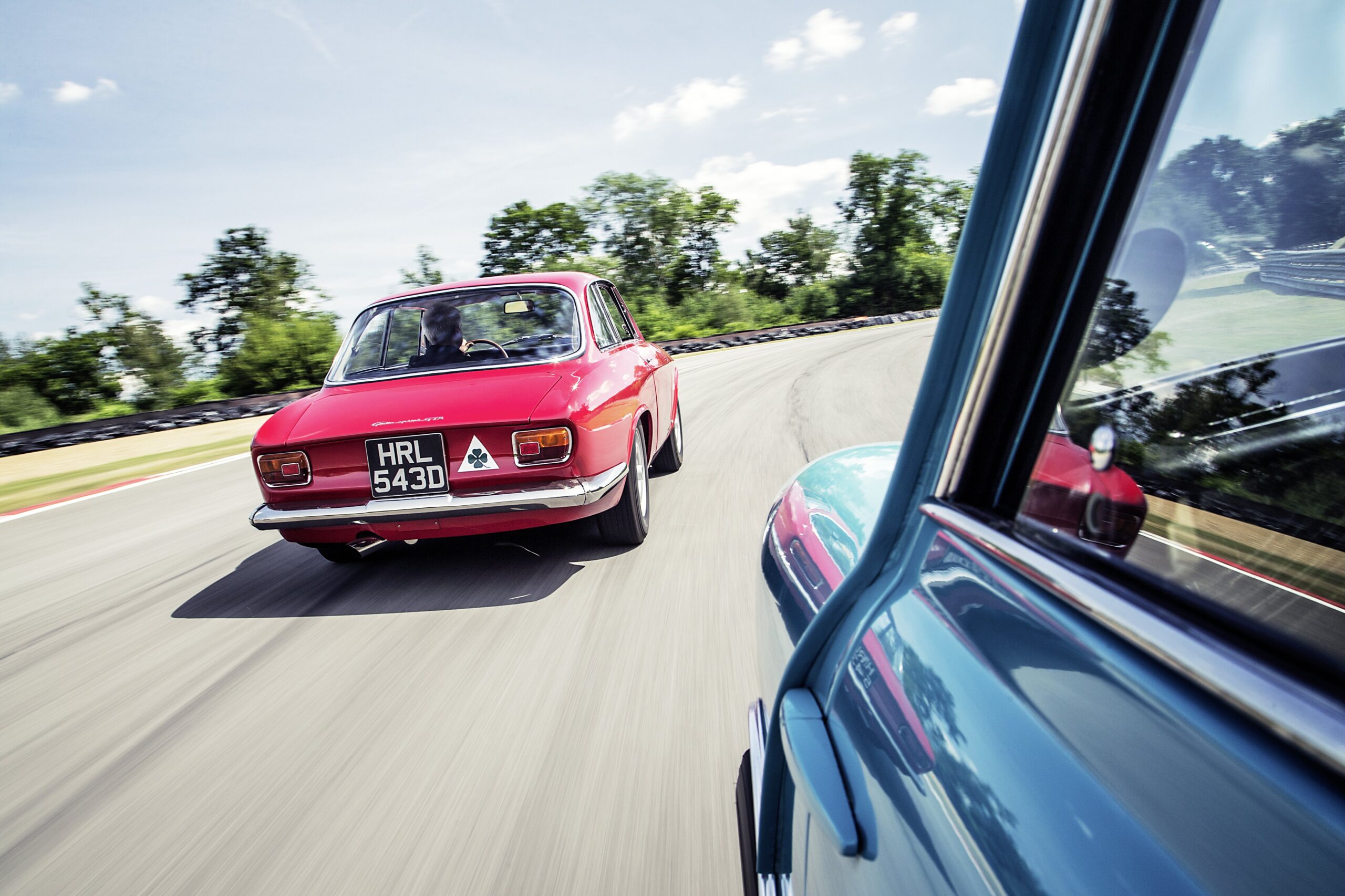
The Alfa GTA is very special – but with a very special price
‘On the track it’s in another league, the nippiest, fastest-cornering, most confidence-inspiring car here’
For the purposes of this encounter, though, the Mini-Cooper S wins. On the track it’s in another league, the nippiest, fastest-cornering, most confidence-inspiring car here. That tiny engine gives it a character different from the torquier and more numerous 1275S’s, and it’s just hilarious. Forget huge wheels and huge power; this is how a Mini should be. Messrs Banks, Rhodes, Hopkirk et al will approve, I’m sure.
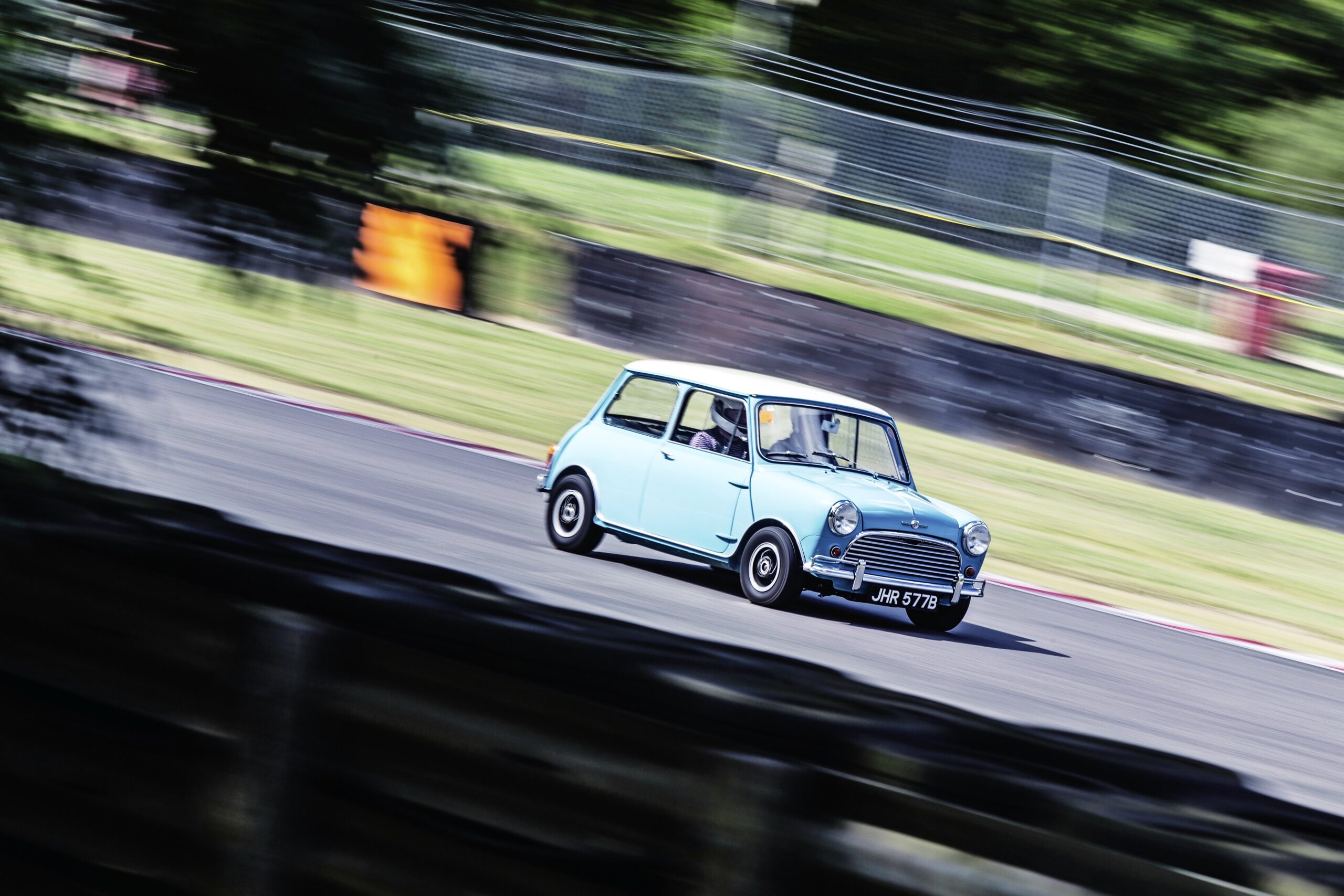
Mini offers thrills aplenty – without the Alfa’s wallet-melting cost
1965 ALFA ROMEO GIULIA SPRINT GTA
Engine 1570cc, 4cyl, dohc, 8 valves, two Weber 45 DCOE 14 carburettors. Power and torque 115bhp @ 6000rpm; 105lb ft at 3000rpm. Transmission: Five-speed gearbox, rear-wheel drive. Steering: Worm and roller steering box. Suspension: Front: coil springs, double wishbones, telescopic dampers, anti-roll bar. Rear: live axle, coil springs, trailing arms, T-shaped upper arm, telescopic dampers. Brakes: Discs all round. Weight: 795kg (1750lb). Performance: Top speed: 125mph; 0-60mph: 8.2sec. Fuel consumption: 18mpg approx. Cost new: £2897. Price range: £70k-£160k.
I RACED ONE: Rhoddy Harvey-Bailey
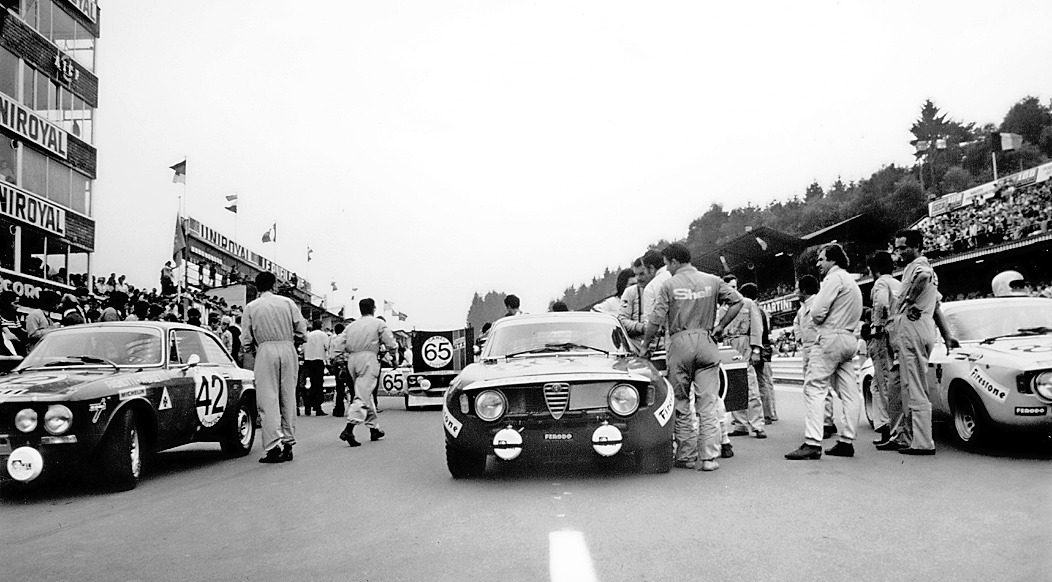
Suspension guru Harvey-Bailey – still operating independently to design suspension improvements for classic and modern cars; contact him on 07966 527853 – raced GTAs for private entrant Derek Morley in 1966 and the works Autodelta team 1967-68.
‘They were successful largely because the twin-cam Escorts hadn’t yet happened. Our problem was that we didn’t have the power – the GTA wouldn’t give much more than 160bhp because we couldn’t go over 6500rpm without the cylinder liners distorting. When we downsized to 1300cc with a solid block of liners we could use far more revs and got 165bhp.
‘In FIA races we couldn’t move the fuel tank, so it, the battery and the driver were all on the left. There’s a photograph of me at Snetterton on opposite lock with two wheels in the air. That never happened with the right-hand-drive Morley car.
‘The cars were very light – they even had aluminium floors – and they could stop very quickly. Carlo Chiti was paranoid about steering at the rear axle, so the GTA had a sliding block to hold the axle in the centre. It tended to bind, which held the car up on two wheels.
‘They steered nicely, though. The Morley car had a fair amount of roll but good traction despite that. It understeered a bit and there was never enough power to get the tail out. They won because they were well driven and kept going – and there were six or seven of them!’
1965 FORD MUSTANG CRUISE-O-MATIC
Engine 4727cc, V8, pushrod ohv, 16 valves, Autolite two-barrel carburettor. Power and torque 200bhp @ 4400rpm; 282lb ft at 2400rpm. Transmission: Three-speed automatic gearbox, rear-wheel drive. Steering: Recirculating ball steering box. Suspension: Front: double wishbones, coil springs, anti-roll bar, telescopic dampers. Rear: live axle, leaf springs, telescopic dampers. Brakes: Drums all round. Weight: 1292kg (2848lb). Performance: Top speed: 116mph; 0-60mph: 9.1sec. Fuel consumption: 16mpg approx. Cost new: £1922. Price range: £5k-£20k.
MY DAD AND I RACED ONE: Henry Mann
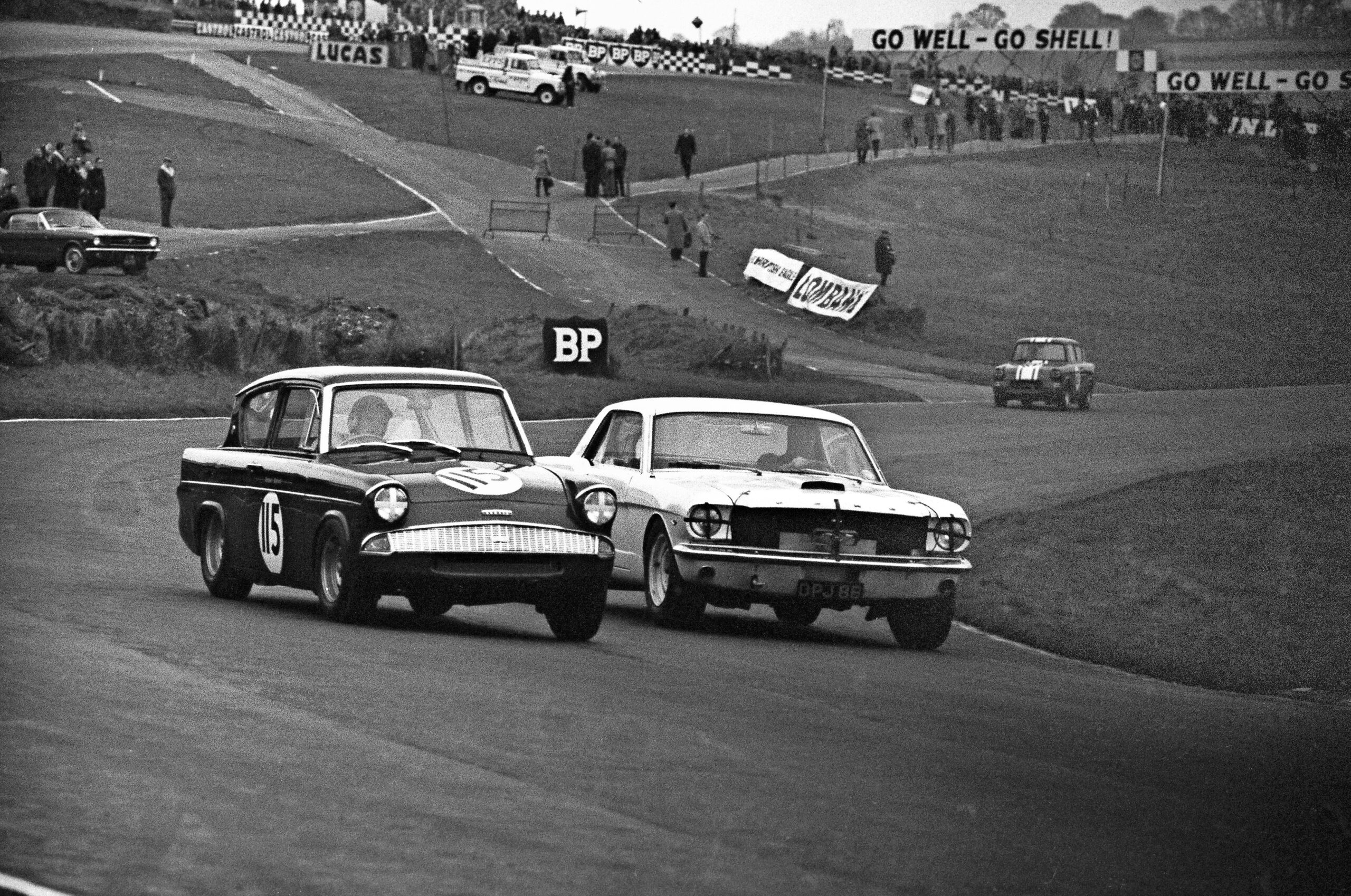
Or several, actually, but as a car-preparer and team entrant rather than a driver. Alan Mann’s team raced Mustangs as well as Cortinas, Falcons and endurance-race sports cars, and today his son Henry races a Mustang under the banner of the team that his father reincarnated in 2004, initially with Alan driving a Mustang and Henry joining in later with a Lotus Cortina.
Nowadays Henry races his own Mustang, in which – on the car’s first race outing – he and co-driver Mat Jackson won the inaugural Alan Mann Trophy race at Donington Park in 2012, held in memory of his father who had passed away earlier that year. The Mustang has given Henry a podium finish in every race it has entered apart from one, when the coil failed.
‘I prefer racing the Mustang to the Cortina, because it suits my driving style better. But the steering is very heavy, so heavy that at one meeting it was hard to apply enough effort to catch a slide, which sent me into the tyre wall. So now we’ve fitted a bigger steering wheel. The Mustang doesn’t really want to turn. You have to provoke it, make it take a set, then slide through the corner.
1959 JAGUAR MK2 3.8
Engine 3781cc, 6cyl, dohc, 12 valves, two SU HD6 carburettors. Power and torque 220bhp @ 5500rpm; 240lb ft @ 3000rpm. Transmission: Four-speed manual gearbox with overdrive, rear-wheel drive. Steering: Recirculating ball steering box. Suspension: Front: double wishbones, coil springs, telescopic dampers, anti-roll bar. Rear: live axle, cantilevered leaf springs, radius arms, Panhard rod, telescopic dampers. Brakes: Discs all round. Weight: 1525kg (3362lb). Performance: Top speed: 125mph; 0-60mph: 8.8sec. Fuel consumption: 16mpg approx. Cost new: £1779. Price range: £5k-£40k.
I RACED ONE: Jack Sears
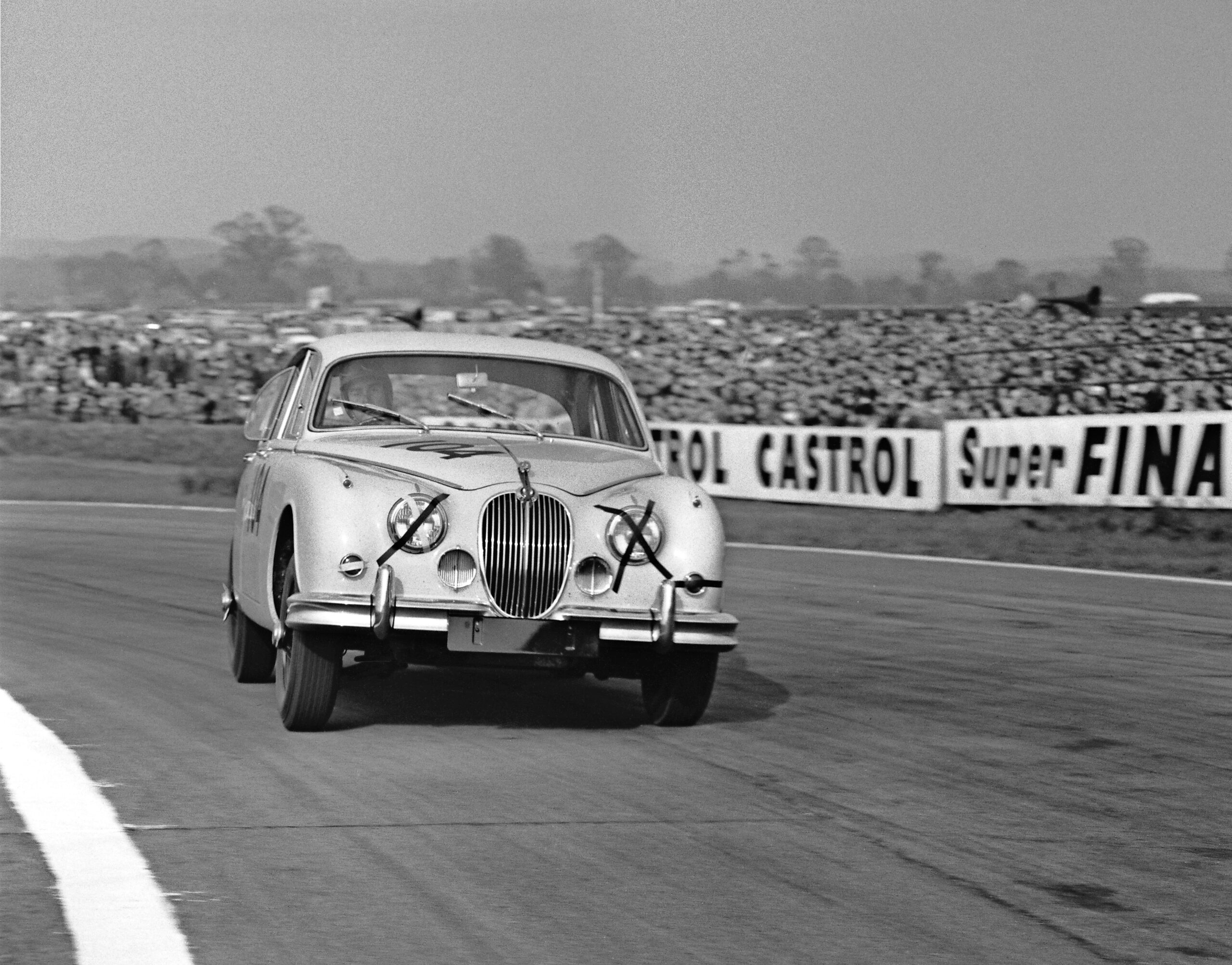
Jack won the inaugural BSCC in 1958, driving an Austin A105, then moved on to Jaguars with considerable success, driving for Tommy Sopwith’s Equipe Endeavour team in some spectacularly close racing.
‘I was lucky to be introduced to the 3.8 Mk2 by Tommy in 1959, after I’d driven his 3.4 Mk1 in a couple of races, and he invited me to be Mike Parkes’ team mate. The Mk2 had the same track width front and rear instead of the narrower rear track of the Mk1, and the extra engine size was a big help. It was an incredibly fast car for a four-seater saloon at the time. You could drive it out of the showroom, run it in a bit and do 125mph, when the average family car managed about 75mph.
‘It handled very, very well and I did some quite good races in the wet. It was easy to do four-wheel drifts; nowadays no one drifts any more, but back then if you weren’t drifting, you weren’t going fast enough.
‘Our cars had hotted-up engines with bigger SUs, but we kept the standard gearbox and overdrive. They were faster than standard, and would reach 140mph on Silverstone’s Hangar Straight.’
1963 LOTUS CORTINA
Engine 1558cc, 4cyl, dohc, 8 valves, two Weber 40 DCOE carburettors. Power and Torque 105bhp @ 5500rpm; 108lb ft at 4000rpm. Transmission: Four-speed manual gearbox, rear-wheel drive. Steering: Recirculating ball steering box. Suspension: Front: MacPherson struts, track control arms, anti-roll bar. Rear: live axle, coil-spring/damper units, radius arms and A-bracket. Brakes: Discs front, drums rear. Weight: From 826kg (1819lb). Performance: Top speed: 105mph, 0-60mph: 9.9sec. Fuel consumption: 22mpg approx. Cost new: £1100. Price range: £17k-£45k.
1964 MORRIS MINI-COOPER 970S
Engine 970cc, 4cyl, pushrod ohv, eight valves, two SU HS2 carburettors. Power and torque 65bhp @ 6500rpm; 55lb ft at 3500rpm. Transmission: Four-speed manual gearbox, front-wheel drive. Steering: Rack and pinion. Suspension: Front: upper and lower transverse arms, triangulating tie-rods, rubber cone springs, telescopic dampers. Rear: trailing arms, rubber cone springs, telescopic dampers. Brakes: Discs front, drums rear. Weight: 635kg (1399lb). Performance (est): Top speed: 95mph; 0-60mph: 12.3sec. Fuel consumption: 32mpg approx. Cost new: £693. Price range: £7k-£25k.
I RACED ONE: John Rhodes
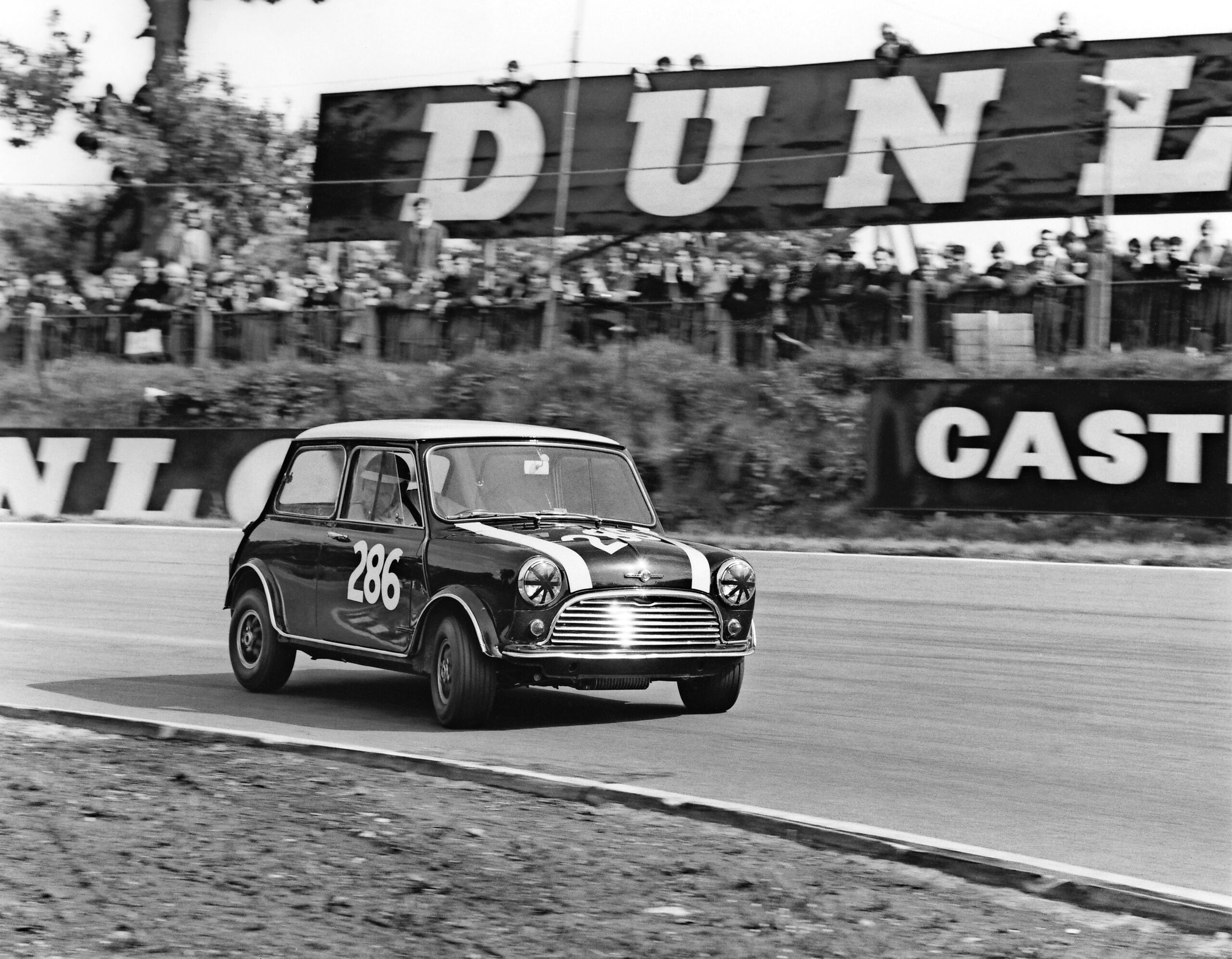
Smokin’ John Rhodes was the most spectacular of Mini racers, pitching the car into oversteer on the entry to every bend, showering onlookers with hot black particles from tyres pumped up to 55psi. From 1965 through to 1968 he and his works Cooper S were the BSCC class championship victors – but the class was the up-to-1300cc one.
‘I never raced the 970S. Sheer ego, I suppose, but I was always in the 1275. It fitted like a glove, and felt very similar to a go-kart. It would slide beautifully, under full control.
‘I preferred it when sliding, because that’s when I felt under total control. I could pass most of the faster cars in the corners. I had total confidence in it.
‘Daniel Richmond at Downton did the engines, with a 7400rpm rev limit, and even if our Minis weren’t the fastest they were the most reliable.
‘It wasn’t at its best on faster tracks such as Silverstone, though, because its aerodynamics were like a brick. So we used to get two or three of them together, Paddy Hopkirk, John Fitzpatrick and me, and run bumper-to-bumper. We’d instantly gain 10, 15, maybe 20mph; it was amazing.
‘Spa was a nice circuit to do that, with its long straights.’