
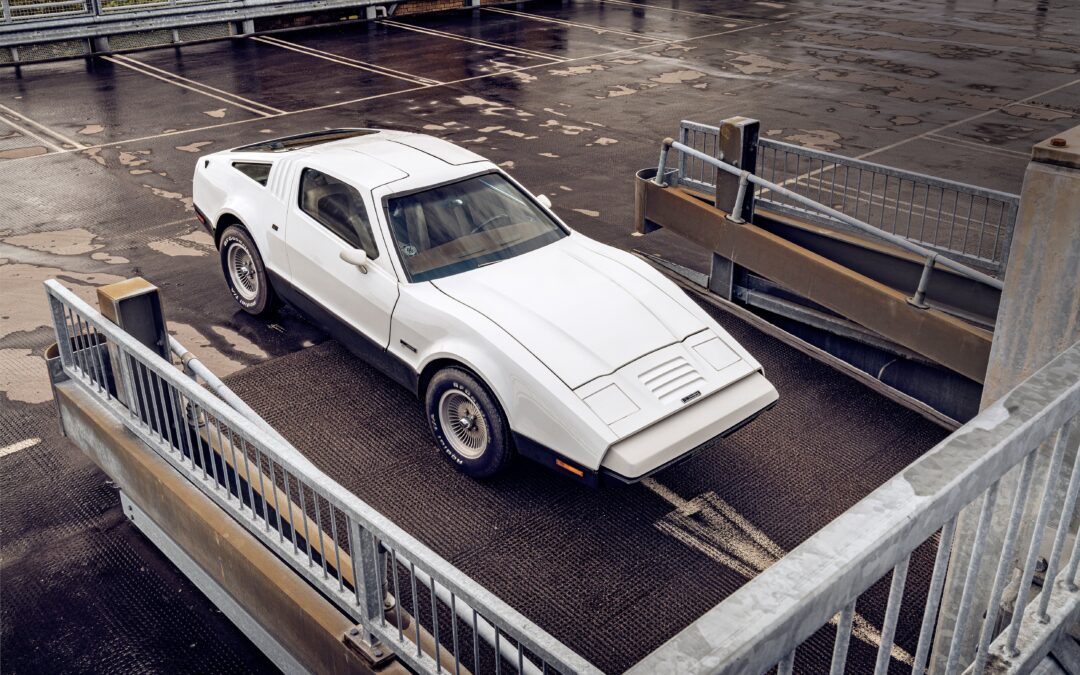
On a wing and a prayer
Malcolm Bricklin’s attempt to build a gullwing sports car was over-ambitious and ultimately unsuccessful. We drive a rare UK survivor and interview the maverick manufacturer
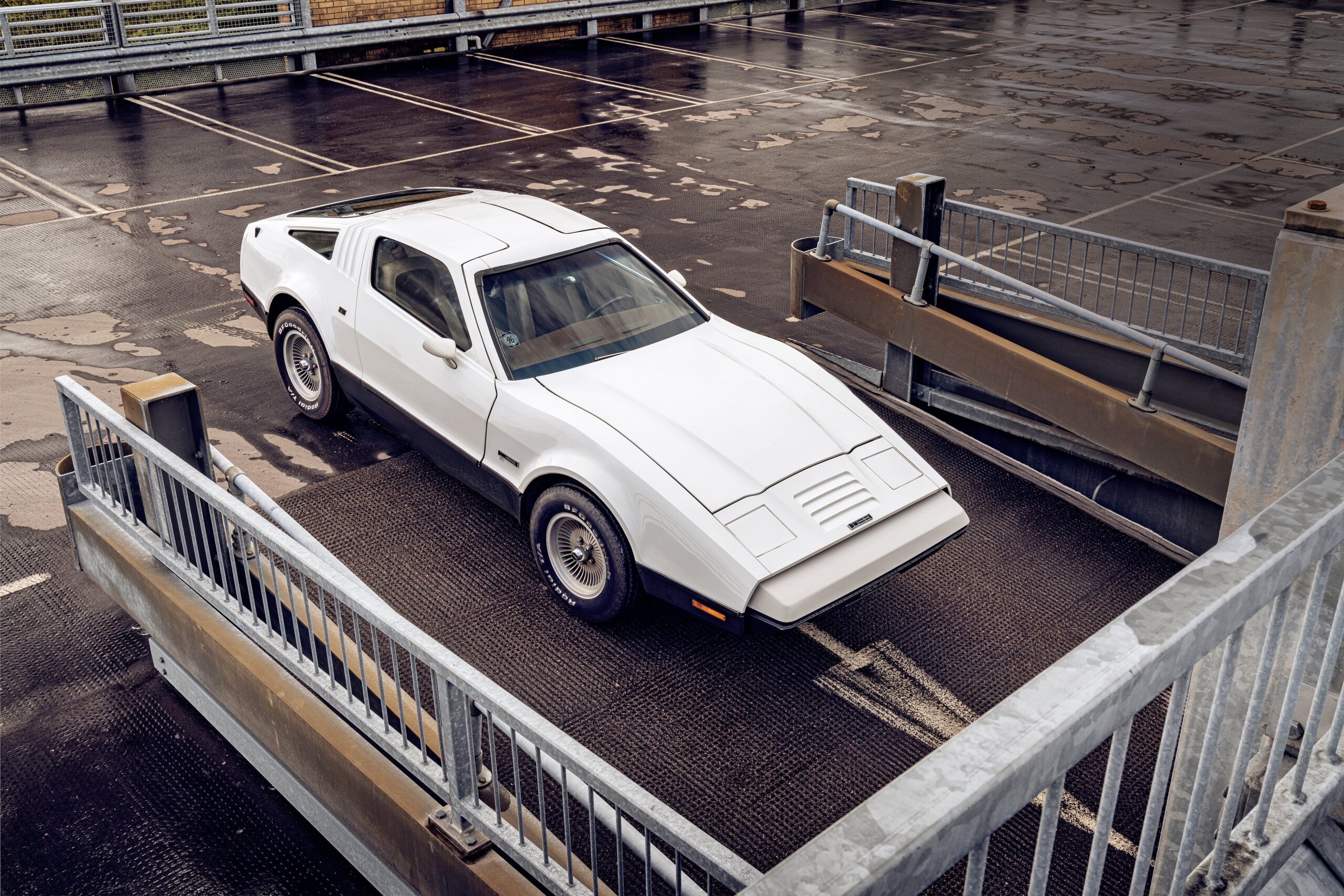
Don’t bother looking for a door handle on the Bricklin SV-1. At first there’s no obvious way to open the signature gullwing doors that curve up from the high sills and cut deeply into the roof. But look closer and there’s a small rocker switch in the rear quarter panel: hold it down, keep well back, and watch as the door swings majestically up into the air. At least, that’s the theory, but like so much of the Bricklin story the result too often fails to match up to the promise.
When Bricklin production cars started hitting the streets in late 1974, owners soon found that the hydraulic system powering the doors was frustratingly slow, and fatally flawed – if you happened to open one door while closing the other, the pump would self-destruct. An emergency release was thoughtfully provided inside the car in case of failure but the real answer was a more robust pneumatic door system that was under development as production of the SV-1 got underway. Bricklin production didn’t last long enough for the pneumatics to be introduced, but many of the 2954 SV-1s built have since had their hydraulics replaced with air. This car, believed to be the only one on the road in the UK, is one of them and when I punch the button the driver’s door hisses dramatically upwards.
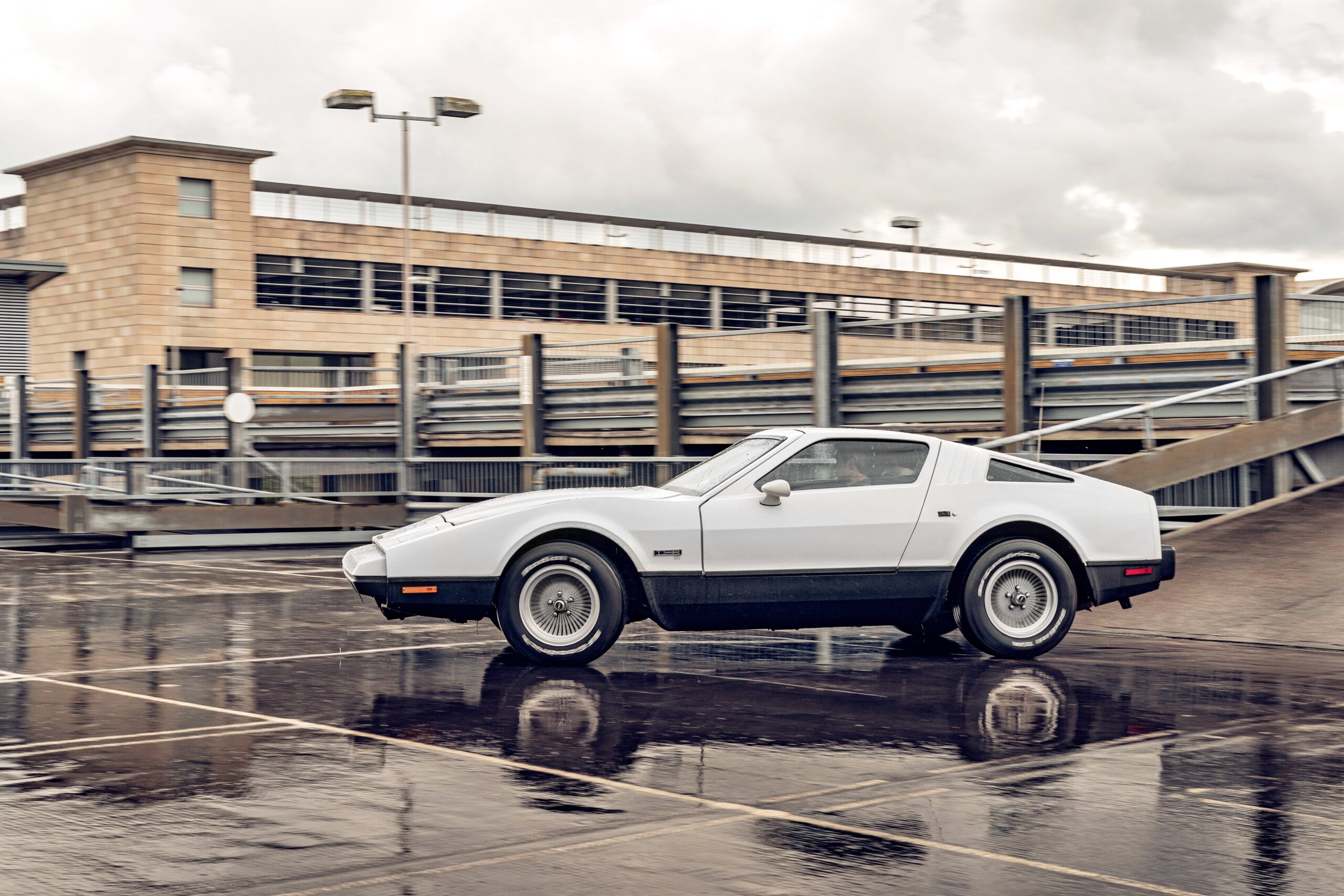
Handling was a cut above the rival Corvette
When Bricklin production cars started hitting the streets in late 1974, owners soon found that the hydraulic system powering the doors was frustratingly slow, and fatally flawed – if you happened to open one door while closing the other, the pump would self-destruct. An emergency release was thoughtfully provided inside the car in case of failure but the real answer was a more robust pneumatic door system that was under development as production of the SV-1 got underway. Bricklin production didn’t last long enough for the pneumatics to be introduced, but many of the 2954 SV-1s built have since had their hydraulics replaced with air. This car, believed to be the only one on the road in the UK, is one of them and when I punch the button the driver’s door hisses dramatically upwards.
It reveals an interior that could only have been crafted in the Seventies. There’s every conceivable shade of brown in here, from the chocolate carpets and spray-tan dashboard to the two-tone cappuccino upholstery. Elegant entry to the cabin is a skill that takes a while to acquire because it’s all too easy to clout the overhanging door with your head while navigating the broad, high sill. That accomplished I sink into a soft driver’s seat that’s faced in buttoned nylon like a Seventies sofa. The door is high up out of reach, but the comically flimsy centre console, retained by exposed Phillips-head screws, has a twin of the exterior door switch down by the driver’s elbow. It sends the door lurching downwards with a hiss and a clank, like the slam of an automatic door on a train carriage. The Bricklin’s moniker might stand for ‘Safety Vehicle 1’ but there are no modern safety interlocks here – leave an errant digit in its path and you won’t see it again.
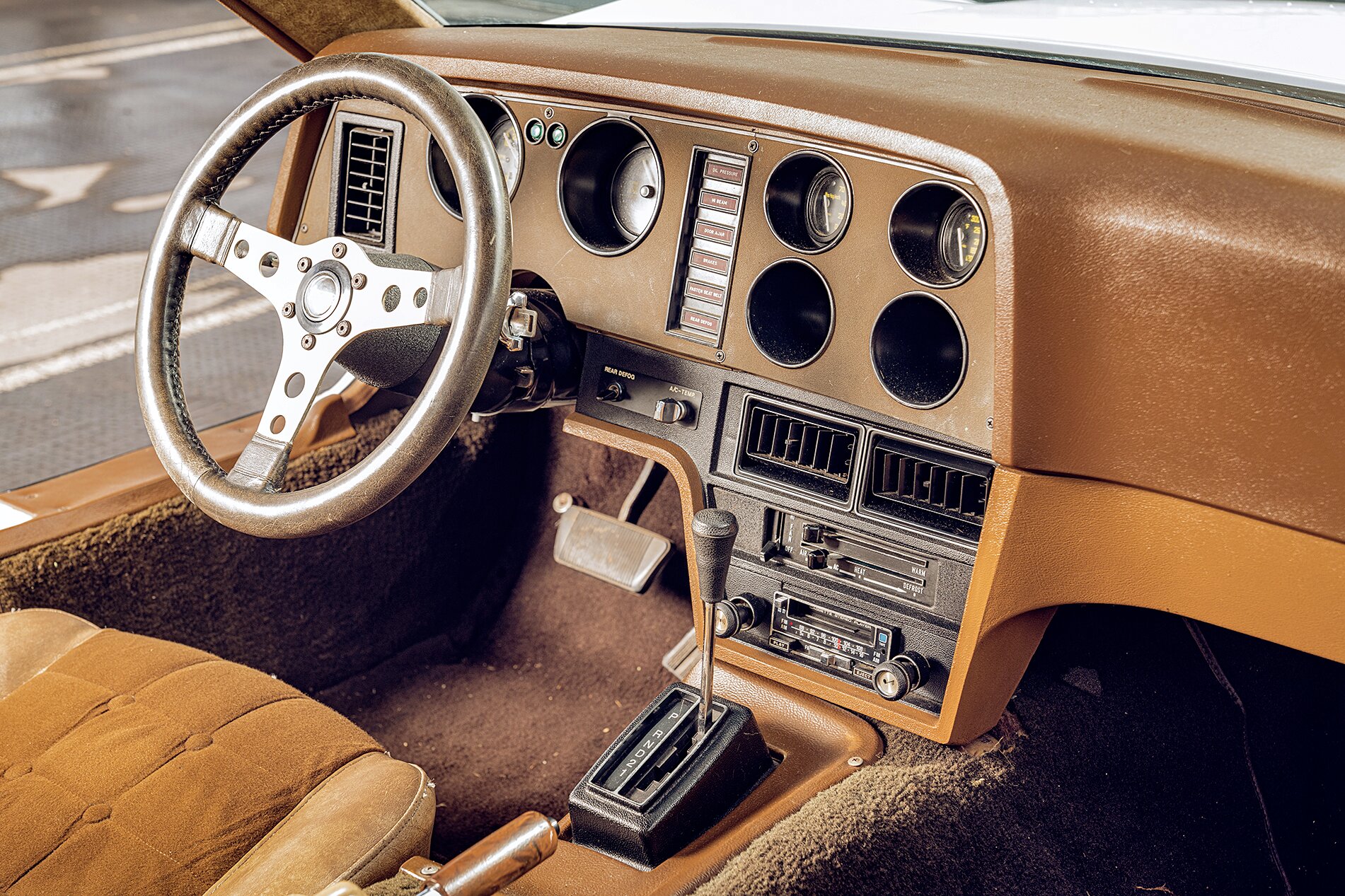
Low-rent brownon-brown interior is cramped but wheel is handsome
The cabin is narrow at the shoulders and though I’m no more than average height the top of my head is uncomfortably close to the headlining. The broad brake pedal and organ-type accelerator are closer than I’d like but the surprisingly small President steering wheel, with three drilled alloy spokes, a fat leather rim and a Bricklin ‘B’ on the boss, is ideally placed. Behind it there are black VDO instruments with yellow legends that look Ferrari-ish, with the 160mph speedo and 8000rpm tacho both mounted upside down in an effort to avoid obscuring the most useful ranges behind the wheel rim. But it doesn’t really work: anything less than 80mph and 5000rpm and you’re in the dark.
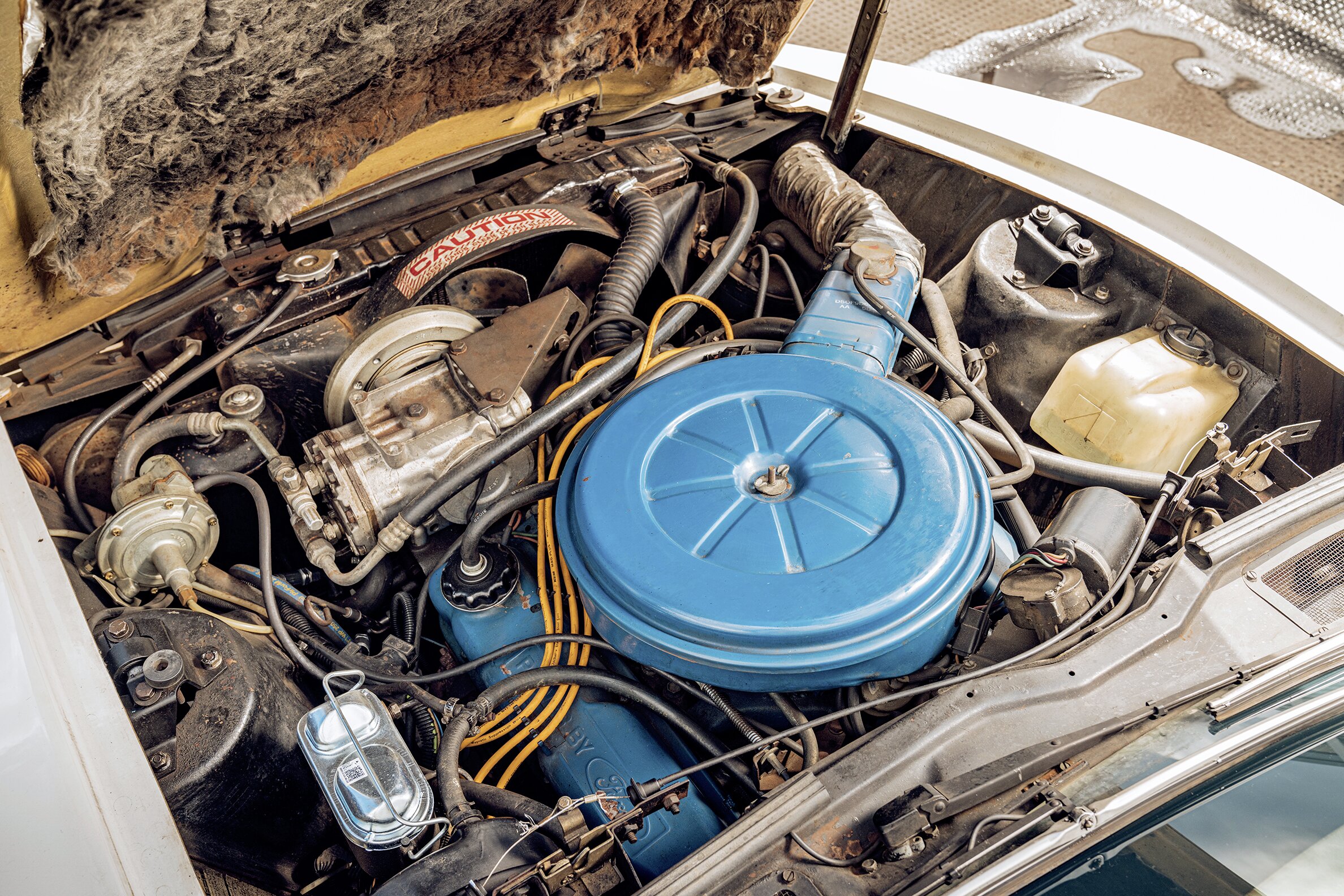
Ford Windsor V8 sounds great, but conjures just 175bhp from its 5.7 litres
The first Bricklin prototype, the ‘Gray Ghost’, was powered by a Chrysler slant-six engine and the first 770 production cars had AMC 360ci V8s, with a choice of manual or automatic gearboxes. For 1975, when this car was built, the SV-1 switched to a 351ci Ford Windsor V8, and the only transmission option was a three-speed Ford auto. The big front-mounted motor fires easily when I twist the American Motors-sourced key in the ignition, settling to a gentle burble through a transverse rear silencer box that protrudes from under the bumper, terminating in a tailpipe on each side. With a twin-choke carburettor the V8 is tuned for torque, so there’s plenty of mid-range urge available, but it tails off towards the 6250rpm redline. Holding second gear manually intensifies the open-throttle cackle of the V8, but performance gains are negligible.
Acceleration is brisk rather than genuinely thrilling. The SV-1 could run a standing quarter mile in 16.6 seconds, about as fast as a US-spec Porsche 911 and half a second shy of its biggest rival, the Chevrolet Corvette. That the Bricklin could almost keep up with the Corvette was not as great an achievement as it may have sounded – by 1975 Chevrolet’s sports car was a shadow of what it had once been, with the big-block engine options dropped and the base 5.7-litre small block offering only 165bhp.
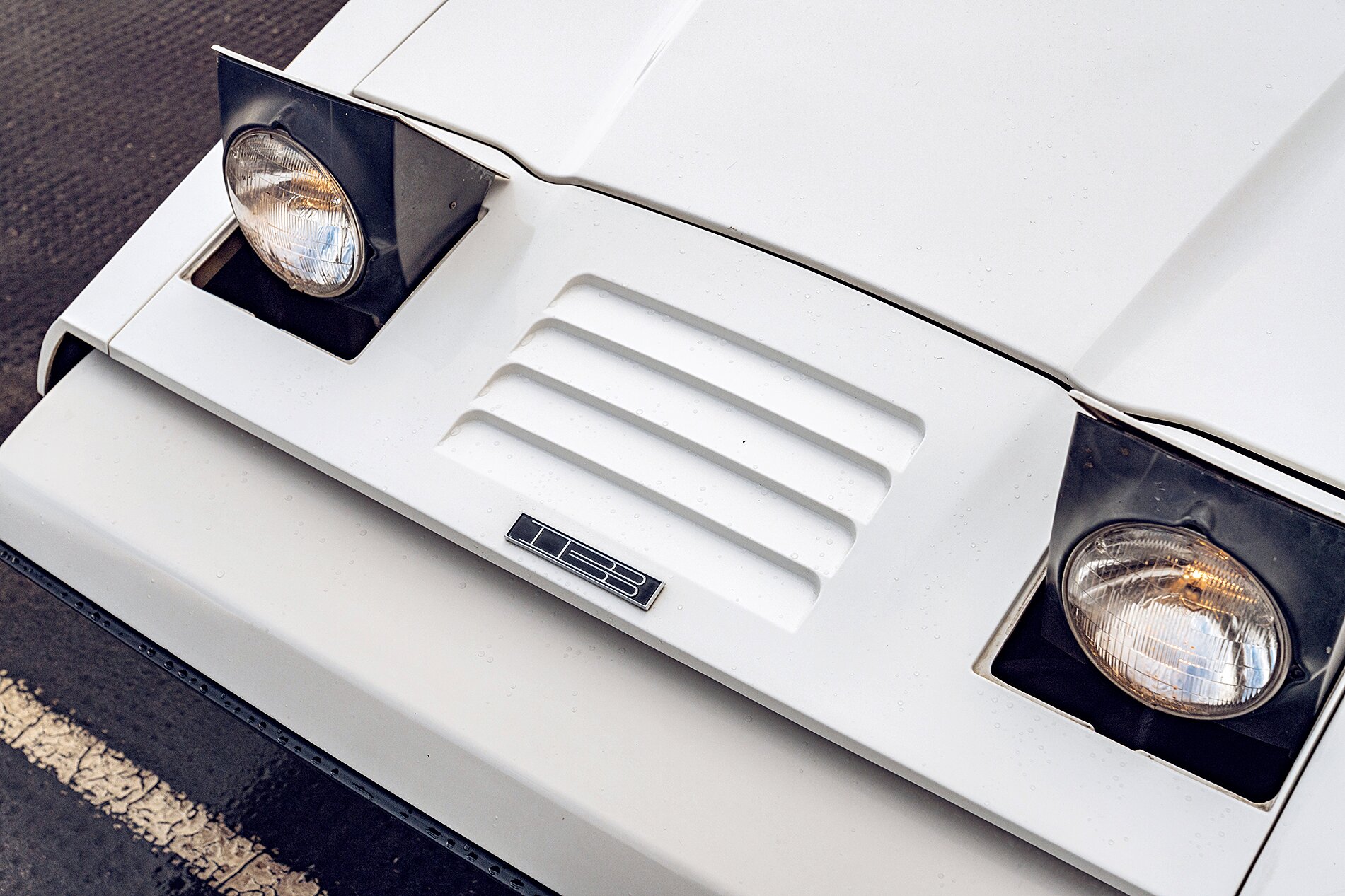
Pop-up head lights essential for Seventies sports car cred
In the corners it was a different story. Car and Driver, comparing the Bricklin and Corvette back to back, found that the SV-1 was more stable and could be hustled along a twisty road more effectively than the sometimes wayward Chevy. The SV-1 makes good use of reworked AMC Hornet suspension, with coil springs and wishbones up front and a leaf-sprung live axle at the back. Soft springs and supple damping deliver a pliant ride that would have isolated occupants from the sunken manhole covers and cracked concrete of American city pavement, yet the Bricklin darts into corners with little roll and remains predictable thanks to a well-located rear axle. But with all that torque on tap it’s all too easy to get the fat rear tyres to spin up on the exit of a tight corner.
‘It darts into corners with little roll and remains predictable thanks to a well-located rear axle’
The power-assisted steering is lower geared than ideal in a sports car, but pleasantly light to the touch. It would make the Bricklin an easy car to live with day-to-day, if the thing wasn’t so infernally difficult to see out of. A hefty steel cage around the passenger compartment gave the strength necessary to live up to Bricklin’s safety mantra, and to take the roof-level loads imposed by the gullwing doors, but the result is fat A-pillars that obstruct the view to left and right. Tiny triangular windows provide only a scant view over the shoulder, so angled junctions are a nightmare. There’s a vast rear-view mirror, but there’s little to see in it because of the slot-like view through the rear window. Worse still, none of the nose is visible beyond the peaks of the front wings because they curve over the top of the front tyres, which means there’s plenty of front-end overhang that’s completely hidden from the driver’s view. At least the high beltline and shallow side windows, while adding to the general feeling of claustrophobia, do nothing further to restrict the view out.
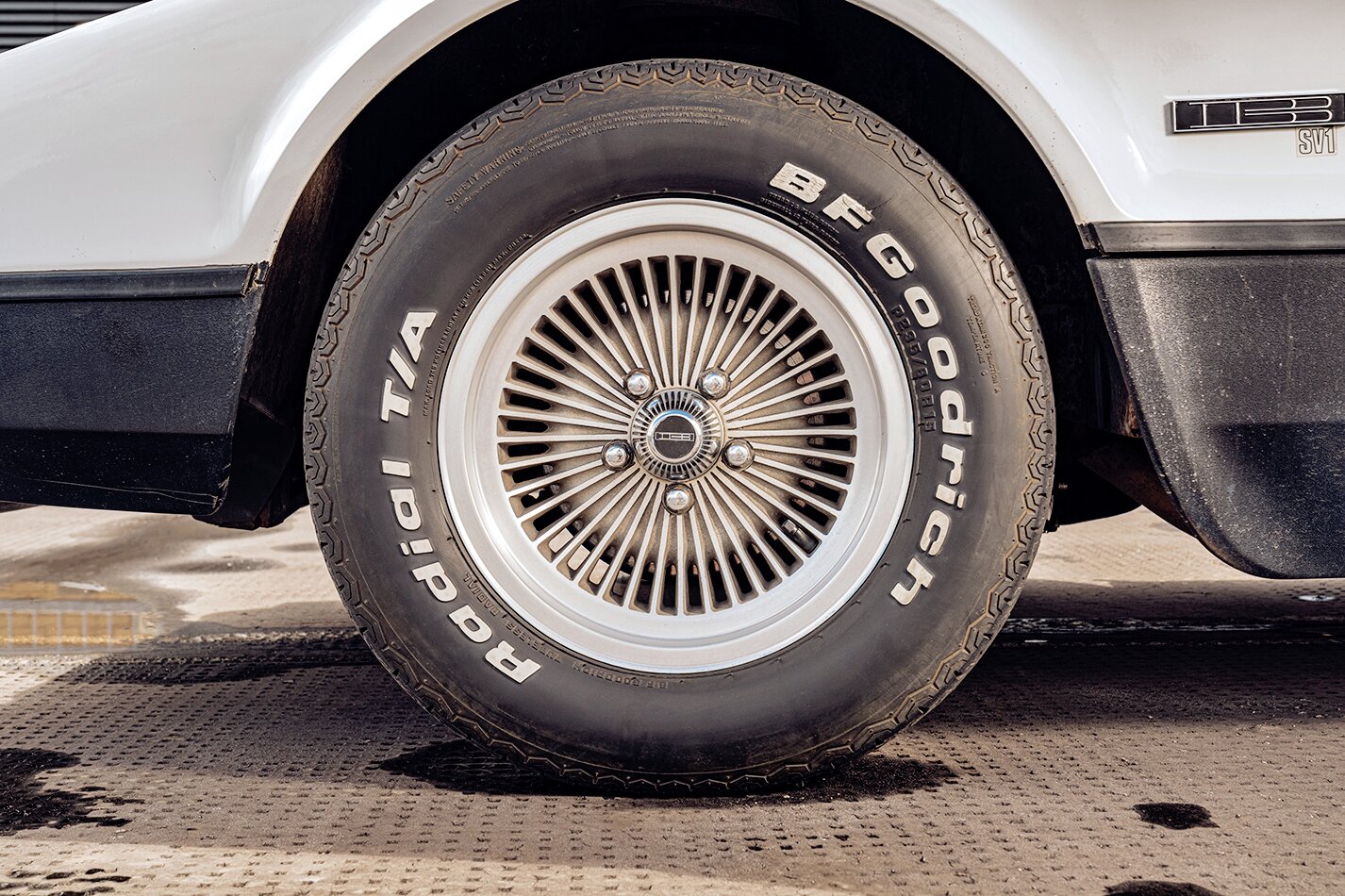
Fat Goodrich radials, but wheelspin is still a threat
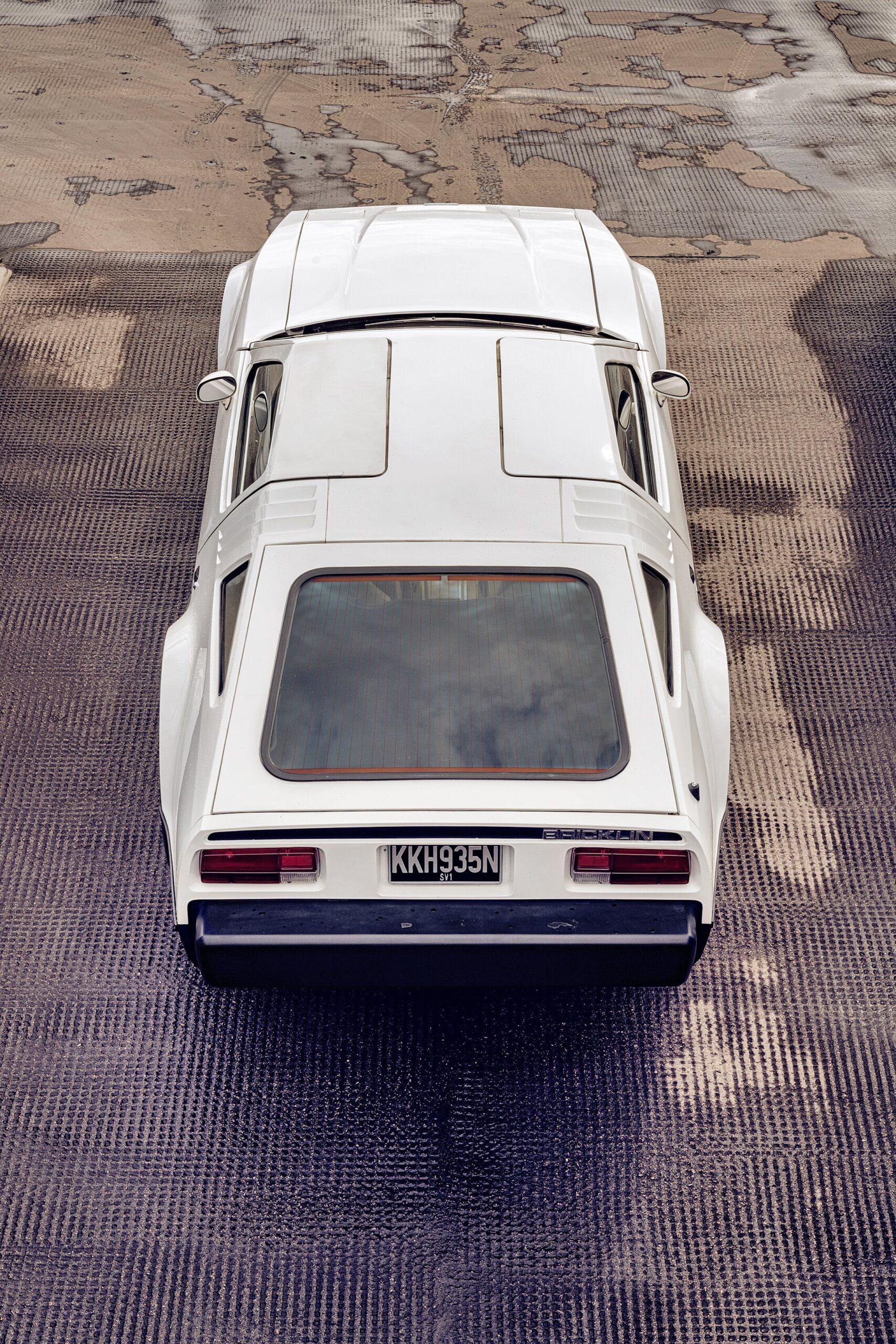
The acrylic body was innovative but ultimately proved troublesome
Beyond the gullwing doors and the safety ethos there were bumpers that could withstand a 10mph impact with no damage, and an innovative body made from blow-moulded acrylic with a glassfibre internal reinforcement. Bricklin built the world’s largest blow-moulding machine to shape the panels, before the glassfibre was bonded on. Hot-weather testing in Arizona made the acrylic outer panels separate from the glassfibre, so Bricklin’s team had to develop a new bonding technique. The acrylic skin was self-coloured, which suited Bricklin because he couldn’t afford to build a paint facility. Five colours were available: Safety White, a bright Safety Green, Safety Suntan (brown), Safety Orange (yellowish) and Safety Red (orange, confusingly). Bricklin had simply ordered acrylic sheet in all five colours the supplier had available.
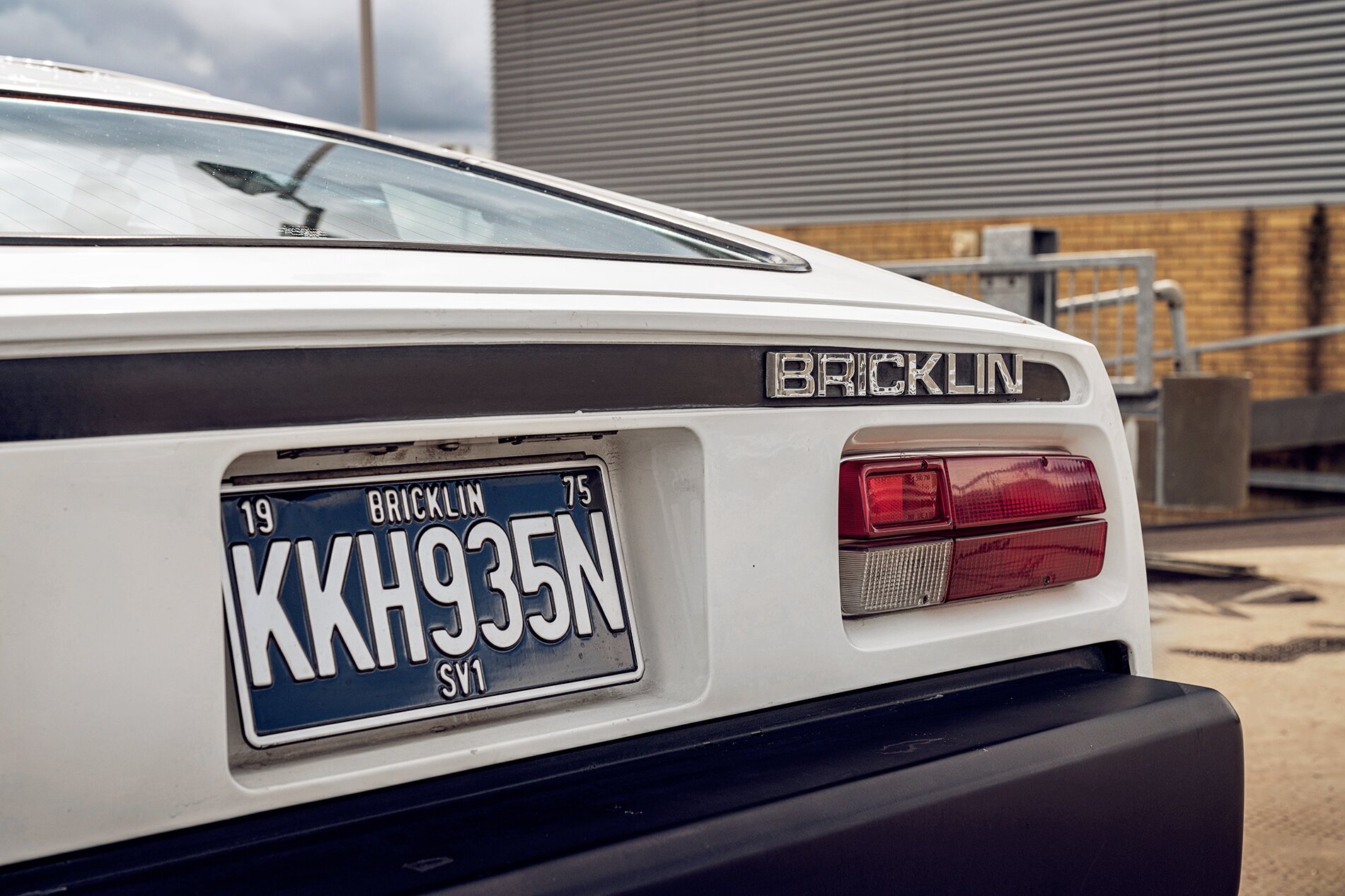
AMC and Ford parts abound – tail lights are De Tomaso Pantera
After a high-profile launch, tens of thousands of orders flooded in. That was despite the price ballooning from less than $5000, where the Bricklin would’ve been a Datsun 260Z or Triumph TR7 rival, to $9450 by 1975. That made it $1000 more expensive than a similarly-specced Corvette, and roughly the same as a V12 Jaguar E-type with an end-of-life forecourt discount.
Plenty were prepared to pay the price though. There was talk of secondhand Bricklins being sold on to eager buyers for $1000 over list. But there were production problems at the two Bricklin factories, set up in New Brunswick, Canada, with an injection of capital from a state government keen to attract industry. At the body plant in Minto, 100 miles north of the final assembly plant at St John, trimming of the innovative acrylic/glassfibre composite panels was being done by hand because the planned automated system had not yet been developed. Errors caused costly waste and delays. The complex-shaped doors often didn’t fit well and rattled on their hinges as the car was going along. The car, and the factories that made it, needed more investment of time and money to get the product and the production process right. Bricklin had achieved an enormous amount in just two years and on a total outlay of around $30 million, but to be a complete and credible package much more was needed. And that never came.
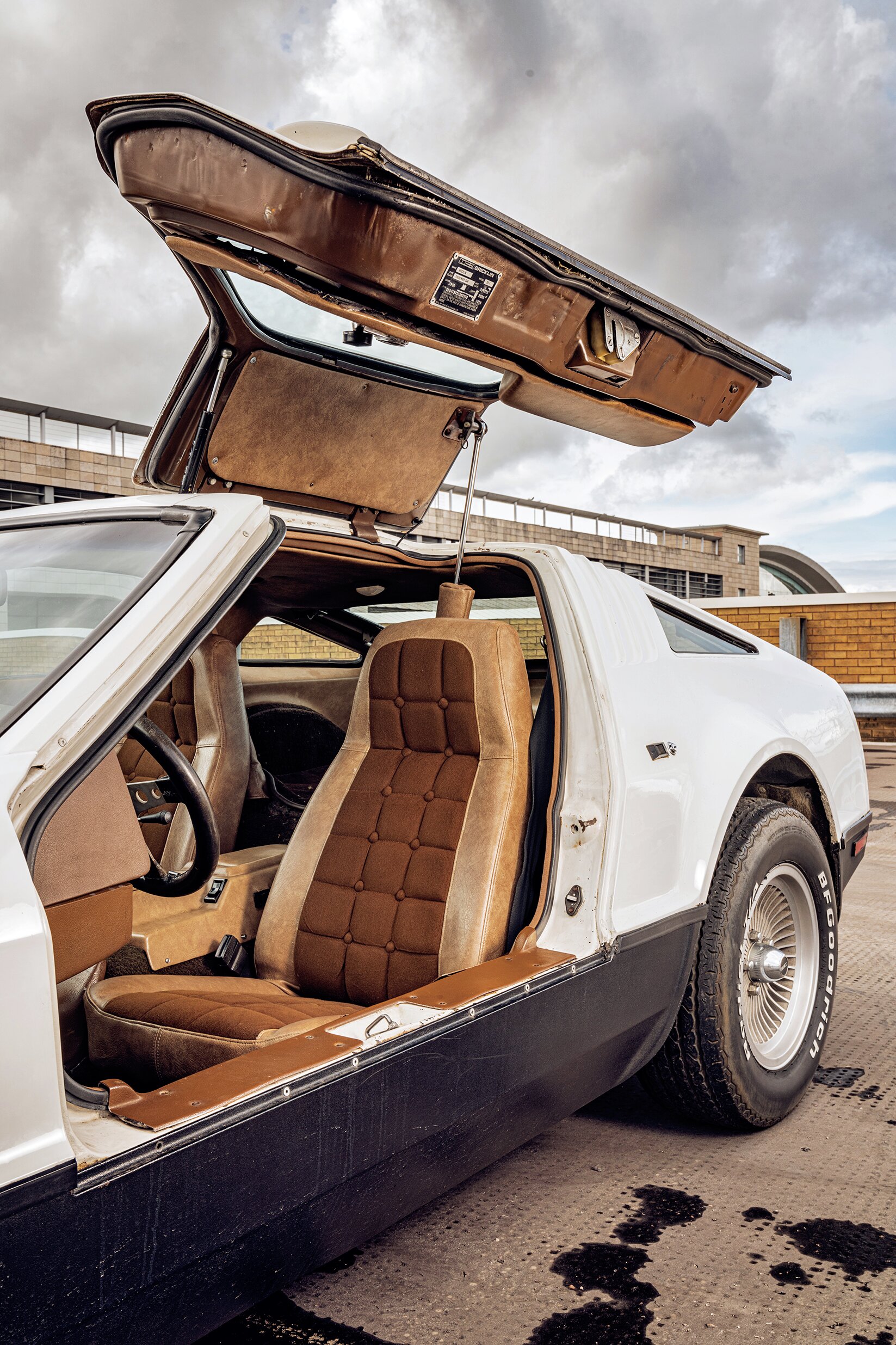
Doors proved a headache; potentially lethal
Instead the state of New Brunswick lost patience with the project and pulled the plug in 1975 before production reached 3000 cars, despite Bricklin having a full order book that would have kept the Minto and St John factories busy for years to come. The car itself has so much about it that is obviously wrong or frustratingly inadequate that it’s easy to overlook just how much of it was so nearly brilliant, despite its lack of time and funding. It’s a flawed, but fascinating, monument to the great showman behind it.
1975 Bricklin SV- 1
Engine 5752cc V8, ohv, Motorcraft twin-choke carb
Power and torque 175bhp @ 3800rpm; 284lb ft @ 2200rpm
Transmission Three-speed auto, rear-wheel drive
Steering Recirculating ball, power-assisted
Suspension Front: independent, wishbones, coil springs, telescopic dampers, anti-roll bar; Rear: live axle, leaf springs, trailing links, telescopic dampers
Brakes Discs, servo-assisted
Weight 1615kg (3560lb)
Performance 0-62mph: 8.3sec; Top speed: 118mph
Fuel consumption 19.2mpg
Cost new $9780 (c. £4350)
Price £32,50