
Mojo
Presents
Same As It Ever Was
Forty years since its emergence, Talking Heads’ Remain In Light stands on a pinnacle of art-pop perfection. Sadly, the fault lines between its creators are just as lasting. As drummer Chris Frantz unleashes his memoir, he pulls no punches on his differences with David Byrne, while bandmates tell the tale of 21st Century music’s biggest influence through its rifts and its gifts. “It was such a great, groovy, funky, joyful band,” discovers Tom Doyle.
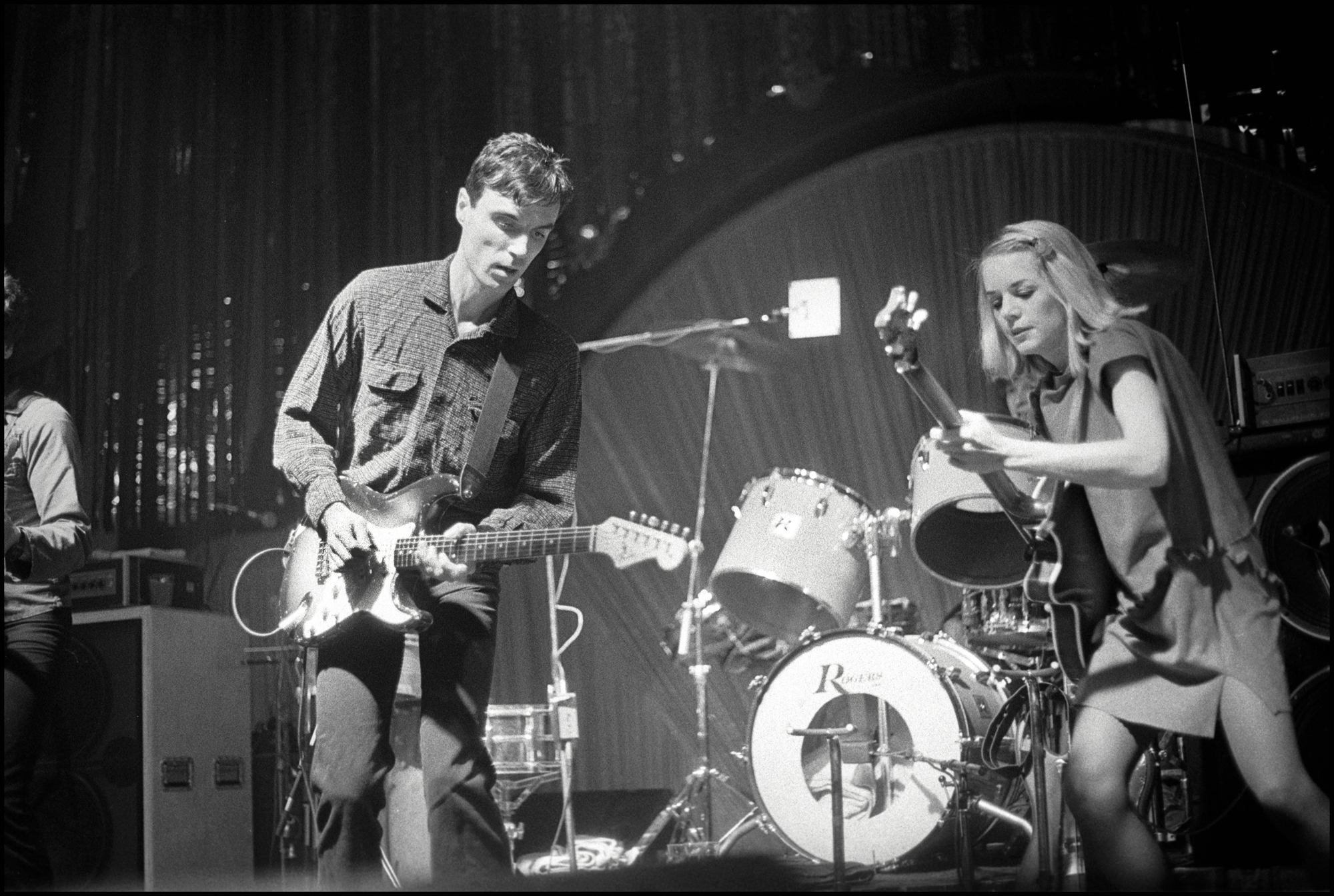
Once In A Lifetime: Talking Heads’ David Byrne and Tina Weymouth at Hammersmith Palais, London December 1 1980.
Rome, December 17, 1980. Like a cinema screen slowly stretching out ahead of the main feature, Talking Heads are expanding in real time. In front of 11,500 fans at the PalaEUR arena, the core four-piece band are adding members as their set progresses, until their number swells to nine. By the climax of the show, they have morphed into a multi-legged groove machine pummelling the fervent Italian crowd with manic, polyrhythmic art-funk.
It’s a group-inflating trick that Talking Heads will be seen to repeat four years later in their landmark concert movie, Stop Making Sense. But on this night of the Remain In Light tour, captured on celluloid by Italian state broadcaster RAI and uploaded to YouTube in 2011, it is presented in thrilling prototype.
“It was such a great, groovy, funky, joyful band,” remembers guitarist Adrian Belew, then fresh into Talking Heads from David Bowie’s Low/“Heroes” world tour. “You can tell that I enjoyed every second onstage playing. I’m so happy being there, I’m just bouncing around.”
For Talking Heads drummer Chris Frantz, watching the film moved him to open his forthcoming memoir, Remain In Love, with his recollections of the Rome gig. “I mean, there were so many peaks to choose from,” he says. “But I began the book with that particular gig because I had watched the video on YouTube and I thought, ‘Damn, man, ain’t that some shit?’”
In 1980, Talking Heads’ position as the world’s pre-eminent art rock band was already well-established. The foursome – geeky, arresting singer David Byrne, elastically inventive bassist Tina Weymouth, relentlessly driving beatsmaster Chris Frantz and the fluidly guitar-to-keys-hopping Jerry Harrison – had already travelled far from their jerky, melodic debut, Talking Heads ’77, whilst maintaining a utilitarian look and attitude that suggested a blithe ignorance of trad rock cliché. Dabbling in African influences on I Zimbra, the hypnotically funky opener of their third album, 1979’s Fear Of Music, had led the band to Remain In Light, with its harmonically minimalist songs built up, layer by layer, like abstract expressionist paintings. Rightly lauded as truly original upon its release, it sounds as thrillingly unique today, 40 years on.
At the dawn of the ’80s, however, Talking Heads’ seemingly united front was misleading. Ahead of Remain In Light, singer David Byrne – compellingly edgy onstage; similarly awkward, allege his bandmates, in day-to-day life – had threatened to quit the group. Friction was particularly marked between himself and Tina Weymouth.
Belew claims that on the Italian leg of the Remain In Light tour, “Tina was so upset that she actually approached me and said, ‘Would you take David’s place in the band?’ I said, ‘No.’ Because I knew that was the wrong thing to do. And I knew that she was just angry. It wasn’t a thing that she really meant.”
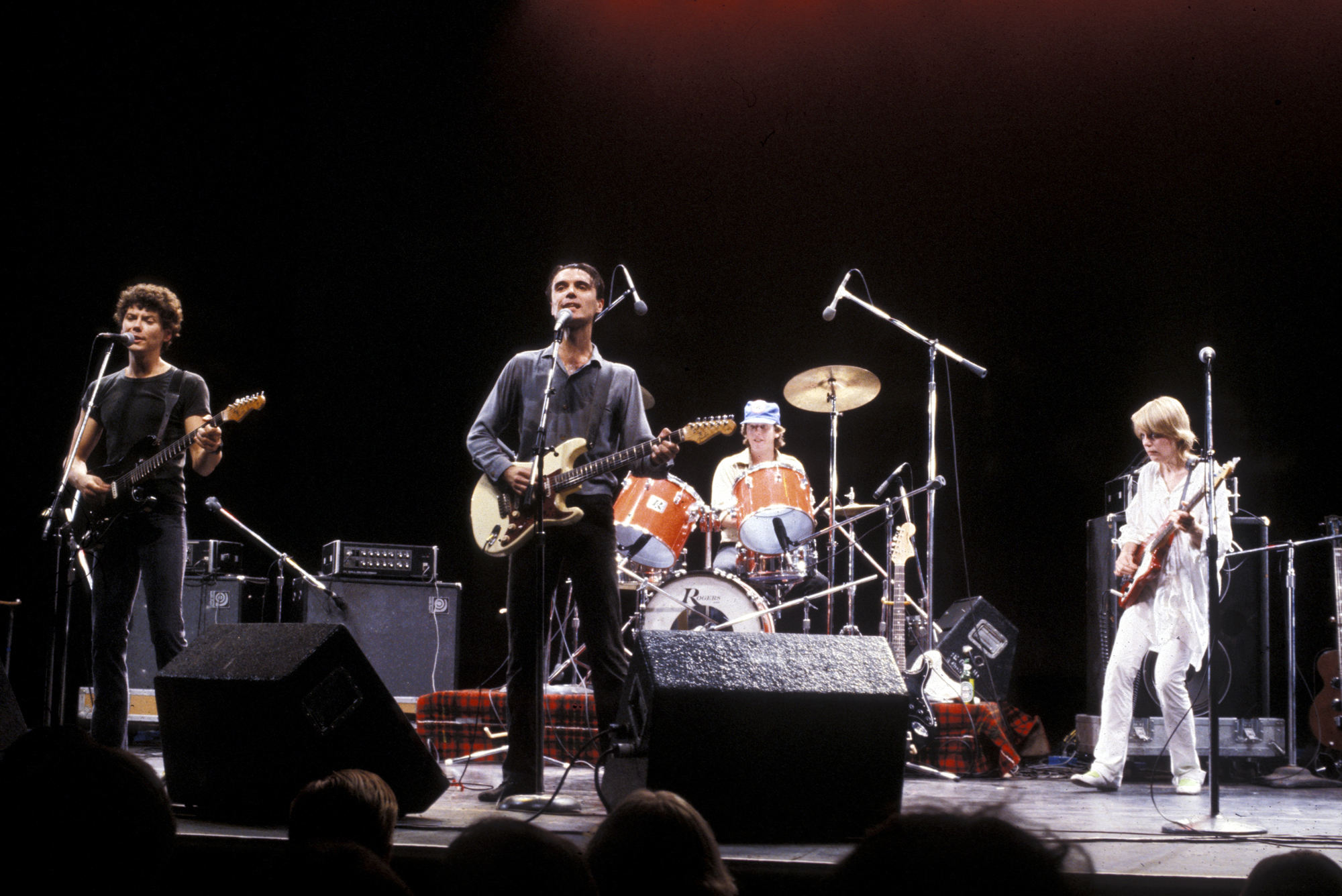
Burning Down The House: (l-r) Jerry Harrison, David Byrne, Chris Frantz and Tina Weymouth
Today, Weymouth refutes that story, insisting that she’d been sounding Belew out with a view to joining Weymouth and Frantz’s gestating spin-off band, Tom Tom Club. “Y’know, it’s very easy for people to misunderstand things,” she reasons to MOJO. “He could see that David was mistreating me a lot. But who gave me the power to replace David Byrne? I had zero power to do that. And why would I?”
Moreover, she says, the expanded onstage group had actually been designed to sustain Byrne’s interest in Talking Heads: “A lot of it had to do with, ‘Let’s see how we can tempt David back into the band.’ David was always leaving the band.”
“It seemed like if we kept the band together, we were gonna really make our mark in music history,” agrees Frantz. “That was a good reason to keep going, despite some of David’s, shall we say, lack of humanity (laughs). We carried on nevertheless because we knew we had a fucking good band.”
“It seemed like if we kept the band together, we were gonna really make our mark in music history.”
Chris Frantz
The subsequently super-chatty Frantz, a drummer since his Pittsburgh youth, asked Weymouth if she would consider starting a band with him. Her response: “No.” “I think she felt that rock’n’roll was sort of a guy’s thing,” says Frantz, “that it was a boys’ club.”
“Rock’n’roll was all about decadence and men,” Weymouth agrees. “Men getting really sloppy and dirty and drinking and drugging too much. It was impossible that I could fit into that. I was a tomboy, but I wasn’t a man.”
Frantz and Weymouth were both from military families (Frantz’s was a two-star army general, Weymouth’s a Vice Admiral) and found themselves in an unusual position on the anti-war student scene of the early ‘70s.
“Tina and I went to anti-Vietnam War protest marches, which my parents were not too crazy about,” says the drummer. “Y’know, my parents were very conservative. Tina’s on the other hand were very progressive, despite being in the military. We were opposed to the war in Vietnam. We just weren’t opposed to every single soldier.”
Bucking his family’s hopes for a lawyer or doctor, Frantz was instead drawn to art, music and the counterculture. Showing true (if slightly demented) dedication to drug experimentation, he’d sometimes set his alarm clock in the mornings so that he could drop acid, go back to sleep and then wake up tripping for class. “The challenge in a situation like that,” he recalls with a chuckle, “was maintaining your composure and not acting like you were tripping.”
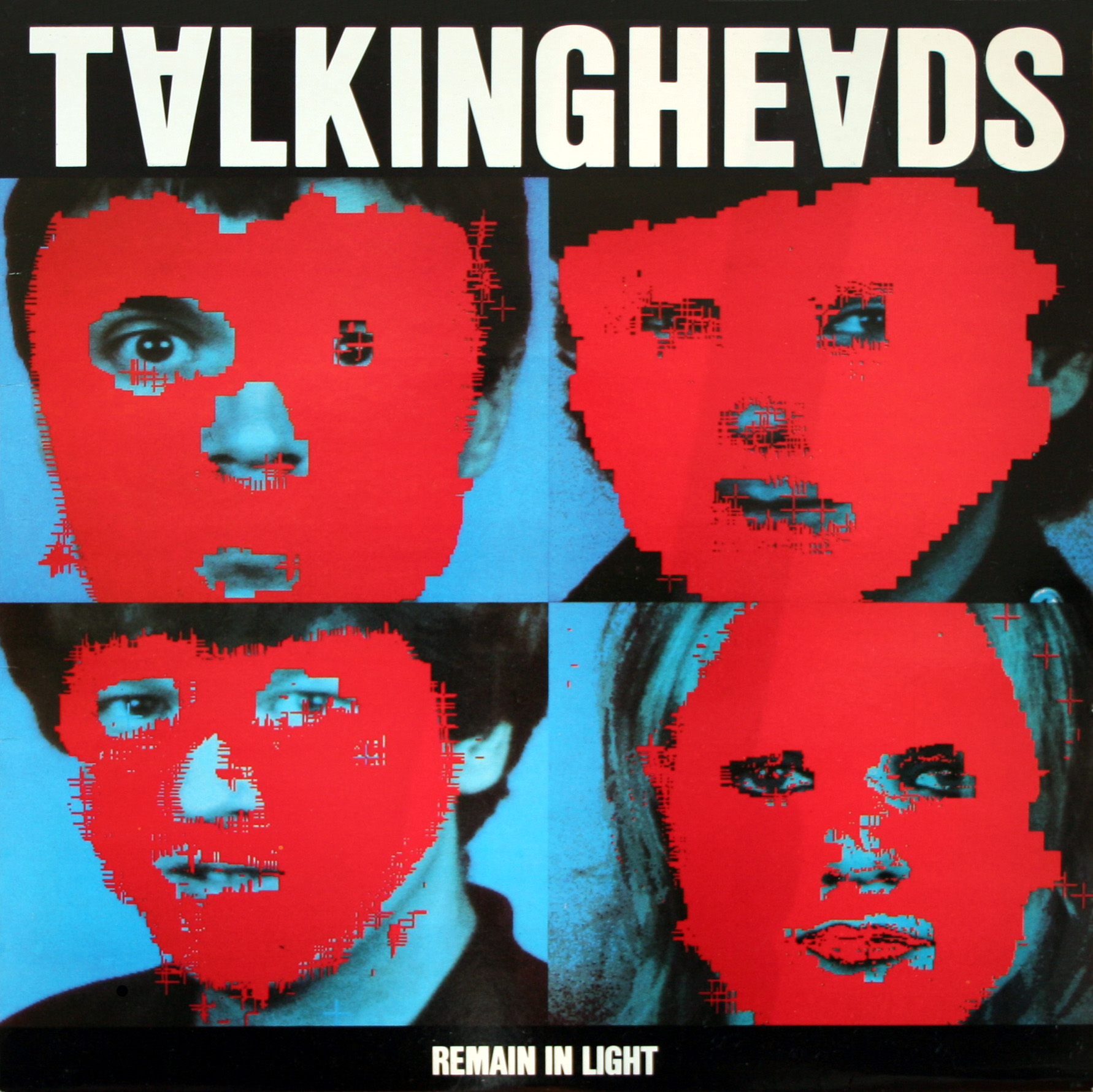
1980’s Remain In Light
“Chris was really an anomaly,” says Weymouth. “I mean, he was completely at ease with homosexuals at a time when this was still very new in society. But at the same time, he was completely a prototypical rock’n’roller.”
Some tolerance and understanding would apparently be required when, in ‘73, Frantz hooked up through a mutual friend with David Byrne, a RISD dropout still hanging around campus. Nicknamed “Mad Dave”, Byrne had, Frantz remembers, worn a “full Rasputin beard” and “what appeared to be hand-me-down clothes” in his freshman year, before disappearing from school to travel around the States. On his return, he looked completely different: bleached-white James Dean quiff, black shirts, leather trousers. He cut an odd but charismatic figure: hugely talented, determined and stage-ready.
The two initially joined forces in a group called The Artistics. “David was always, let’s just say, eccentric,” says Frantz. “All around RISD,” says Weymouth, “they were known as The Autistics.”
Not until 2012, in the pages of his How Music Works book, would Byrne diagnose himself with mild Asperger’s syndrome. “We all knew,” says Weymouth. “I mean, all of David’s friends knew. He didn’t always have the full shilling, you might say, in terms of emotional intelligence or that sort of thing. But we loved him.”
The Artistics’ standout song, Psycho Killer, had been written by Byrne, Frantz and Weymouth during a brainstorming session. “David had begun the song,” the drummer remembers. “He had the first verse and the chorus, but he wanted Tina to write the bridge in French. You need more than one verse, so he asked me would I write some and I happily did. All of that happened within the course of about an hour-and-a-half.”
In what was a portent of things to come, Frantz says that Byrne claimed more credit than the others. “I came up with Psycho Killer,” Byrne maintained to MOJO’s David Fricke in 2018. “Chris and Tina helped me with some of the French stuff.”
Another early composition, Warning Sign, was, Byrne told Fricke, a creative leap forward; moreover, “It felt more completely me.” Initial copies of Talking Heads’ 1978 album, More Songs About Buildings And Food credited the song to Byrne alone, yet in Remain In Love, Frantz claims to have penned the entirety of its lyric, and insisted the song be identified, on the album’s second pressing, as a Byrne/Frantz co-write.
“Particularly later on I realised, ‘Oh, David was just making a move to get a bigger piece of the pie,’” says Frantz. “Which he was always doing. It was always like that with David. It was if he couldn’t help himself.”
“David didn’t always have the full shilling in terms of emotional intelligence. But we loved him.”
Tina Weymouth
One morning, they found themselves having to push hard at the street level exit door to leave the building. “There was a poor dead guy frozen lying there,” Frantz recalls. “He was not that old, either. It made you think, ‘Please, don’t let this happen to me.’”
Regularly performing at CBGB on the Bowery, Talking Heads were, as Frantz remembers, insulated by innocence from the smacky excesses of the nascent punk scene. “I had no experience with heroin,” he says. “I knew that Johnny Thunders was a heroin addict, I knew that Richard Hell was supposedly dabbling in heroin. But, those guys, I didn’t have anything to do with them socially. The people I hung out with were trying to do something interesting, new and exciting.”
After signing to Seymour Stein’s Sire Records, Talking Heads ’77 was quickly committed to tape. For its successor, More Songs About Buildings And Food, they were keen to employ the co-production skills of Brian Eno, who’d become a fan after seeing the group play in London at the Rock Garden. Eno encouraged Talking Heads to become bolder in the studio. “He taught us that you can just go up to the console and push that fader up or twist that EQ knob until it sounds really weird,” Frantz laughs.
It was a collaborative arrangement that continued successfully through 1979’s Fear Of Music. But in the wake of that record, Eno and Byrne peeled off to begin their extraordinary found-sound oeuvre, My Life In The Bush Of Ghosts (subsequently released in 1981). The pair’s growing creative alignment was to have a detrimental effect on band relations when they regrouped for the recording of Remain In Light. “When we tried to establish boundaries, which began to happen because of Brian Eno,” says Weymouth, “that’s when the problems began.”
Yet album sessions began in a spirit of healthy competition. In the sunshine setting of Compass Point Studios in the Bahamas, Eno and Talking Heads’ self-imposed remit was a simple but effective one: repetitive beats and musical motifs multi-tracked while paying no mind to conventional verse/chorus song structures.
“Because so much was recorded as one track at a time and written in the studio, anybody could do anything,” says Jerry Harrison. “Our role also sort of expanded into knowing enough about the studio that we could be making suggestions that had traditionally been ones that Brian made alone.”
“Tina was so upset she approached me and said, ‘Would you take David’s place in the band?’”
Adrian Belew
According to Frantz’s memoir, by the time the project moved to Sigma Sound’s New York studio, Eno and Byrne had commandeered the project, the former at one point complaining that there were “too many people in the control room”. Harrison reckons that the situation was more nuanced: Weymouth and Frantz were unhappy with some of the embellishments the tracks were undergoing under Eno’s direction, while Byrne himself struggled to write melodies over one-chord songs.
“It was hard work at times,” says Harrison. “It presented a real challenge for David. There was a certain joie de vivre in the Bahamas. That became a little changed in New York.” Harrison cites unfinished outtakes such as Fela’s Riff and Right Start (an early version of Once In A Lifetime), released as extras on the 2006 reissue of Remain in Light, as evidence of where they stood as they left Compass Point. “If you listen to those rough mixes,” he says, “you can see how if you really had bought into them… [the embellishments] could be frustrating to you.”
Into this tense creative scene stepped Adrian Belew, who happened to be in New York performing showcases for record labels as he tried to get a deal for his band, GaGa. Belew had worked with Eno the year before on Bowie’s Lodger. After a GaGa show at Irving Plaza, Eno, along with Byrne and Harrison, approached him with an offer.
“They kinda cornered me and said, ‘Hey we’re making a record. Could you possibly play on it?’” recalls the guitarist. “Jerry later told me that at the time I came into the record-making process, they were kinda stumped as to how to go further. They were almost ready to give up on it. Then I walked in and I guess what I did excited them enough to continue. So, the world can thank me for that (laughs).”
At Sigma Sound, Belew overdubbed fractured or feedbacking solos onto Crosseyed And Painless and The Great Curve, greatly enlivening both the tracks and the vibe. “It seemed to me like every time I tried to get a note to do a certain thing, it just worked,” Belew enthuses. “It was almost a magical kind of thing. I looked in the studio control room through the glass and I saw Jerry, David and Brian all kind of jumping up and down.”
Carving up the songwriting credits for Remain In Light, however, brought aggro. Eno suggested a controversial and provocative method: each member was to write down on a piece of paper what they considered to be their percentage contribution to each track.
“Then we could average those out,” Frantz remembers, “and arrive at a fair conclusion. Before we began recording, knowing that all five of us would be involved in the composition of the music, we agreed that the music writing share would be split equally among us. But Brian and David reneged on that agreement.”
“I would write down things like, ‘Oh my share was three per cent,’” Weymouth laughs, darkly. “And Eno was still mad about that and threw it in our faces. I think he wanted 50 per cent of everything. I don’t know. I have no idea. I mean, how can you be that greedy?”
Additionally, Harrison remembers the co-producer pushing for the banner credit of the album to be Remain In Light by Talking Heads and Brian Eno: “That was, I think, put to rest when our manager said, ‘Well, Brian, you are ready to do the tour, aren’t you?’ And he said, ‘Oh, I can’t do that.’ I think he has really terrible stage fright. And our manager goes, ‘Well, there’s no way that we can do it. It’d be a rip-off to the audience.’”
“His demands just became unreasonable,” says Frantz. “To the point where we had to say, ‘Sorry Brian, you carry on. We’re gonna do our thing.’”
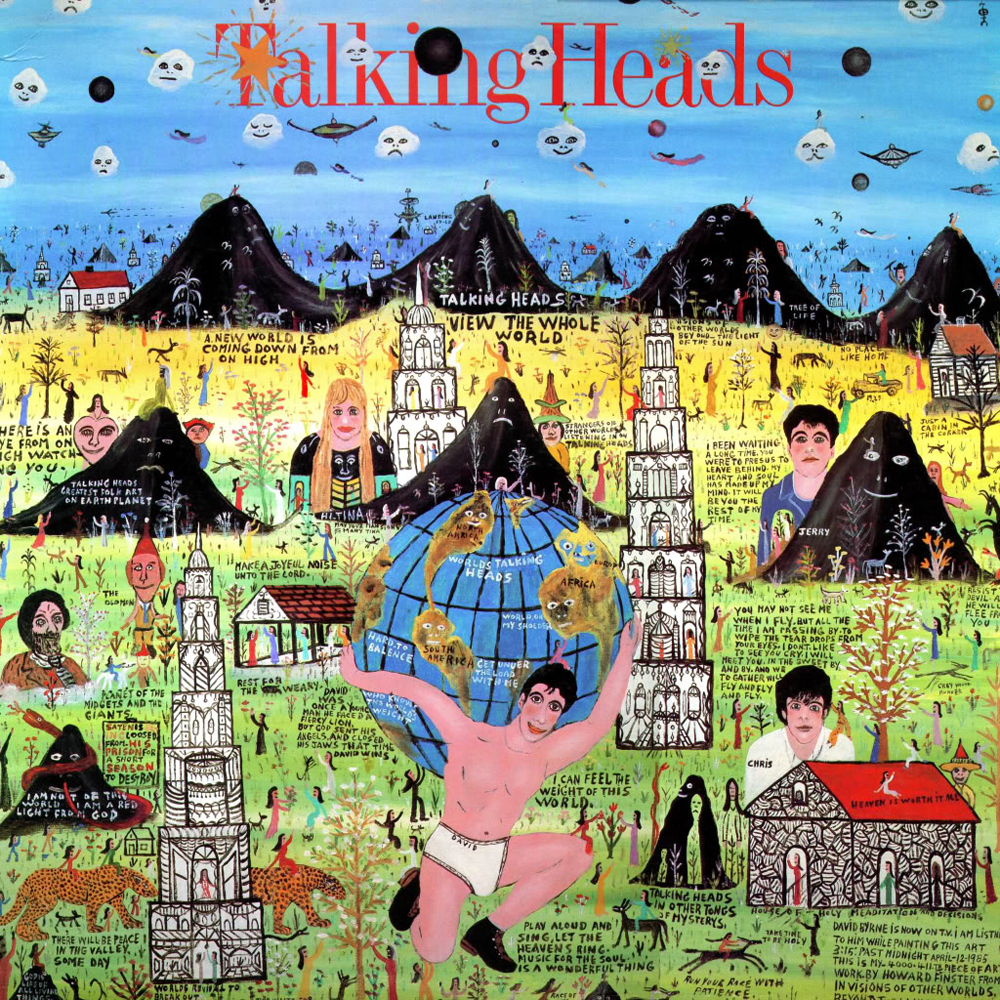
1985’s Little Creatures
Summer, 1985, the Montcalm Hotel near Marble Arch. Tina Weymouth and Chris Frantz were in London, promoting the release of Talking Heads’ sixth album, Little Creatures. Arriving to interview them as a wide-eyed 18-year-old fan-turned-writer, I was both amazed and slightly dispirited to hear the couple talk about the difficulties of being in a band with David Byrne.
“He keeps us on our toes, because he thrives on rejection,” a very friendly but quietly intense Weymouth told me, as she maintained eye contact and – as we all did – chain-smoked. “If you’re a person who’s constantly praising him, he doesn’t respect you at all. The only form of love that he can really accept is fame for his work.”
“He’s a really driven person… like a workaholic,” added Frantz, breezily. “His work is the most important thing in his life. Sometimes that makes personal relationships a little bit difficult. However, we’ve worked with him for so long now that we can kinda predict the way he’s gonna act. One thing we’ve had to learn is how to surprise him by being unpredictable.
“In other words,” the drummer added with a laugh, “it’s a constant battle working with him.”
Stop Making Sense, the album and film, had been released the previous autumn and was already a phenomenon. Captured over four nights at the Pantages Theatre in Los Angeles by director Jonathan Demme, and subsequently immortalised, the group had seemed almost freakishly energised. As Weymouth concedes, they may have had a little help.
“The band were doing too much [coke] in the December of 1983,” she tells MOJO. “The second night they were all racing to get to the end. I was ridiculously trying to keep the tempo down and that was against two drummers (laughs). Part of the ethos at that point was faster, faster, faster.”
As it would transpire, by the time Stop Making Sense reached cinemas, Talking Heads were already over as a live touring band. “David said, ‘Oh, this will tour for us,’” Weymouth remembers. “And we said, ‘Are you serious?!’”
The breaking point had been the Sweetwaters South Festival in Christchurch, New Zealand on February 6, 1984, where Talking Heads were headlining a bill featuring Simple Minds and The Pretenders. Ahead of their set, says Weymouth, Byrne had agreed to allow a couple of campaigners onstage to talk about Maori Rights. By the time Talking Heads walked on, the air was filled with boos and projectiles were being lobbed stagewards. Byrne stomped off after five songs. “That’s when the shit really hit the fan,” she says.
After Talking Heads’ demise as a live band, cocaine got a grip on Chris Frantz. “Tina was concerned that I might die,” he writes in Remain In Love – a view she maintains. “Yeah,” Weymouth tells MOJO, quietly. “It was a constant fear.”
“First, of all I should say there’s good cocaine and then there’s bad cocaine,” says Frantz. “All cocaine is not equal (laughs). I was fortunate enough to be in a position where I could get some good cocaine. The good cocaine you can survive on and deal with for a much longer period of time.
“When we stopped touring, that’s when it really snowballed. Y’know, I could go into a nightclub in New York like The Mudd Club and people would turn me onto cocaine for free. And it just got to the point where I was doing it, like, all the time, every day.
“I was also in a sense grieving the loss of what Talking Heads had been,” he reflects. “I was depressed, I think, about that. But thanks to Tina and our manager and a few friends of mine, I got into a treatment programme and I got over it. And I came out the other side in better shape than I had been.”
Talking Heads: 77 released in, er, 1977
2003, a tapas restaurant on the Lower East Side of Manhattan. Chris Frantz and David Byrne had met up in their old, rapidly gentrifying neighbourhood to talk about a temptingly lucrative offer the drummer had received for Talking Heads to reform and headline the 2004 Bonnaroo Festival in Tennessee.
It had been 12 years since the band officially split. In 1991, Byrne told an LA Times journalist he’d quit Talking Heads. This prompted an urgent group meeting in New York where, according to the drummer, the singer was in an uncharacteristically combative mood.
“He screamed at us, ‘You should be calling me an asshole!’” Frantz remembers. “And we said nothing because we were like, ‘Woah, David. Is that how you really feel?’ He knew he was being an asshole and he was upset with us for not getting mad about it.”
“Hey, y’know, Picasso was an asshole too,” Weymouth offers, brightly. “But he also painted some great paintings.”
In 2002, surprising everyone, Talking Heads had briefly reformed to play a short, three-song set at their induction into the Rock and Roll Hall of Fame at the Waldorf Astoria hotel in New York. Hence the Bonnaroo offer and Frantz and Byrne’s détente over patatas bravas.
Frantz says he told Byrne, “They’ve offered us a lot of money. Basically, we would own the rights to any sound recording and we would own the rights to any video recording. And it would really be smashing if we did this show.”
Byrne, says the drummer, responded by asking to think about it over the weekend. “David said, ‘I’ll call you.’ Well, he never did call, but he sent me an email and he said, ‘I told you once and I’ll tell you again. I am never going to reunite with Talking Heads under any circumstances. Please don’t ever ask me to do this again.’
“When we stopped touring, that’s when [the cocaine] really snowballed. I was grieving.”
Chris Frantz
“That was the extent of it, OK?” Frantz adds. “That was, like, on a Tuesday. On a Wednesday, I got a call from our management offices. ‘Guess what? David Byrne is headlining the Bonnaroo Festival, solo.’ Solo.”
Jerry Harrison reveals that a subsequent attempt by U2 manager Paul McGuinness and Live Nation’s Arthur Fogel to revive Talking Heads as a touring act was similarly rebuffed by the singer. Harrison would still like to see their music on stage again – it’s the motive, he says, behind a group he’s formed with Adrian Belew and Brooklyn funk band Turkuaz to tour the songs on Remain In Light.
“I mean, it’s not just about greed,” he says. “There is a whole audience that you’re gonna make really happy. New fans that never got to see the band perform, but also people that saw it back then and want to have another memory of it. I think it would’ve been an exciting challenge for David.”
In 2018, Byrne explained his reticence to MOJO. “I could see where things were going, towards being more of an arena act. It didn’t seem like a lot of fun.”
“It’s very unfortunate,” Harrison resumes, admitting that he’s often found himself acting as peacemaker between the Byrne and Frantz/Weymouth factions of the band. “I sort of understand everybody’s position. I do think that, for a few years, me being in the middle of it helped hold it together longer than it might have if I had not been there. It couldn’t go on forever.”
And so, ultimately, Talking Heads contracted, retreating back into the wings and disappearing, while leaving behind an indelible mark on music. In the 21st Century, their tangential approach to groove-based songwriting echoes on through Arcade Fire, Vampire Weekend, Black MIDI and, most acutely of all, LCD Soundsystem, whose leader James Murphy told NPR in 2011 that he regarded Talking Heads as “a perfect band”.
Nonetheless, Tina Weymouth acknowledges that the divisions between its members have in some ways tainted memories of Talking Heads.
“Y’know, with a band there’s a lot of damage control that goes on,” she points out. “You don’t want people to look bad. It was a wonderful band.”
“When I balance it out,” Chris Frantz ponders in summation, “I think, ‘God, I would do it all again. It was so good.’”
Remain in Love by Chris Frantz is out in hardback now, published by White Rabbit.
Images: Getty