
Mojo

Presents

“I Think We Accomplished Our Mission”

From the trenches of Horses’ 40th Anniversary tour, Patti Smith reaches out: to Lord Byron, Robert Mapplethorpe, Nick Cave’s tragic son Arthur, and beyond, to the whirlwind woman who changed rock’n’roll in 1975. “I’m a nice person,” she tells Martin Aston, “but when I pick up my electric guitar, I’m not so nice!”
The tour manager says to ask for Patricia Smith’s room at Portovenere’s Grand Hotel, the singer’s latest port of call on Horses’ ongoing 40th Anniversary tour. “But please call her Patti.” Further instructions: “A quick hello greeting and directly to questions, no chit-chat.”

As an artist and performer, Patti Smith’s reputation for fierceness is unbested. It followed her from Chicago to New Jersey to New York, where in the late ’60s she established herself as a self-contained creative unit in the footsteps of her idols, the beats. It resonates in the unsettling lyrics she co-wrote for Blue Öyster Cult (Career Of Evil, The Revenge Of Vera Gemini), flowed through Piss Factory, the b-side of her eponymous group’s 1974 debut single, and the extraordinary, unconventional swagger of *Horses and its successor albums. But fierceness hasn’t always been confined to her creations. In 1997 Smith accepted an Inspiration Award from a British music magazine, but used her speech to pick apart a filmed tribute by Bono and to inveigh against the ‘pathetic’ recipients of her influence seated at her feet. ‘No chit-chat’ then. Bit daunting.
And yet, as it happens, MOJO’s apprehensions are unfounded. Patti/Patricia turns out to be an extremely amiable companion, dispensing her wisdom in a measured, thoughtful manner without batting away a single line of enquiry. She’s a compelling repository of resilience and tenderness, as revealed by her exquisite 2012 memoir Just Kids, which recalls that heady New York baptism, specifically her friendship with photographer Robert Mapplethorpe as both began their journeys toward iconic status. In 1989, he died of AIDS, and thereafter grief became a constant visitor; in 1990, her keyboard player Richard Sohl died, then her beloved husband Fred ‘Sonic’ Smith (formerly of the MC5) in 1994, and a month later, her brother Todd.
In October, Bloomsbury publishes a new instalment of memoir. M Train documents her ‘lost’ (to rock’n’roll, anyway) years living in Detroit raising kids with Fred, and how she’s struggled to move on since his fatal heart attack. It alternates between New York coffee shop reveries and her restless travels, many of them pilgrimages to commune with the deceased: visits to the grave sites of Rimbaud and Genet; encounters with reliquaries including Herman Hesse’s typewriter and Frida Kahlo’s crutches. “I love the human mind,” she explains. “All the different kinds of genius, whether it was Jesus or Camus. Or a baker whose bread makes you want to weep when you eat it.”
It’s where our conversation starts. “We’re staying near where Lord Byron did one of his famous swims through a grotto, to a whole other fishing village, and it’s still heralded in this little town,” she says, by way of a little chit-chat, before we revisit the legend of Horses, still very much alive in 2015…


 “I never thought I’d be doing a second record. I fully expected to go back to the bookstore.”

How has Horses’ 40th anniversary tour been panning out?

Beyond my expectations. Audiences have been so receptive everywhere. There have been many people under 25, who seem to know all the words, who give us lot of energy.

You celebrated the album’s 30th anniversary too; has your relationship with it changed in the interim?

We didn’t tour Horses at 30; we only did a handful of shows. It was really by accident. I was walking in New York, and a kid of about 20 said hello, and told me next year will be Horses’ 40th anniversary, were we planning something special? I hadn’t even contemplated it until then. But Lenny and I are pressing 70. We’ve reached many milestones together, alongside the band, so it seemed a perfect time to celebrate our lives together and the many friends and colleagues who are no longer here. By maintaining a sense of balance and the grace of God, some of us are, we’re strong. It’s like that Jimi Hendrix line I love: “Hurray, I wake from yesterday.” We awoke, we’re still working. So it’s a celebration of life and vitality as well as the album.

Let’s play Word Association. I say Horses…

For me, it begins long before the record, with the inception of a poem I wrote called Oath when I was around 20, that began, “Jesus died for somebody’s sins but not mine.” It was my statement of independence from being fettered by any particular religious institution, not any statement against Jesus Christ. That’s the start of my evolution as a young person that got me to *Horses.

Was it daunting, the prospect of laying down these songs for posterity?

We had two challenges. I wasn’t trained to be a musician. I had no desire to be one. So I had to wrap my head around the idea that we were freezing a performance, because I like the spontaneity of the moment. But also we’d evolved without a drummer – we’d only had Jay Dee [Daugherty] for a couple of weeks – so we had to work out the songs with drums in the studio, and in less than six weeks. We were young, so there was no fear, only to produce something mediocre and unworthy to put out into the world. It helped being shepherded by John Cale, who comprehended the situation. He’s an artist and I was a young artist, so we locked horns, but he understood me better, and I comprehended that he was a good shepherd. I think we accomplished our mission, by doing the absolute best we could at that point. I didn’t know how to do better, having had no studio experience, and being keen on presenting an album that was authentic and sounded like us. I don’t have any regrets. I understand its flaws, technical or otherwise, its hubris… If you see flaws, then do something new, try to evolve.

Horses’ finale, Elegie, must be hard to sing, given who you’ve lost over time.

It’s increasingly harder. It was originally for Hendrix, and also Brian Jones, Jim Morrison, Janis Joplin, these people we felt such a loss for. It was written with [one-time Patti boyfriend and Blue Öyster Cult member] Allen Lanier, who was a beautiful person – he passed away recently. We also lost my husband Fred, my brother Todd, who was head of my road crew, all four Ramones, Joe Strummer, Jim Carroll. We keep adding names. Ornette Coleman just died and he was a good friend, John Nash the mathematician, Nick Cave’s son Arthur. I didn’t know him but I’m a mother, that’s been one of the most painful. I’ve added his name to the list I call out just to hear it resonate in different places. People respond with such love, and some get loud cheers, like Lou Reed, and some people don’t know, which doesn’t matter, they’re just symbols of many, many different people. But the field keeps growing, and specifically within our burgeoning camp. But we’re celebrating these people, it’s not all sad. It keeps their energy and life force around. So performing Elegie is difficult, but also liberating.

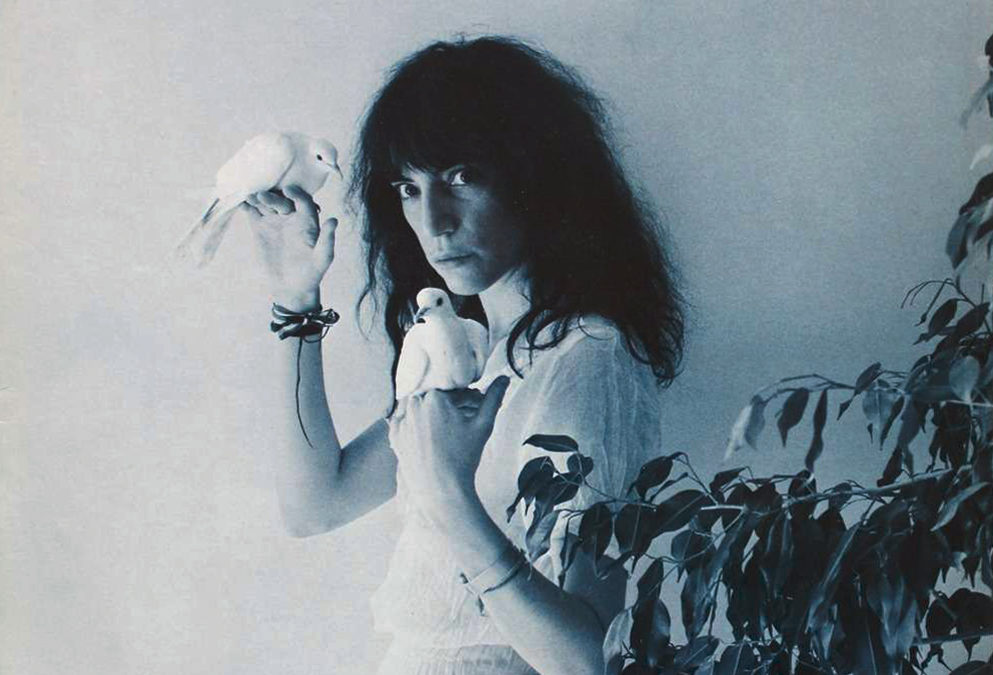
“Arista didn’t like the Horses cover at all. They thought it was too masculine, that my hair was a bit messy.”

John Cale recalls the Patti Smith Group was an especially tight-knit family, and, 40 years on, Lenny Kaye and Jay Dee Daugherty are still with you.
Jay’s the only drummer I’ve ever had with me on every album. Lenny’s been a friend since 1971, so we have almost 45 years of friendship as well as collaboration. Actually, the hardest thing performing has been the loss of Richard Sohl, who I expected to work with my whole life. He was younger than us, classically trained but not afraid to play three chords for nine minutes straight. He was elegant, mischievous, beautiful… It was a great blow when he died of a faulty heart valve – he was 37 – not long after he recorded Dream Of Life with Fred and I. It was very difficult to come back performing without Richard. But our bassist Tony [Shanahan] has been with me for 20 years, even Jack [Petruzzelli, guitar] has been playing for seven or eight years. He’s evolved with the band and he’s as intrinsic a member of any, he’s a real team player. And Tony spent months, years, working on piano to give me an accompanist in the style of Richard.
It’s not a virtuoso-style band, but we can still improvise. I’m disciplined on one end but I break form all the time. We try to make *Horses as close to the album experience as possible, but *Horses opens up for improvisational possibilities. It’s not out of indulgence; it could be inspiration, frustration, anger. We don’t have a regular lighting person, no cues or tapes. The only thing that fetters us is the sequence on the album. We do it religiously, which isn’t easy because you usually don’t come out of the gate with your most strenuous song [ie. Gloria]. But toward the end, Land opens up. That was improvised in the studio, so it allows for more.
The beautiful thing about this band is that we’ve worked together so long, they’re ready for me. And we’re friends. It’s not like we got pissed off with each other ten years ago and then reformed. I may have stopped working for 16, to raise children, but after the death of my husband, I slowly returned. Sometimes my son [Jackson] plays, he’s a great guitarist, sometimes my daughter [Jesse], who plays piano. Our modular situation is family.
The Library of Congress has Horses in its National Recording Registry, calling it, “culturally, historically, or aesthetically significant”. Does that tickle you? 
I’m very proud. The album, as a full package, has its merits. The beautiful cover by Robert Mapplethorpe was his entrance into the public consciousness, so it has historic value. The liner notes, my manifesto at the time, shows its strengths. Horses was embraced critically and globally, by like minds, poets and artists and musicians and outsiders, but it never got a gold record, it was never a big seller, so I feel very proud that it has endured.
I think of Michael Stipe, Morrissey, Siouxie Sioux, Courtney Love, they all say Horses was a life-changer. It’s like what’s said about the first Velvet Underground album; it didn’t sell much at the time but everyone who bought it formed a band. 
[laughs] That’s awesome. I never thought I’d be doing a second record. I thought we were offered an opportunity to document this body of work then I fully expected to go back to the bookstore where I was working. I didn’t feel I was embarking on a career. The main mission in *Horses was that rock’n’roll in 1974, at least in America, was going through a difficult transition. The ’60s was like the Renaissance. You had Hendrix and Morrison and Lennon and Neil Young and Grace Slick and Janis Joplin and the Stones, the Animals, you can go on and on, all the great R&B artists. And then many people died, and the culture was shifting into opulence and decadence.
I was young, but I felt our cultural voice was in jeopardy and needed an infusion of new people and ideas. I didn’t feel like I was the one to do this, I didn’t consider myself a musician in any way, but I was a poet and a performer, and I did feel that I understood where we were at, what we’d been given and where we should go, and if I could voice it, perhaps it could inspire the next generation. I did Horses as a bridge, a touchstone, for the future, and if that sounds presumptuous, what’s more presumptuous than youth?
Horses did seem to have some impact on young kids when we toured, all these anarchistic desires. I felt we’d accomplished this mission. But I don’t hear our influence. I mean, I hear Michael Stipe’s lyrics with envy. “It’s the end of the world as we know it and I feel fine”? That’s one of the greatest lines in rock’n’roll. I see these people you mention as extremely independent. So I’d rather say we inspired people, through energy or nourishment, to become themselves.
The mood of your debut UK show, at London’s Roundhouse, was astonishing: like someone jumped out of the crowd and grabbed the microphone, and unleashed everything she’d been wanting to sing her whole life.
[laughs] That’s awesome. You have exactly described how I felt! You can’t imagine what it was like for us, playing places like CBGBs, with no idea what the rest of the world thought, and to go into London and to have the people… to share that kind of energy. I really felt like the future would be fine. We always have to pin our faith on new generations.

“I was walking in New York, and a kid of about 20 said hello, and told me next year will be Horses’ 40th anniversary, were we planning something special?”

I read that Arista wanted to change the album cover.
They didn’t like, or understand, the photo at all. They thought it was too masculine, that my hair was a bit messy. Some thread was probably hanging from my shirt. They wanted to airbrush me to make sure my skin was perfect. I saw a cleaned-up version but I’d never have allowed that, and anyway, Robert was an artist, his work shouldn’t be tampered with. History proved us right. Robert chose the image, he shot it quite quickly, he took just 12 pictures, and said, ‘We have it.’ I replied, How do you know? He said, ‘I know.’ When he got the contact sheet, he chose the eighth image. He said, ‘That’s the one with the magic.’ He was seldom wrong.
There’s a line in your new book, M Train, which fascinated me instantly: “I realised I missed that version of me, the one who was feverish, impious.” How has the Patti of Horses changed? And how long did she exist?
I’ve evolved. At this point in my life, I have years and years of experience, and I know who I am, but I’ve still never lost that spirit. I’m still her, because it’s ingrained in who I am. If I had lost it, I could never perform *Horses. I’m still the girl who wrote Rock’N’Roll Nigger and loves to perform it. I’m still the girl who doesn’t really know how to play guitar, but I put my amp on ten, and I play the greatest feedback ever, which is the one thing I’ve always been interested in, not in chords and licks but the sonic ‘scape of the electric guitar. But truthfully, what I was speaking of there was more male and female relationships. I’m 68 years old, I’m not 22, I’m not even 52. Right now, I have my own romantic concepts, I have nice companions, things like that, but that feverish, obsessive energy that we have when young mercifully evolves as we get older.
It’s a delicate subject, because I’m talking about aging. But I still understand being an 11-year-old, I can feel that anytime. I have that punk rock energy when I’m playing. As an artist, I’m the same. And I feel very strong as a performer. But as you age, it’s a trade-off. I love aspects of getting older: I’m really comfortable with myself, I enjoy my solitude, I only feel the fear of something happening to those I love. But we’re not going to be as reckless in love as you do when we’re young. In the book, it was just someone from my past who called to wish me Happy Birthday, and that person made me remember the passions of youth.
But also, in performing *Horses, I never go on stage and say the words “Jesus died for somebody’s sins but not mine” without feeling a schism, because I’m not 20 years old, I’m well beyond that fight now. I have great respect for Jesus Christ as a revolutionary and teacher and a professor of love – I follow a lot of the ideology of Pope Francis in terms of the environment and the global economy and the poor. So my concerns aren’t those of youth, so I have to deliver that line with two minds, one who’s evolved and the girl who wrote that. I still have to deliver the song with an authentic spirit, and compassion.
Marriage to Fred, becoming a mother, put your career on hold…
When I first married and had children, I was very happy not to be performing, which gets back to the line you like about being feverish and impious. As an artist, I had the same exact careless spirit – I was only concerned about the moment. Artists often feel, out of necessity, that they’re the centre of the world – you need that kind of hubris as a performer to do your work. But with a family, that hubris was obsolete. Once you wed, it’s your relationship that’s the centre, and once you have children, you know who’s the centre of your world. So it was a good time for me to extricate myself from public life. I was also lucky, because I still wrote, drew, took photos, painted, so I had creative outlets for my energy. But then I couldn’t have performed Horses with any authentic hubris. Now my children have grown, I’m sort of an old dog. It might seem that I’m a nice person, but when I pick up my electric guitar, I’m not so nice!
In M Train you write a lot about your obsession with TV detectives. When one interconnecting flight in London was late, you took it as a sign, and checked yourself into a Covent Garden hotel for an ITV3 marathon…
I still do that! It’s one of my favourite things; the only rival is sitting by the sea. There’s Morse, Lewis, George Gently, Wallender, Broadchurch – nobody does them better than the British. I watch them all. First, it’s their minds. They’re detectives who are ultimately flawed, but they have obsessive genius, starting with Sherlock Holmes, and Vera [ie. Brenda Blethyn’s DCI Vera Stanhope] too, unexpectedly! They see things just like artists, things other people don’t see, and therefore they’re able to unravel stuff. Every time I see Kenneth Branagh’s Wallender, it’s like a new movie.
Last question: Before Horses, you released the Piss Factory single, in which you fantasised “I’m gonna be a big star…” What’s your feeling now regarding the notion of stardom? Or has that evolved too? I’m thinking of you bringing the Dalai Lama on to the stage at Glastonbury this summer…
I didn’t think of myself as a star when I wrote Piss Factory. I was just angry, that they’d literally stuck my head in a toilet bowl. I was going to avenge that place, but I had no real plan. I wasn’t great at anything, like studying, but I had energy, guts… I was a tough kid, but I wrote poetry, which wasn’t very good, but I had the will. To say I was a star would be too small. I think of myself as just *blessed, lucky, and also a product of really hard work, I’ve worked hard my whole life. I love some of our pop stars, but that’s a whole other realm, I don’t have the talent, I’ve never written a song that captured millions of people, but I’ve have wonderful experiences. To be at Glastonbury is awesome, it’s one of our greatest festivals, and then to have the Dalai Lama come share the stage, to even have the opportunity… I think everybody was happy, it was one of these rare, beautiful, happy moments, and he loved it too! Seeing ninety, a hundred thousand people, everyone singing Happy Birthday, and so much love…
This article originally appeared in MOJO 263

Images: Getty