
Mojo
Feature
YES
In 2018, which legendary band celebrated 50 years pushing the boundaries of rock by touring as two hostile entities under the same name? Yes.
Words by Mike Barnes
When MOJO arrives at Yes guitarist Steve Howe’s north London home he is friendly and welcoming but initially subdued. The house is near the end of a gated road and inside it is almost completely silent. “It feels like being out in the country”, Howe says. We chat awhile before the he quietly disappears into the kitchen to make some tea. Following the sudden and unexpected death of his drummer son Virgil, aged 41, in September last year, Howe cancelled the final seven dates of Yes’s American tour and halted in-person interviews. “It was a respite that we desperately needed,” he says, before adding, with crushing understatement, “we are really cut up about all this.”
In recent years Howe has also lost singer and bass guitarist John Wetton, who played with him in Asia, and another bass guitarist, Yes founder Chris Squire. Last November, Howe released Nexus, the album he and Virgil had recently completed, as a tribute to his son.
“We love these people and want to move on with them in our minds. It’s a holistic healing process that we are all going through.”
And when he takes the stage again with Yes, there will surely be a lot of positive emotion shown toward him.
“I think so… that will be lovely.”
“We didn’t want to be ordinary or bluesy or rocky. We used to deny that we were a rock band.“
Steve Howe
IN 2028 YES WERE CELEBRATING THEIR 50th anniversary and their long history is more complicated than most. The Yes revolving door has seen 19 musicians come and go – usually more than once – with Squire the only constant until his death in 2015. But what further complicates matters is that there are now two revolving doors, as there are effectively two Yeses.
Howe’s latest stint with Yes has been unbroken since 1995. Also in the group’s current line-up are Jon Davison on vocals, Billy Sherwood on bass, Alan White on drums and Geoff Downes on keyboards.
Another group, officially announced in 2016 as Anderson Rabin Wakeman, or ARW, features original Yes vocalist Jon Anderson, guitarist Trevor Rabin and keyboard player Rick Wakeman. They are now known as ‘Yes Featuring Jon Anderson, Trevor Rabin, Rick Wakeman’. “You couldn’t make it up,” sighs Howe.
In April 2017, Yes were inducted into the Rock and Roll Hall of Fame in a ceremony held in Brooklyn. Anderson, Wakeman, Howe, White and Rabin – with Rush’s Geddy Lee on bass – played together on Roundabout and Owner Of A Lonely Heart. Many Yes fans would have been praying that this heralded a unified line up of Yes, but Howe’s advice could be summarised as ‘don’t wait up’. “We did it at the Hall of Fame,” he says, “and that’s going to be the only time.”
At the start, it all seemed so straightforward. On November 26, 1968, Cream waved goodbye to their brief and somewhat tempestuous career with a concert at the Royal Albert Hall. Supporting them were a hot young London-based band called Yes. Melody Maker’s Chris Welch was instantly impressed.
“They brought together such an unexpected range of influences from folk to jazz and rock and made it all sound so new, fresh and attractive,” he wrote. “Here were songs that stopped and started with nerve-shattering suddenness, paused for reflection, and then stormed back with all guns blazing.”
He wasn’t the only convert. Both Atlantic Records boss Ahmet Ertegun (who’d recently signed Led Zeppelin) and Cream/Bee Gees manager Robert Stigwood (who had a deal with Polydor) were chasing Yes’s signatures, and when Ertegun saw them at London’s Speakeasy club he made his move. Both parties initially agreed on a very long contract for low points. But Atlantic appeared oddly indifferent to the group, with some people at the label’s New York office thinking that they had signed a folk act.
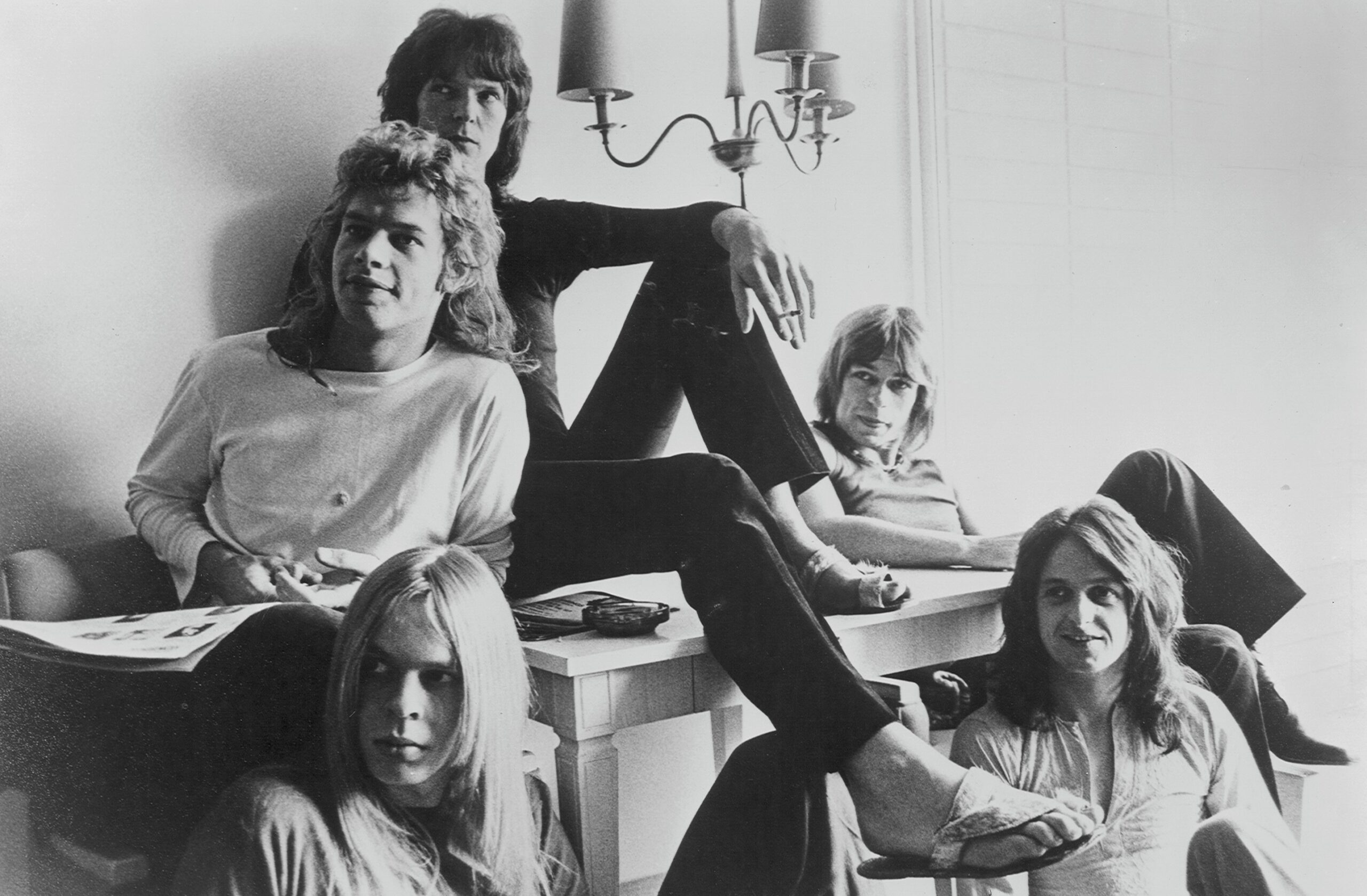
Yes then comprised singer Jon Anderson, Peter Banks on guitars, keyboard player Tony Kaye, Chris Squire on bass and Bill Bruford on drums. They had been trading under the name Mabel Greer’s Toyshop since late ’66 [see panel], but had settled in 1968 on a new line-up and name. Two albums for Atlantic followed: 1969’s self-titled debut and 1970’s Time And A Word, the latter recorded with an orchestra, to mixed reviews and Banks’s chagrin. Steve Howe from UK psych pioneers Tomorrow replaced him.
“We were all trying to move up a gear,” Howe recalls. We were looking for songs with depth. Any intro that was under two minutes we thought, That can’t be long enough! So we enjoyed that sort of flamboyance and reckless turning away from convention. We didn’t want to be ordinary or similar or bluesy or rocky. We always used to try to deny that we were a rock band.”
Released in 1971, The Yes Album demonstrated the group’s potent new chemistry and reignited Atlantic’s enthusiasm. Gone were the cover versions and strings, and in came a batch of striking all-original compositions, with pop melodies and harmonies set in expansive and exploratory structures. It came with an unusually vivid sound for the day, courtesy of engineer/producer Eddy Offord. “The idea,” says Howe, “was that you should be able to hear everybody all the time.”
But creative success did not translate into line-up stability. After friction between himself and Howe, Tony Kaye was asked to leave – a move initiated by Squire that irked Bruford. Kaye was replaced by Rick Wakeman, who’d made his name as a session player (notably on Bowie’s Space Oddity) and with the Strawbs. His work on Heart Of The Sunrise, a key song on Yes’s next album, Fragile, shows the group’s growing mastery.
“I’d written Heart Of The Sunrise, then I heard Chris [Squire] and Bill [Bruford] weaving a great riff in the studio,” remembers Jon Anderson. “I suggested they modulate to a different key, then do a jerky stop/start idea, very Stravinsky-ish, then play in another key. By then Steve had joined in, and I suggested to Rick to create an orchestral sound [on Mellotron] rising out of the riff, then join in. We had so much harmony at that time. The song expanded and that became the key to real Yes music.”
“In 1973 NME called us The Peoples’ Band. Three years later we were rock dinosaurs.“
Steve Howe
LOFTY AMBITIONS WERE BECOMING Yes’s trademark. A booklet that came with Fragile included a short poem by Anderson: “Music’s chosen words (move the feeling)/Directed to our soul/War music Peace music Love music/We move to it all”; inside, Wakeman thanked Wolfgang Amadeus Mozart alongside Brentford Football Club. Their artwork, which from Fragile onwards was created by fantasy artist Roger Dean (1972’s Close To The Edge was the first to bear their classic ‘bubble’ logo) implied that their music was of another, more rarefied world. The aesthetic would come to define the phrase coined by Chris Welch to describe Cream: “progressive rock”.
Meanwhile, the music grew ever more astonishingly complex, exemplified by the high-speed section of Close To The Edge’s side-long title track.
“That was influenced by the Mahavishnu Orchestra and Zappa,” Howe says. “We thought, Let’s go bang! Let’s be right up there as soon as it starts. And if it was a 20-minute song, you needed to really take the listener on a journey. It’s about the up and down, the drama, the release, the excitement.”
But if the band’s long-form, multi-section pieces seemed painstakingly planned, the reality was more chaotic, with marathon tape-splicing and mixing sessions at Advision in London, and much prevarication. During the making of Close To The Edge, a near disaster was averted when the group had decided on a take, but couldn’t locate the particular section of tape. They found it in the bins, where it had been dumped by the studio cleaners.
The fevered atmosphere and finicky musical mosaic-building wasn’t for everyone. “Every instrument was up for democratic election, and everybody had to run an election campaign on every issue,” recalled Bill Bruford later. “It was horrible, it was incredibly unpleasant, and unbelievably hard work.”
Bruford would leave, to be replaced by Alan White (ex-Plastic Ono Band), but Yes’s journey towards a kind of prog gigantism was not hindered. Driven by Howe and Anderson, Tales From Topographic Oceans spread four songs over four sides of vinyl. Anderson’s lyrics were based on a section of the 1946 book Autobiography Of A Yogi by Hindu mystic Paramahansa Yogananda, but were open to accusations that he was boiling down complex philosophical ideas to the point where they’d become largely incomprehensible.
Released in December 1973, the album reached Number 1 in the UK charts, but serving it up live in its entirety before it had been released – with Anderson sharing his views on the nature of God with the audience from the stage – was a challenging gambit. Meanwhile, Wakeman complained that Tales’ percussion-led sections amounted to padding. Understandably, Alan White is more generous.
“There’s a lot of experimental percussion work,” says the drummer today. “The rhythm section got very inventive and Chris was a fantastic bass player to play with. He was very adventurous and articulate and would do things that no one would expect.”
Wakeman’s protest was to hang out with Black Sabbath, who were recording Sabbath Bloody Sabbath in the studio next door, drinking beer and adding keyboards to their album. He left shortly after the album was released.
Commercially, Yes were riding high (Tales From Topographic Oceans peaked at Number 7 in the US) but the press were lining up a backlash, using the fact that all but Wakeman were vegetarian to reinforce the image of a namby-pamby bunch divorced from the pie and chips reality of rock’n’roll. “It seemed logical to us that you weren’t in a rock band to destroy yourself,” says Howe today, laughing. “But that isn’t necessarily the norm.”
Yes followed with Relayer in 1974, featuring Patrick Moraz on keyboards. It remains their most aggressive album, with Howe’s playing jagged and angular, and Anderson and White playing a rack of car parts on the turbulent The Gates Of Delirium that they had salvaged from a scrap yard. But Yes’s toughened-up sound wasn’t washing with the press. “At one time NME called us ‘The People’s Band’,” Howe recalls. “That was in 1973, but three years later we were rock dinosaurs.”
“Someone asked Rick, ‘What do you think about the other Yes?’ and he said, ‘The same way I think of the Dave Clark Five.“
Trevor Rabin
INDEED, THE WHOLE IDEA OF progressive rock appeared to be losing currency and momentum. In autumn 1974 Robert Fripp mothballed King Crimson (now featuring ex-Yes drummer Bill Bruford), not to return to that well for another seven years. The following spring, Peter Gabriel’s departure left Genesis in crisis. Punk loomed, and although the punk-prog antithesis has been overplayed (Keith Levene, guitarist with the prototype Clash and later Public Image Limited, admired Steve Howe and had roadied for Yes in his teens) Yes were obliged to respond. The return of Wakeman added oomph to 1977’s Going For The One (“It was a joyous experience,” says Howe) but for 1978’s Tormato, the band made the mistake of entering the studio with insufficient material. And from the irreverent tomato-spattered sleeve designed by Hipgnosis, distancing it from Roger Dean’s mythical landscapes, to the shorter songs, it seemed to be signposting a need for change without knowing how to achieve it.
This time it wasn’t just Wakeman who left, but – shockingly – Jon Anderson too. “The band was fragmented by then,” says the singer. “No real direction, no harmony, a tired energy, too many tours.”
Yes chose two of the least likely replacements imaginable: Trevor Horn and Geoff Downes, aka The Buggles. Their arch, synthetic-sounding UK Number 1 single Video Killed The Radio Star (1979) seemed the opposite of Yes’s mystical rock symphonies. Howe recalls Chris Squire playing him the Buggles album The Age Of Plastic.
“I just ignored the single, ’cos it drives you crazy in a way,” says the guitarist. “But when I heard the album I could see what he meant. Those guys were talented, very progressive, so I said let’s get them in.”
“It wasn’t that weird from our own perspective because Trevor and I were big Yes fans,” says Downes today. “I think that Drama, the album we came up with, is very strong. Yes were probing for direction and probably needed something like that to take them into another generation.”
But it was in concert that the new Yes – or ‘Yeggles’ as wags had it – came unstuck.
“It wasn’t so bad when we took it out to the States because everyone was stoned at that point,” Downes says. “I don’t think that anyone really gave a fuck who was in the band; it was more a case of, ‘We’ve got Yes and it’s the brand.’”
But UK audiences were less forgiving, especially of the funny-looking bloke with big glasses who was the new lead singer.
“I wouldn’t say it was a complete disaster, but at a break in one of my keyboard solos, someone shouted out ‘Rick Wakeman!’ at the top of his voice.” Downes recalls. “But Trevor was the focal point of the complaints – not because of his vocal performance but because he wasn’t Jon Anderson.”
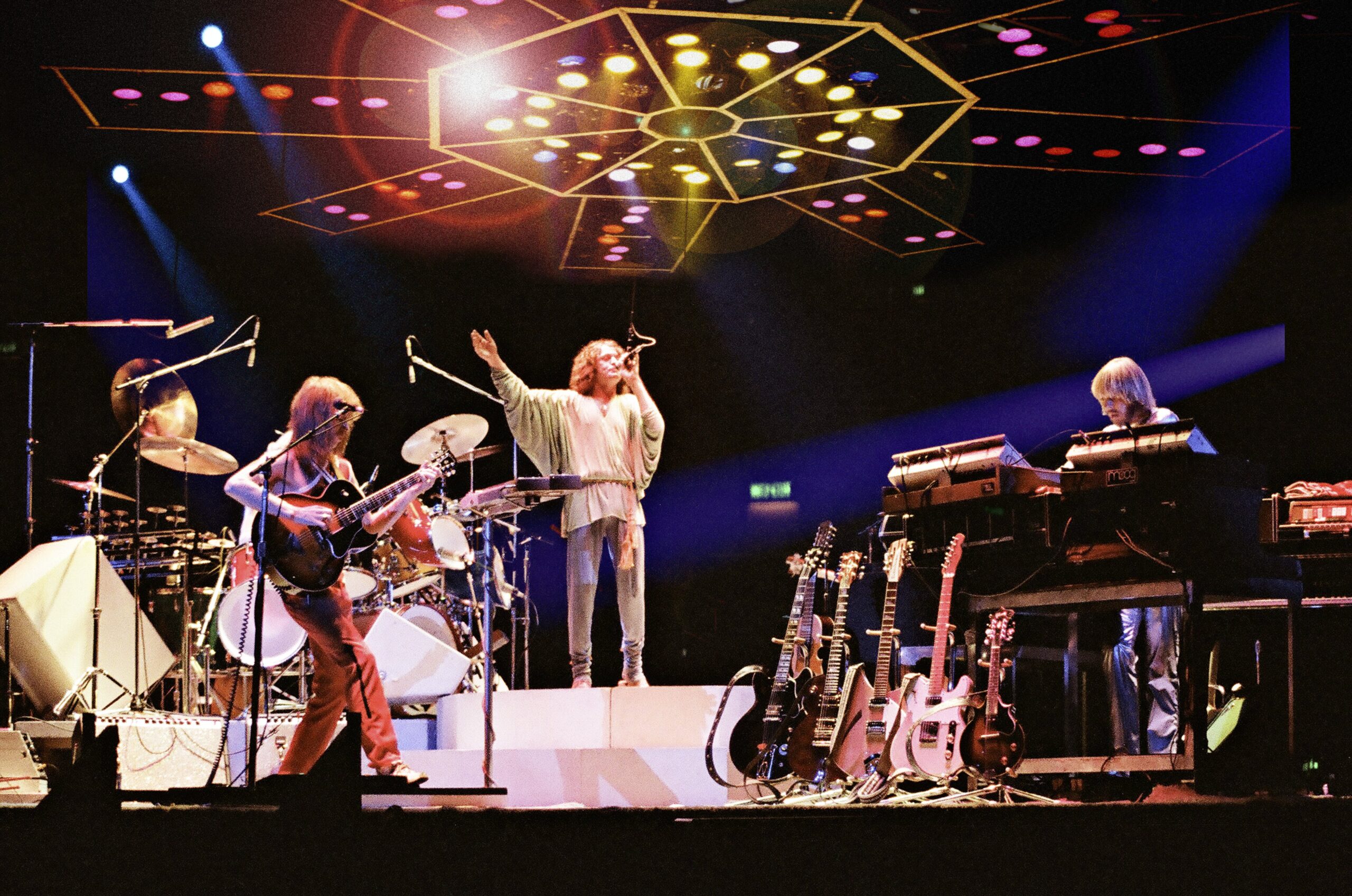
Steve Howe, Jon Anderson and Rick Wakeman of Yes perform on stage at Wembley Arena, on October 28th, 1978
The remains of Yes split in 1980. Howe reconciled himself to the fact that it would be “goodbye Yes” and focused his attention on GTR with Steve Hackett and then formed Asia with John Wetton and Carl Palmer, with Downes on keyboards. Anderson and Wakeman did their solo projects, and the Squire and White rhythm section made some recordings for XYZ, a project with Jimmy Page which remains unfinished. But the Yes name – the brand – proved to have a power of its own.
White recalls the uncertainty of the time. “Chris and I looked at each other and said, ‘What do we do now? I guess we are still Yes.’”
London-based, South Africa-born guitarist Trevor Rabin had signed to Geffen Records but, having fallen out with them, was shopping a demo around other record companies, including Atlantic. The label brought it to the attention of Squire and White and soon the three of them began working on Rabin’s musical template, under the name of Cinema.
“The band was fine with it being Cinema,” says Rabin. “But suddenly a whole load of bands emerged as having been called Cinema – [angling] for money, obviously. We thought, ‘Why go through this?’, and the record company were pushing to put ‘Yes’ on it, because the album was strong and it would be a good way for them to re-establish the name and regenerate their back catalogue, because Drama and Tormato had done bad business and that tainted the band. There was no attempt to bring back some past Yes; it was just us trying to do some new music.”
Even so, “some past Yes” was intimated by Yes’s choice of ‘new’ keyboard player and singer. Back came Tony Kaye after 11 years away. And here, again, was Jon Anderson.
“It was perfect timing. I’d had a break and written a couple of albums with Vangelis,” says Anderson. “Then on a trip to London, Chris played me the tracks. Totally blew me away, and it was very well produced, perfect in every way. So Chris asked if I would join the band and I immediately said yes.”
With Trevor Horn returning to produce, the album 90125, released in November 1983, was a greater stylistic shift even than Drama, turning away from the extravagances of the past to focus on more mainstream melodic songs. Some fans were shocked, but it became the group’s best-selling album – strongly supported by Atlantic and Ahmet Ertegun – and gave Yes a huge worldwide hit single with Owner Of A Lonely Heart.
As Rabin rightly notes, “90125 re-established the name Yes. And helped regenerate their back catalogue.” But the same team toiled for two years over a follow-up, with clashes between Kaye and Horn – who eventually quit as producer – meaning that Rabin finished Big Generator (1987) with Paul De Villiers. Unsurprisingly, Yes ground to another halt (although the line-up reconvened to record the quixotically-titled Talk in 1994).
“At a break in one of my keyboard solos, someone shouted out ‘Rick Wakeman!’ at the top of his voice.“
Geoff Downes
YET ONE OF THE STRANGEST twists in the Yes tale was due. Anderson claims that the Big Generator line-up was “all about finding hit records – great fun to be in, but I felt very confused”. His next step could hardly have been a more transparent claim to Yes’s pre-Yeggles, echt prog legacy.
Convening Bill Bruford, Steve Howe and Rick Wakeman, along with Bruford’s former King Crimson bandmate Tony Levin on bass, they recorded an album, Anderson Bruford Wakeman Howe in 1989.
Calling their concert tour ‘An Evening Of Yes Music Plus’ drew the attentions of Chris Squire’s legal representatives. Their argument – that musicians leaving Yes of their own volition forfeited claim to the name – is not one that Howe cares to engage with in 2018. “This is where it does get private,” he says. “Company structures and company rights.”
Though the dream of a harmonious Greater Yes was not dead, some will argue it should have been. With Yes’s management and Anderson aligned for once, 1991 saw the Union tour and album, which featured material from Anderson Bruford Wakeman Howe and new songs supplied by Rabin, with some session musicians drafted in to overdub parts. Wakeman preferred to call it ‘Onion’, because it made him cry, and only Anderson doesn’t consider the whole episode a debacle.
“Touring the Union show was a blast for me,” he says. “Eight musicians on-stage, a glorious version of Awaken [from Going For The One] to end every show. All our hits, very happy fans… Who could ask for more?”
Howe, on the other hand, regrets ever getting involved.
“We’d just established a terrific group with ABWH,” he says. “We knocked America sideways. You couldn’t compete with this band, it was incredible, and to be honest [Union] fucked it all up rotten, because by the time we morphed with Yes and made this record that was a hodge-podge of different people who didn’t know what they were doing, it was like we’d lost the plot. We had a really good thing going and we lost it chasing the bigger chalice.”
In 1995 Anderson, Squire, Howe, Wakeman and White reconvened as Yes to record Keys To Ascension, a live album including two lengthy studio songs that hark back to what could be called the group’s classic ’70s sound. And with the customary comings and goings Yes have continued with Howe, with White a constant since 1972, and Squire ever present until his death in 2015.
Anderson left for the last time in 2008 after a lengthy respiratory illness grounded the band. He was replaced by Canadian Benoit David, who had sung in a Yes covers band, and though at the time Squire didn’t rule out Anderson’s return, the singer has gone on record as being unhappy with the way it was handled and didn’t think the group should have been regarded as Yes. David was in turn supplanted by Jon Davison from the American progressive rock group Glass Hammer in 2012. Geoff Downes rejoined the group in 2011 after having been away for 30 years. Then, in 2016, Anderson Rabin Wakeman introduced a whole new bone of contention.
“For years and years we had been talking about Jon, me and Rick getting this band together, and every time it came about someone was busy,” says Trevor Rabin. “Rick was in a good place time-wise and Jon had come around to some of my orchestral dates, and I went to see him do his solo stuff. It was gradual and very natural. Not a bad word or disagreement, except for creative ones, have been associated with this new Yes.”
And how about there being two Yeses now?
“It’s kind of awful,” Rabin says. “But luckily for me I really don’t think about it and I concentrate on what we’re doing. Someone asked Rick, ‘What do you think about the other Yes?’ and he said, ‘The same way I think of the Dave Clark Five’. The guy looked at him in a puzzled way and said, ‘What do you mean?’ Rick said, ‘It means I don’t care.’”
Anderson, meanwhile, appears unquenchably upbeat: “I’m just happy there are many bands performing Yes songs out there in the world, that I helped to create all those years ago.”
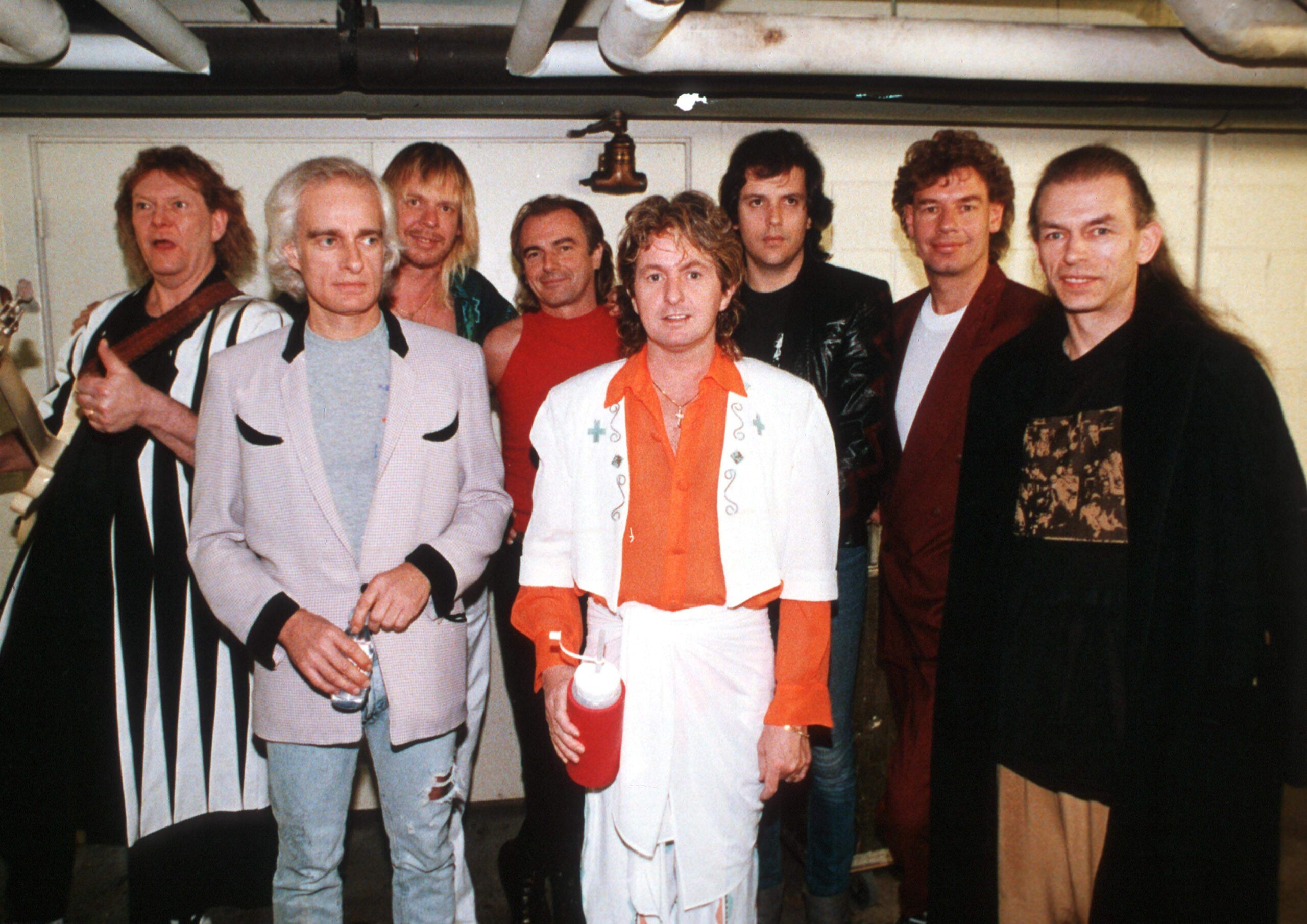
L-R: Chris Squire, Tony Kaye, Rick Wakeman, Alan White, Jon Anderson, Trevor Rabin, Bill Bruford, Steve Howe
PERHAPS THERE ARE TWO WAYS OF looking at Yes’s extraordinary saga of line-up turmoil. While the fall-out has often been undignified, it’s forced the band (or bands) to keep changing. Maybe it’s even fuelled this institution’s longevity, and what Anderson describes as its “adventurous musical energy”.
“Yes’s music has always been about five people in the band,” says Downes. “So each person at any given time has made a contribution to continuing Yes music, and so you have all these different influences.”
But with both Yeses touring in this anniversary year and planning to release new material, the situation – as Howe describes with yet more understatement – is “definitely awkward”. He doesn’t want to say too much more except that Yes will remain “passive” and carry on regardless of his former bandmates’ plans.
“Yes thought that they could stop ABWH,” he says. “But we weren’t silly enough to think we could stop ARW, so we didn’t bother.”
But haven’t recent events – specifically, the deaths of Chris Squire and Virgil Howe – proven that life really is too short? Couldn’t they all just kiss and make up?
“Of course we all thought of it,” says Anderson. “But outside influences were always in the way. Life is full of ups and downs and not everyone gets on with each other. It’s very normal.”
Ultimately, there is too much history here. Scrunch two unwilling sets of musicians together and you might get Union Part Two.
“I don’t put it out of my mind, let’s put it that way, and neither did Chris [Squire],” says White of a full reunion. “It’s a possibility in the future, but at the same time I’m carrying on with what I’ve done for the last 46 years and I’m enjoying it. The music’s the most important thing.”
“I can’t knock anybody who wants to see us back together again,” says Howe. “But if I was to go to their house and ask them to go back to live with their ex-partner for five years, I’m sure they would say, ‘I’m sorry Steve, but I don’t want to do it.’”
Howe laughs at the analogy, but while he remains as composed and even-handed as he has been all afternoon, you can’t help but detect a note of exasperation.
“I’m not overdressing this,” he says at last. “I’m only saying that, unless you’ve got really excellent communications, you can’t go back.”
This article originally appeared in Issue 294 of MOJO
Images: Getty