
Mojo
FEATURE
Let There Be Light
In 2013 the dark overlord of electronica returned to assume control of Nine Inch Nails once again. This time the “creepy addict behaviour” had been banished in favour of married life and tea time with the kids. “It’s not about me anymore,” said Trent Reznor, “I’m at my most unfiltered.”
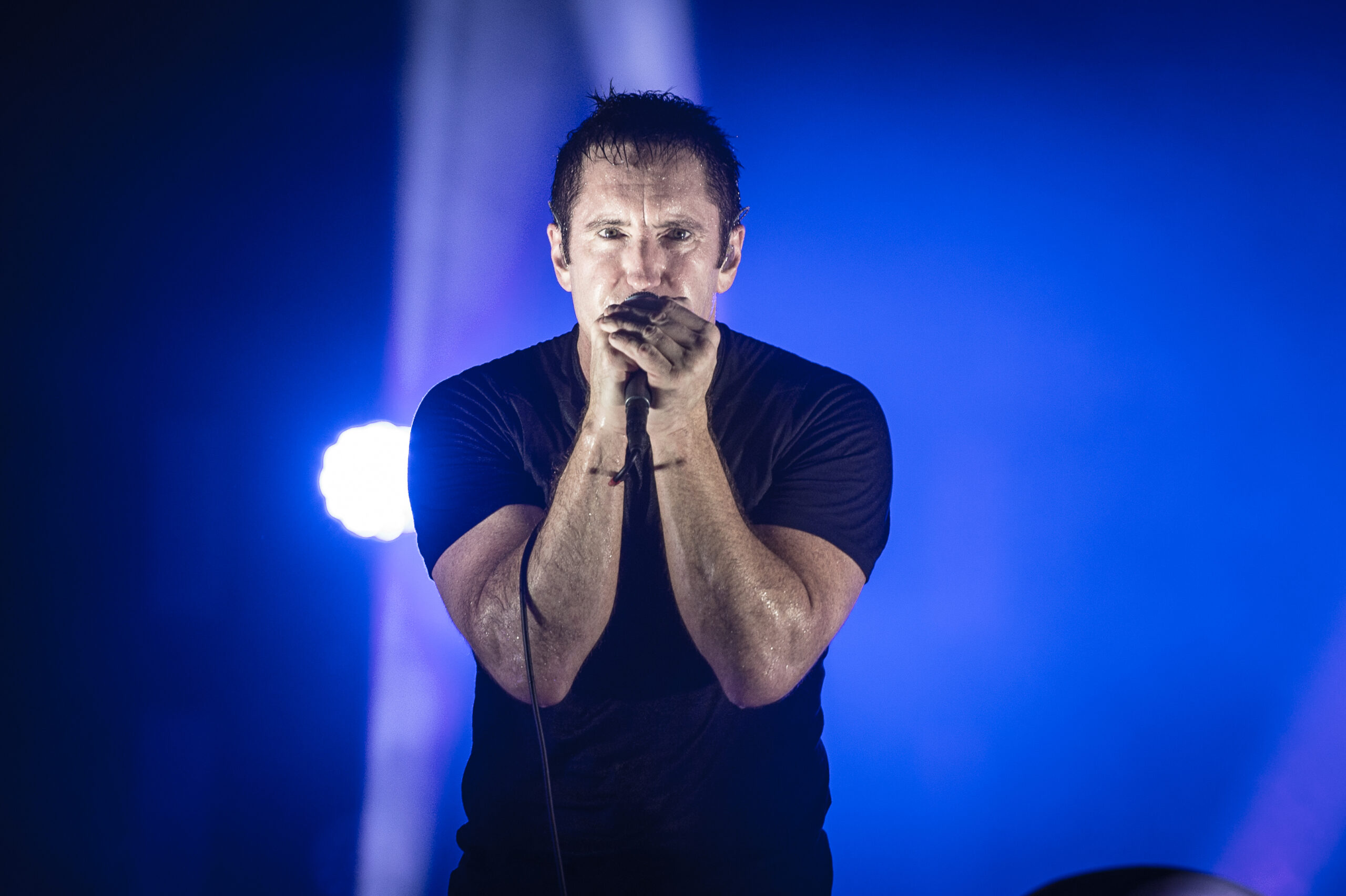
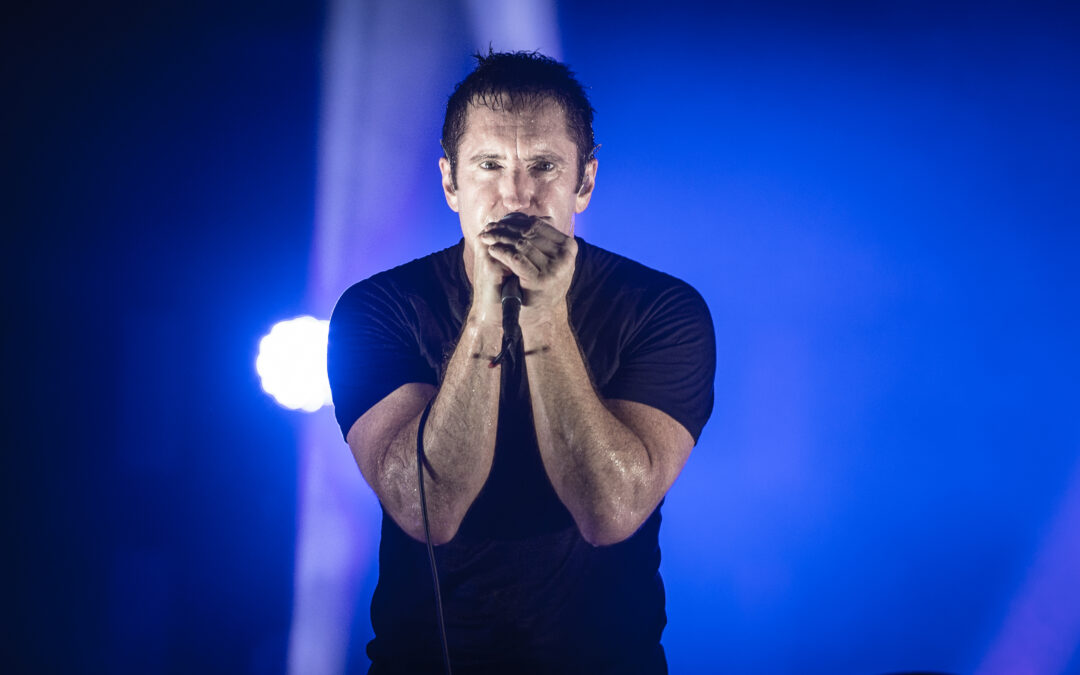
Trent Reznor from Nine Inch Nails
IT IS JUST AFTER LUNCHTIME ON A PAINFULLY hot California day. We are inside a huge warehouse in Van Nuys, a nondescript district of Los Angeles. Trent Reznor is taking a break from rehearsing with the current live line-up of Nine Inch Nails. Even under the fluorescent tube light of a windowless storage area where we talk sitting at a shabby table, the 48-year-old looks tanned and well. He wears black boots, matching shorts and a plain green T-shirt. His hefty biceps suggest preparation for imminent touring commitments extend beyond merely tinkering with musical arrangements. “There’s no better motivator than standing feeling naked in front of a bunch of people,” he says. “I’m putting in a couple of hours of cardio every day. I wake up super early, I run and then I have a little circuit in my back yard. Just some weights and shit. Then I come here. So that’s my exciting life.”
Following a four-year break, Reznor is returning to Nine Inch Nails with an eighth studio album, Hesitation Marks. He had wanted to step away and test himself by tackling other projects, which included scoring 2011’s Hollywood version of The Girl With The Dragon Tattoo. Reznor also recorded with How To Destroy Angels; this quartet featured his wife Mariqueen, with whom he has two young sons, Lazarus and Balthazar. Having worked on a soundtrack – where he was the subordinate – and within the democracy of a group, Reznor is now firmly back in charge.
“I had been getting an itch to work on something that was more me in the forefront,” he says. “There’s part of me that was probably longing to be the dictator again. But after a couple of weeks of micro-managing every fucking molecule… I got what I asked for. It’s a full plate.” Reznor has recently found himself unexpectedly engaged in managing human resources, as in the past few months both bassist Eric Avery and guitarist Adrian Belew have left Nine Inch Nails.
“It really came down to chemistry,” says Reznor. “I’m delicately addressing this matter because I wish it would have worked out but it just didn’t. What’s happened is for the best. As far as I’m concerned there’s no ill will there.”
The burden of dictatorship has been slightly eased by Reznor’s decision to get back into business with a major label. He had been independently releasing music on his own The Null Corporation imprint ever since leaving Interscope in 2007, but Hesitation Marks will be released through Columbia Records. “It’s a one-album license,” he says. “I’m not just saying this like the brainwashed guy that’s reneging on… I found myself spending a lot of time thinking about marketing and worrying about if a record store in Prague had the product. It’s shit I can do if I have to, but I’d rather not.” This deal also lends Nine Inch Nails enough promotional muscle to reach beyond Reznor’s existing constituency.
“Arguably we could make more money – if that was the point of it – just satisfying the people we have and not sharing the pot,” he explains. “To me that feels like death. If I see my name and ‘nostalgia’ too many times in the same sentence I’m going to stop. When I’m on-stage and I look out, generally I see youth. It doesn’t look like I’m at an Eagles concert yet.”
“There was that new wave synth explosion. The Human League. I think that Thomas Dolby’s first shit was cool. Devo, I loved.”
Trent Reznor
REZNOR GREW UP IN THE TINY PENNSYLVANIA TOWN of Mercer. His parents split up soon after his younger sister, Tera, was born and he lived with his maternal grandparents from the age of five. Once he’d moved in, his grandmother decided Trent should take piano lessons. “Pretty quickly I learned that work equals reward,” he says. Reznor had a natural talent for the instrument and enjoyed the discipline of mastering a Mozart sonata until he could play it precisely without needing the sheet music.
“Often there were competitions at the local college for different age groups,” he says. “I would win that. It felt good to have confidence and be able to know, Hey, I’ve got this!”
Reznor can’t recall the first single that he bought but remembers sitting on the porch as a boy listening to Summer Breeze by Seals & Crofts. His father introduced him to Jimi Hendrix and the first Crosby Stills & Nash album, which he thought was excellent. “I still listen to that fairly regularly,” he says. “Embarrassingly regularly, actually.” When Reznor was 12 he discovered Kiss through their 1975 albums Alive! and Dressed To Kill. “I look at them as pivotal,” he says. “Not for the music so much. It seems kind of comical now but at the time it felt dangerous, like something your parents didn’t want you to listen to.” Reznor’s father didn’t share this enthusiasm for Kiss (“He kind of said, ‘This shit sucks!’”) but he did indulge his son’s rock fantasies by buying him a Wurlitzer electric piano.
“Rather than being a rigid kind of performer, I was excited by this rebelliousness, the larger than life characters and feeling free. The best spirit of rock is that sense that there are no rules. I was extracting that from Kiss and that electric piano.” Gratifyingly, when he turned his piano up really loud the sound would distort.
As a teenager Reznor had a friend who played drums, so they’d set up in his basement to play Smoke On The Water and old Tom Petty songs. His musical tastes developed to embrace Pink Floyd, The Clash, David Bowie and Prince, who he saw perform when the 1999 tour reached Pittsburgh in 1983. “I was the white person in the audience,” he notes. By the time he started playing in semi-serious bands Reznor had spent a year living 45 minutes away from home, studying computer engineering at Allegheny College. Here he was exposed to more esoteric acts such as XTC.
“There was that new wave synth explosion,” he says. “The good stuff would have been The Human League. I think Thomas Dolby’s first shit was cool at the time. Devo, I loved. That dribbled down to the Thompson Twins and some other stuff that hasn’t weathered the storm so well.”
Reznor was also fascinated by video games and amusement arcades. “What I saw in that, and I still feel passionate about this, was taking technology and making art out of it. This art was in the form of entertainment that you couldn’t have made five years ago, or even five months ago, and doing it in a way that was almost like a hooky song.”
Using his journals to write confessional lyrics, Reznor applied these values to 1989’s Pretty Hate Machine, the first album he made as Nine Inch Nails. “It was unfashionable – here, at least – to have synthesizers because grunge was just about to happen,” he says. “Retro type stuff. All that flannel-shirted bullshit.”
Reznor’s passion for all things futuristic does have its limits, as evidenced by his opinion that unlimited access to music means that a lot of people don’t really seem to “cherish” it any more. He reasons that it took at least a dozen listens until he understood Talking Heads’ 1980 album, Remain In Light. With more than his meagre record collection to choose from he might well have given up on an album that he grew to love. That being said, Reznor is a realist and so he has collaborated with his old Interscope Records boss, Jimmy Iovine, in developing a forthcoming streaming subscription service for Dr. Dre’s Beats brand. “It’s like the best radio station ever but personalised for you and easy to use,” he says. “Anyway, that’s what I do in my spare time.”
The lengthy Reznor to-do list means even the most tempting job offers might be declined. Last year Josh Homme contacted him to see if he could do some production work on Queens Of The Stone Age’s sixth album, …Like Clockwork. Reznor was flattered but too busy, though he eventually guested on a couple of tracks. The two men had toured together in 2005 as Reznor clung to sobriety – he didn’t do much socialising in those days. “I spent a lot of time just isolated so I didn’t get to know Josh that well,” he says. “Since then we keep crossing paths and we’ve nurtured a respectful friendship.” While Reznor was unavailable for studio employment, that initial conversation with Homme opened the door for dialogue of a more profound nature about their roles within an ever-changing industry.
“What wound up being helpful – at least for me and I hope for him – was having some honest talks with someone that I really feel is a peer,” says Reznor. “I saw the same kind of fear in him that I experience. Without getting too intimate about what we were exactly talking about, you reach certain points in your career when you have to pause for a minute, which is sometimes hard, and say, ‘Why am I doing this? Is this just the next thing that you’re supposed to do? Is this fulfilling to me any more?’ It was nice to see … well, it wasn’t nice but it felt relatable… to see him experiencing a similar element of being unsure. I think being unsure can lead you into making better music. It’s sometimes tough to be objective about who you are and how people see you as an entity. Does what I’m saying have any relevance outside my own head? Questions. I don’t take take it for granted that everyone can’t wait to hear the next thing I come up with. I was unsure while I was working on this record. When I finished it, then I started to feel this is fucking good.”
“I was an asshole to a lot of people for a while. I realised there was a resentful small-town person in there.”
Trent Reznor
HESITATION MARKS IS REZNOR’S FIRST NINE INCH Nails album recorded as a married family man. “There’s been a bunch of things that have changed,” he says. “My grandfather and my mom died in the last few years. They raised me. But having kids unquestionably changed how I feel about things. I’m in the picture but it’s not about me any more; I’m here for these dudes and I love them more than anything. My life until, probably, getting married was me at the top and whatever else happens is insignificant to some degree.” Reznor explains that this harmonious domestic situation doesn’t necessitate adopting a malcontent persona in order to perform as Nine Inch Nails (“It’s not like I have to not eat for a day and make myself really pissed off to really get into the spirit of things”) but admits that his prevailing mood will, of course, have a bearing on the music. “I think this album is outwardly less brutal than anything I’ve done,” he says.
So is this record – trademark electro desolation with a title that refers to tentative self-harm using a razor blade – Reznor at his most happy-go-lucky? “I didn’t say that,” he counters. “I said I’m at my most… unfiltered. What I have intentionally made a bit limiting about Nine Inch Nails is that it feels like it’s under one umbrella of things. You can throw words in there to describe what that is and ‘happy’ is probably not one of them. Or ‘carefree’.” Reznor returns to the theme of second-guessing how his music will be received. “I’ve spent a lot of time being concerned about what people think and hoping that it reaches the right critical response. In this day and age I have crossed the line into really not paying much attention to what’s written about me, whether it be from people getting paid to do it or from the unwashed masses that feel the need to comment on everything that anyone does in the world. Who cares?”
For the first 15 years of his career, Reznor cared very much indeed. He describes this period as “scrutinising myself in the mirror of failure at every turn”. The result was, rather less poetically, countless hours wasted in the service of “dicking around”. When it came to composing material, Reznor would see a blank piece of paper as something that must be filled by the best song ever written. No wonder he could always find something else to do. “I let fear govern the process and slow it down,” he says. “I’ve spent half of my time as Nine Inch Nails avoiding doing it because I was afraid that it was going to be shit.”
Not coincidentally, this crippling self-doubt afflicted Reznor most acutely when his problems with narcotics and alcohol were at their peak. From the second Nine Inch Nails album, 1994’s The Downward Spiral, up to The Fragile in 1999, he struggled to function as a musician while maintaining a fingertip hold on his sense of self. “There wasn’t a lot of me left,” he says. “So I’d read about me and that became who I thought I was, in a way, and perpetuated kind of what… I don’t know how to explain it better than that. I like The Fragile a lot now but it was hard to make, it was painful to make and it was a struggle to get through the cotton and the clutter. Could I have written better lyrics for that? Yes. If I could think, I could have.”
The consequences of Reznor’s unwholesome leisure activities would eventually prove near-fatal. In 2000 he mistook heroin for cocaine – his usual pick-me-up – and woke up in a London hospital having overdosed, which forced the cancellation of a show. A year later he cleaned up for good in New Orleans. “I was sitting in a detox psychiatric ward where the door doesn’t open,” he says. “How did I get in here? That wasn’t part of the plan.” Contrary to his tortured public image, Reznor had always felt that he liked himself. Drugs changed that. “That was the worst thing,” he says. “I didn’t trust myself. I was a liar. Creepy addict behaviour starts to take over. On top of that, my art was sucking. My ability to write was clouded.” Having prioritised sobriety rather than trying to fit it in around his career, Reznor approached 2005’s With Teeth, his first post-rehab album, with some trepidation.
“Did I need to be high to come up with ideas?” he wonders. “But when I got round to doing it the actual creation process became fun.” Reznor accepted that not everything had to be perfect and it was fine to arrive at the finished article through trial and error. He also felt that he was no longer a liar. “I said that I could get into a committed relationship and I have,” he states. “I said I wouldn’t do something and I didn’t. It could just be, ‘I’m not going to eat chocolate chip cookies today.’ I can’t say that I’ve kept that promise but you know what I mean. Now I can trust myself.”
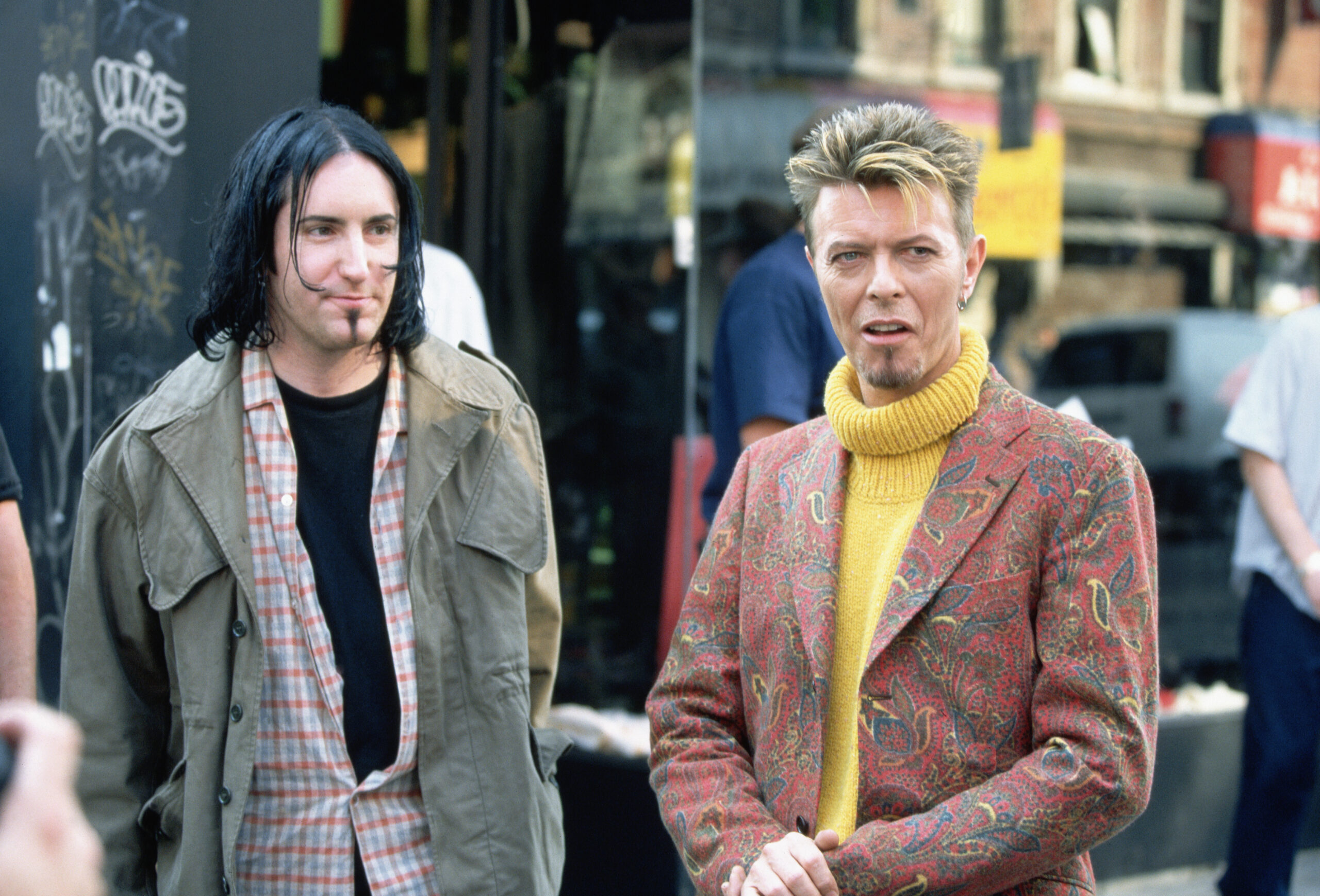
David Bowie and Trent Reznor on the set of Bowie’s video “I’m Afraid Of Americans.”
Reznor is not proud of his debauched nadir but acknowledges that going through the intense counselling and self-examination of recovery – apart from achieving the primary goal of remaining alive – allowed him to face his character flaws, stop dodging problems and behave more like an adult. He says that it is also crucial for him to remember that, even after 12 years of abstinence, self-destruction is forever one drink away.
Perhaps it is the rehabilitation movement’s code of truth that compels Reznor to be quite so blunt. We talk about what he has learned about himself having spent half of his life operating as Nine Inch Nails. Reznor begins by saying that he can’t think of any glaring examples of where he has compromised his artistic integrity. Soon he is contemplating how he has altered as a person. “I’ve seen how external factors like fame can distort one’s personality into monstrous things,” he says. “I’d like to think, Hey, things didn’t change me. Well, it did change me. I was an asshole to a lot of people for a while. I realised there was a resentful small-town person in there. I realised that I’m not beyond being susceptible to forms of corruption. Spiritual corruption? All forms. You name it. But what I’ve tried to keep pure is that vehicle of music; that place to take whatever’s made me mean and funnel it into something that feels like pure work. It’s the same as sitting at that piano when I was a kid, rehearsing endlessly and getting a reward back. That’s the carrot.”
Fame does, however, still come with the odd harmless perk. When Reznor began tightening up the material for Hesitation Marks he thought that it might be helpful to bounce some ideas around with an outside party, so he decided to see whether Lindsey Buckingham was free. “I’ve always thought he was one of the best guitar players, and kind of underrated too,” says Reznor. “Not to mention his great songwriting, his voice and every other fucking thing. I worked with him for a day at the Village Recorder, where Fleetwood Mac recorded Tusk. I don’t think he’d been back since then. He played on a few things; there were bones of certain songs that existed. As soon as he picks up his guitar I’m in a room sitting three feet away from Lindsey Buckingham and he knew who I was. This is pretty fucking cool.”
Buckingham only lives a couple of miles from Reznor’s house. He hoped that they might become friends.
So did you and Lindsey keep in touch?
“Of course not (laughs). No, we’ve kept in touch but we haven’t hung out much. He’s been on tour.”
Reznor has his own live shows – the imminent Tension Tour – to get ready for and so, at just after three o’clock, he must join his band for practice. “I haven’t done an interview for a little while so I feel semi-violated,” he concludes. “It’s not every day that I end up talking about the worst parts of my life.” Reznor shrugs, “I’ll get over it.” The delivery is deadpan but discussing that damaged mastermind phase doesn’t really seem to cause him any discomfort, almost as if it all happened to an entirely different person. Later this afternoon Reznor is even meeting someone for a drink, albeit not the kind that guarantees immediate and utter meltdown. His elder son has been given a toy kitchen and is exceedingly keen to play at making tea with dad. “I don’t know how he got into tea,” says Reznor. “But there will be tea before bedtime.”
This article originally appeared in Issue 238 of MOJO
Images: Getty